
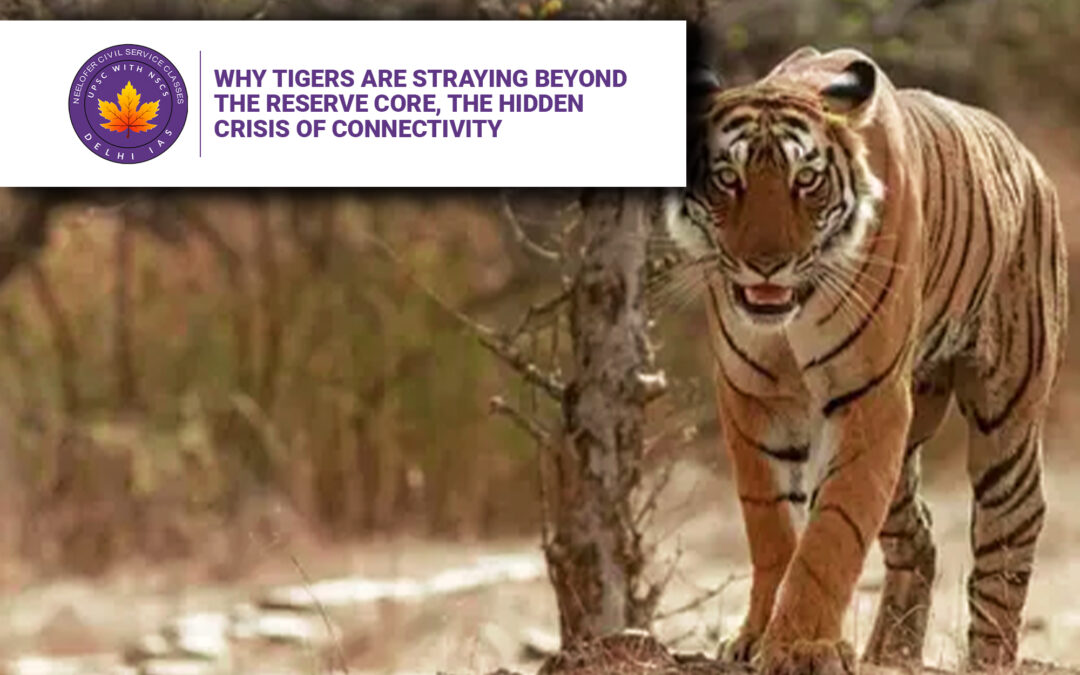
Why Tigers Are Straying Beyond the Reserve Core, The Hidden Crisis of Connectivity
Why in News?
India has seen a noticeable increase in tigers venturing outside their designated reserves, often traveling long distances—even across states. These movements are not random, but rather indicators of a deeper ecological challenge: the degradation or lack of viable wildlife corridors necessary for tiger survival and dispersal. 
Introduction
Tigers are magnificent, solitary apex predators that require vast territories for survival. While the creation of tiger reserves has played a pivotal role in stabilizing and increasing their numbers, recent patterns of tiger movement outside these protected zones reveal a concerning truth: the long-term survival of tiger populations depends not just on the protection of reserve cores, but on the availability and integrity of connecting corridors that allow them to move between habitats.
Key Issues
1. Dispersal Behavior and Habitat Pressure
Young male tigers typically disperse from their natal areas in search of territory, often leading to long-distance travel. For example, one tiger recently walked over 500 km from Tipeshwar Wildlife Sanctuary in Maharashtra to Solapur-Dharashiv districts. Such movements are signs of habitat pressure—often due to competition, lack of prey, or habitat saturation in the core area.
2. Corridor Disruption and Fragmentation
Many reserves in India are increasingly isolated due to encroachments, agriculture, livestock grazing, infrastructure development, and mining. These fragmented landscapes leave tigers no choice but to cross human-dominated areas, where they often clash with people or livestock, leading to conflict situations and retaliatory killings.
3. Diminishing Habitat Integrity
Despite the increase in tiger numbers, habitat integrity is declining. As per the 2022 All India Tiger Estimation, India supports over 3,680 tigers, but only about 1,200 tigers occupy the most secure core areas. The remaining roam fragmented landscapes, highlighting that conservation efforts must go beyond just population counts.
Alternative Approaches
1. Focus on Corridor Connectivity
Instead of focusing solely on reserve cores, conservation efforts must aim to restore and protect wildlife corridors. The movement of tigers from Tadoba in Maharashtra to Similipal in Odisha, for example, shows the importance of these pathways in ensuring genetic diversity and natural dispersal.
2. Mitigating Human-Wildlife Conflict
Conflict areas must be managed through awareness campaigns, compensation schemes for livestock loss, and community engagement. Infrastructure such as roads and railways must include wildlife passages and mitigation measures.
Challenges and the Way Forward
India faces significant challenges: habitat loss, increasing livestock density, illegal encroachments, and limited political will. Certain tiger landscapes like the Western Ghats, Chhattisgarh, Jharkhand, Telangana, and parts of Odisha are most vulnerable due to rapid urbanisation and developmental pressure.
To secure India’s tiger population, it is essential to:
-
Identify and restore degraded corridors
-
Engage local communities as stakeholders
-
Integrate conservation with sustainable development
-
Use modern tracking to monitor movement patterns
Conclusion
Tigers walking out of reserves is a warning signal, not a sign of progress. While India celebrates the rising tiger numbers, these majestic cats continue to face habitat fragmentation, poor corridor connectivity, and increasing human conflict. Sustainable tiger conservation in India must shift focus from counting cats to connecting habitats.
Q&A Section
Q1. Why are tigers leaving their reserve cores?
Due to territorial saturation, lack of prey, or degraded habitats in core areas, especially for dispersing young males searching for new territory.
Q2. What risks do tigers face when they leave protected areas?
They encounter human settlements, leading to livestock attacks, conflict, injury, death, or capture. They are also vulnerable to poaching and road/train accidents.
Q3. How important are corridors for tiger conservation?
Vital. Corridors enable tigers to move between protected areas, ensuring genetic diversity, natural dispersal, and species survival in the long term.
Q4. Which regions in India are witnessing high tiger-human conflict?
Chhattisgarh, Odisha, Telangana, parts of West Bengal and Jharkhand, largely due to habitat loss and fragmentation.
Q5. What is the long-term solution?
Go beyond reserve-based conservation to holistic landscape planning—secure corridors, reduce conflict, engage communities, and integrate wildlife needs in infrastructure projects.

