
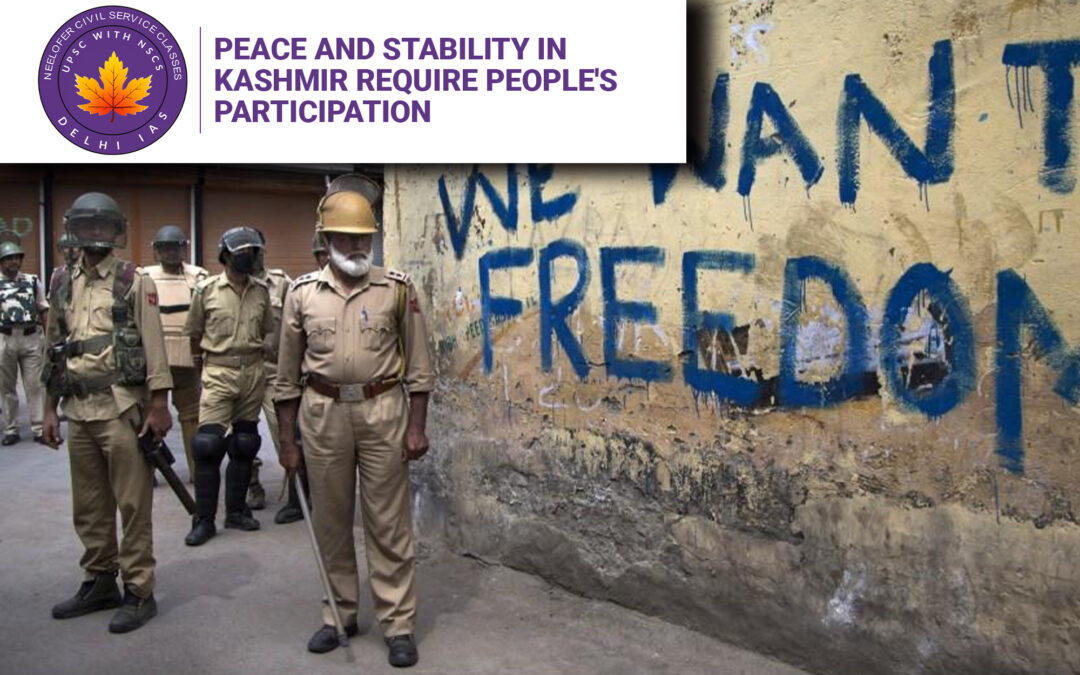
Peace and Stability in Kashmir Require People’s Participation
Why in News?
Recent developments in Jammu and Kashmir (J&K) indicate a significant shift in political dynamics, as several separatist leaders and outfits have publicly renounced separatist ideology. This reflects a broader transformation in the region’s political narrative since the abrogation of Article 370 in 2019. However, challenges remain in ensuring long-term peace and integration, particularly through the inclusion of people in the democratic process. 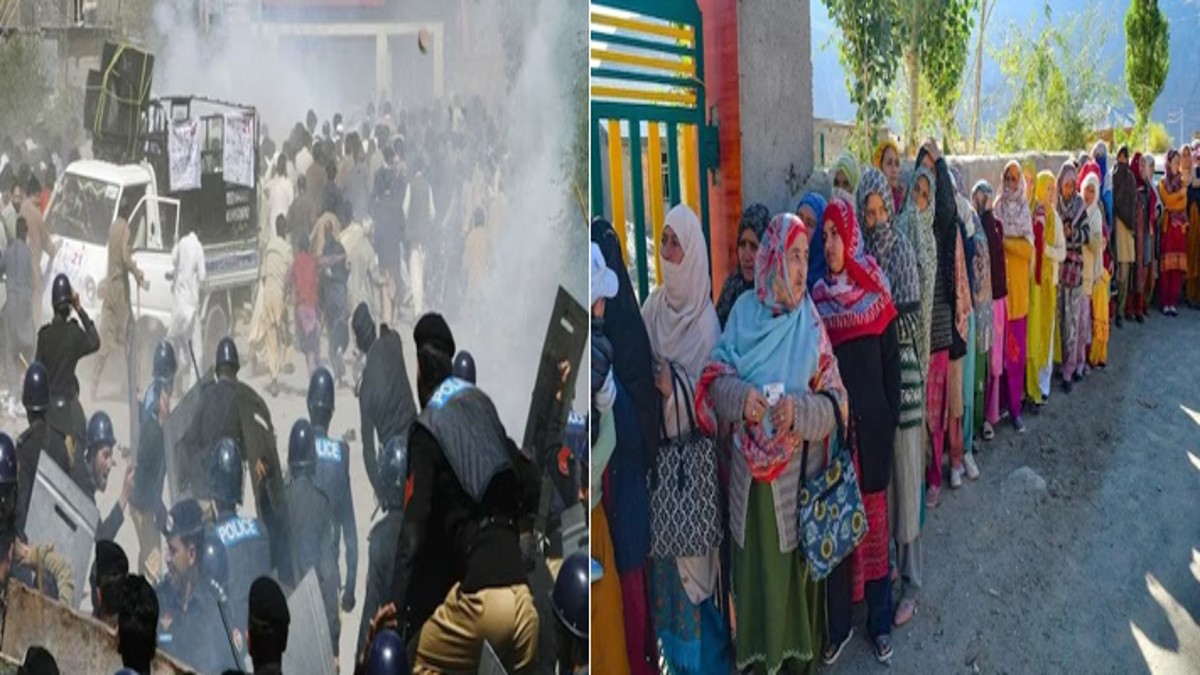)
Introduction
The Union Government, under the leadership of Prime Minister Narendra Modi, has altered the ground realities in J&K by adopting a more assertive and centralized approach. The government’s firm stand on national integration, development, and peace has led to a decline in separatist influence. However, stability in the region cannot be achieved solely through military presence or bans on separatist organizations. Sustainable peace requires people’s trust, participation, and inclusive governance.
Key Issues
1. Decline of Separatist Influence
A significant number of separatist groups and leaders in J&K have recently declared their dissociation from separatist ideology. Among these are:
-
J&K Peoples Movement
-
Democratic Political Movement
-
J&K Tehreek Isteqlal
-
Tahreek-i-Istiqamat
-
J&K Salvation Movement
Union Home Minister Amit Shah hailed these developments as signs of a “developed, peaceful, and unified Bharat.” Even lesser-known or second-rung separatist leaders are renouncing the ideology, indicating a marked shift from the past.
2. Shift from Dialogue to Firm Action
Previous Prime Ministers — including P.V. Narasimha Rao, Atal Bihari Vajpayee, and Manmohan Singh — adopted a dialogue-based approach, engaging with separatists and occasionally involving Pakistan. This changed sharply after 2014, with the Modi-led government taking firm decisions, such as:
-
The abrogation of Article 370 in 2019
-
Banning of key separatist outfits (e.g., Jamaat-e-Islami, JKLF, Hurriyat factions)
As a result, separatism now operates on the margins, with most leaders jailed, sidelined, or inactive.
3. Security vs. Acceptance
Despite the decline of separatism, it remains unclear whether the political class and people of J&K have fully accepted the post-2019 order. The heavy deployment of security forces in urban centers suggests ongoing unrest or resistance. This raises questions about organic integration versus enforced stability.
4. Changing Nature of Militancy
Militancy has evolved from an urban-based threat into guerrilla-style forest warfare, using:
-
Advanced communication tools
-
Terrain-mapping technology
This shift indicates a more decentralized and adaptive threat, requiring updated security and engagement strategies.
5. The Pakistan Factor
Despite internal crises, Pakistan remains unwilling to relinquish its strategic interests in Kashmir. While direct infiltration has reduced, cross-border propaganda and indirect support for militancy persist, complicating India’s peace efforts.
Alternative Approaches
To move forward, the government must adopt inclusive and people-centric policies that:
-
Restore democratic processes and grassroots participation
-
Promote development and employment opportunities
-
Address grievances through dialogue rather than suppression
Most importantly, restoring J&K as a full-fledged state of the Indian Union could create a sense of ownership and accountability among the local population.
Challenges and the Way Forward
Challenges:
-
Lack of public trust in the current political framework
-
Continued militant threats using modern tactics
-
Potential political alienation if integration is seen as one-sided
-
Need for administrative and electoral restoration
Way Forward:
-
Restore Statehood: Re-establish J&K as a full-fledged state, fulfilling the Centre’s commitment to the Supreme Court.
-
Engage Youth: Provide vocational training, education, and job opportunities to deter youth from radicalization.
-
Democratic Inclusion: Hold local elections and empower Panchayati Raj Institutions.
-
Transparent Governance: Combat corruption and improve service delivery.
-
Trust-Building Measures: Open communication channels between the Centre and the people of J&K.
Conclusion
The decline of separatist politics presents a crucial opportunity for lasting peace in Jammu and Kashmir. However, military presence or administrative orders alone cannot ensure stability. What’s needed is deep-rooted democratic engagement, people’s participation, and inclusive governance. Rebuilding trust with the people, restoring statehood, and promoting development must form the core of India’s Kashmir strategy in the years ahead.
Q&A Section
Q1. What recent shift has occurred in Kashmir’s political landscape?
Several separatist groups and leaders in Kashmir have renounced separatist ideology, reflecting a broader shift towards peace, prosperity, and integration under the Modi-led central government.
Q2. Has separatism been completely eliminated?
While separatist politics have weakened, complete elimination is yet to be achieved. Many top leaders have been jailed or sidelined, but separatist sentiments still exist on the margins.
Q3. Why is people’s participation important for Kashmir’s peace?
Force alone cannot ensure lasting peace. Stability requires trust, inclusion, and public involvement in democratic and development processes.
Q4. What challenges still remain in Kashmir?
Key challenges include guerrilla-style militancy, public distrust, continued security force deployment, and Pakistan’s indirect involvement in the region.
Q5. What is a suggested first step toward sustainable peace in Kashmir?
Restoring Jammu and Kashmir’s full statehood within the Indian Union, as promised by the Centre, is seen as a crucial step toward long-term stability and democratic integration.

