
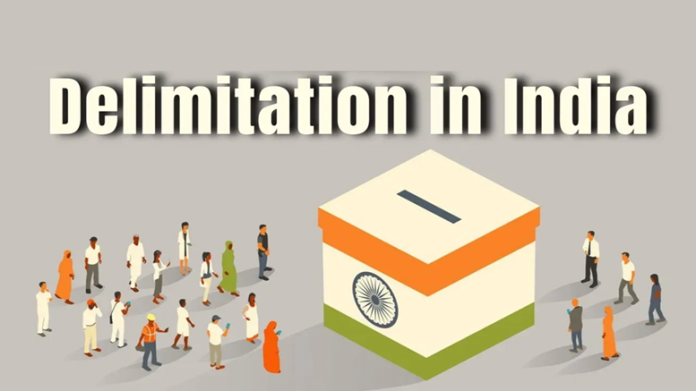
Population Based Delimitation May Shift Political Power from Richer States
Why in News?
A growing debate over population-based political delimitation in India has raised concerns that richer and economically developed states could lose political influence in Parliament. The discussion is not just about a north-south divide, but rather a broader issue of regional disparities in population and economic growth.
Background
-
India’s constitutional framework mandates a redrawing of Lok Sabha seats after every Census to reflect population changes.
-
However, due to concerns over regional imbalances and development disparities, the process has been postponed since 1976, with the most recent freeze being extended until 2026.
-
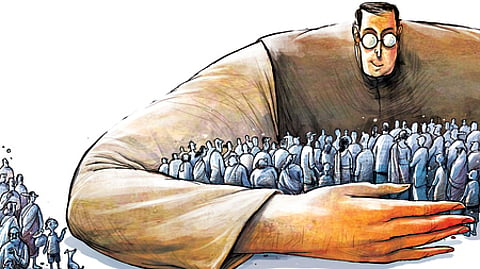
As the deadline approaches, the impending delimitation process has sparked fears that economically advanced states could lose parliamentary representation due to their lower population growth rates compared to less developed states.
Key Findings
-
Over time, income disparities between states have widened significantly.
-
In 1961, the relative per capita income of Kerala, Andhra Pradesh, and Karnataka was comparable to that of Uttar Pradesh (UP), Madhya Pradesh (MP), and Rajasthan.
-
By 2001, the southern and western states had surged ahead, while the Hindi heartland states saw their relative income levels decline due to high population growth and economic stagnation.
-
By 2024, the gap has widened further, with southern and western states being economically advanced, while UP, Bihar, and other northern states continue to struggle with lower income levels and higher population shares.
Implications of Delimitation
-
If parliamentary seats are redistributed strictly based on population, then states with higher population growth (UP, Bihar, MP, Rajasthan) will gain more Lok Sabha seats.
-
Conversely, richer states with stable or declining population growth (Kerala, Tamil Nadu, Karnataka, Maharashtra, Gujarat, etc.) may lose political representation, despite contributing more to India’s economy.
-
This could lead to policy imbalances, where political power shifts to economically weaker but populous states, potentially influencing resource allocation and federal decision-making.
Possible Challenges and Solutions
-
Challenge: If seats are redistributed purely based on population, states that invested in education, health, and family planning could be penalized politically.
-
Solution: Policymakers could consider alternative delimitation models that balance population representation with economic contribution and governance efficiency.
-
Challenge: The debate risks becoming a politically charged North vs. South issue, further deepening regional divides.
-
Solution: Instead of focusing on geographical divides, the discussion should highlight development-based representation to ensure fairness.
Conclusion
The upcoming delimitation exercise will be a turning point in India’s democracy, as it could reshape political representation for decades to come. Striking a balance between population size and economic contribution is essential to maintaining equity and federal stability. A fair, well-planned approach to delimitation can ensure that both developed and developing states get appropriate political representation without disrupting India’s economic and social fabric.
Q&A Section
Q1: What is the main concern regarding population-based delimitation?
A: The concern is that richer states with lower population growth (like Kerala, Tamil Nadu, and Maharashtra) may lose parliamentary representation, while states with high population growth (like Uttar Pradesh and Bihar) may gain more seats, leading to an imbalance in political influence.
Q2: Why has India postponed delimitation since 1976?
A: Delimitation was postponed to avoid penalizing states that successfully controlled their population growth through better governance, education, and healthcare. The freeze was extended multiple times and is set to expire in 2026.
Q3: How has the economic gap between states changed over time?
-
In 1961, Kerala, Karnataka, and Andhra Pradesh had similar per capita income levels as UP, Bihar, MP, and Rajasthan.
-
By 2001, the South and West surged ahead, while the Hindi heartland states saw declining income levels.
-
In 2024, the gap has widened significantly, with southern and western states far ahead economically, while northern states struggle with lower incomes but higher population shares.
Q4: How will delimitation impact governance in India?
-
If seats are redistributed solely based on population, political power will shift towards states with higher population growth.
-
This could lead to policy biases, where economically weaker states have more control over national decision-making, potentially affecting resource allocation.
Q5: What alternatives can be considered to ensure fair representation?
-
Balanced representation: A model that considers both population and economic contribution for seat allocation.
-
Weighted voting system: States with higher GDP per capita or governance performance could be given a proportionate say in decision-making.
-
Gradual transition: Implementing changes over time to avoid sudden shifts in political power.
