
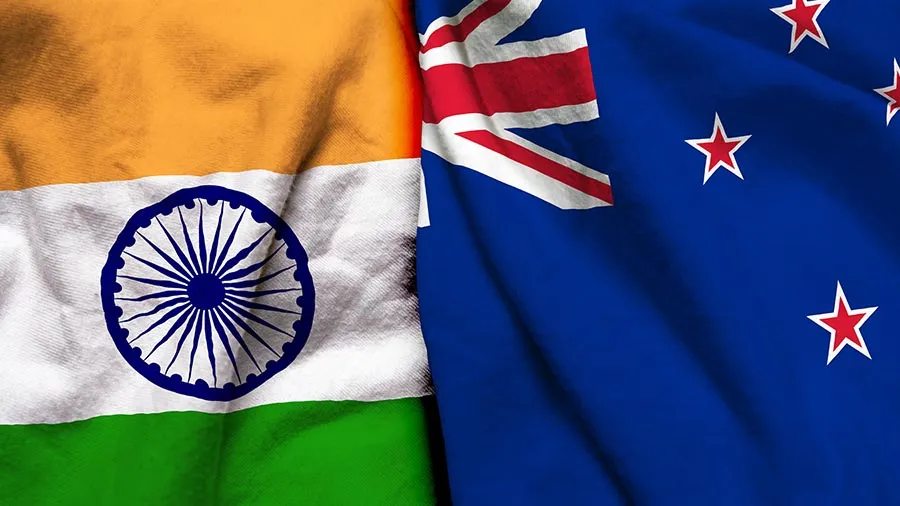
India and New Zealand Strengthen Ties for Economic and Strategic Gains
Why in News?
During the 10th edition of the Raisina Dialogue, New Zealand Prime Minister Christopher Luxon emphasized the need for greater cooperation between India and New Zealand in areas such as trade, defense, and regional security. 
Introduction
India and New Zealand, despite their economic and geographic disparities, share common interests in promoting security in the Indo-Pacific, ensuring stable trade relations, and fostering stronger diplomatic ties.
Prime Minister Luxon highlighted the three major geopolitical trends shaping the world today:
-
The redefinition of rule-based power structures
-
Security concerns over economic dependencies
-
The push for resilient and efficient supply chains
Both nations have a shared commitment to free navigation in the Indo-Pacific, although New Zealand is not part of the Quad (Australia, India, Japan, and the U.S.).
Economic and Trade Prospects
-
Boosting Trade Relations: Both nations agreed to resume talks on a free trade agreement, which could significantly enhance their bilateral trade, currently valued at under $2 billion.
-
Market Access Challenges: Issues like market access for dairy and agricultural products remain a hurdle, partly due to India’s decision to exit the Regional Comprehensive Economic Partnership (RCEP), of which New Zealand is a member.
-
Air Connectivity: Air India and Air New Zealand’s decision to sign a codeshare agreement will improve connectivity, potentially enabling direct flights between the two nations by 2028.
Strategic and Security Cooperation
-
Defence Agreement: A Memorandum of Understanding (MoU) was signed to enhance military ties, including naval port calls, staff exchanges, and military training cooperation.
-
China Factor: While India remains cautious about China’s growing regional influence, New Zealand’s trade dependence on China (approximately $24 billion in trade) poses strategic challenges.
Political and Diplomatic Challenges
-
Concerns Over Anti-India Activities: PM Modi expressed concerns over anti-India elements in New Zealand, citing protests and a pro-Khalistan referendum held by the ‘Sikhs for Justice’ group in Auckland last November.
-
New Zealand’s Response: PM Luxon reaffirmed his country’s commitment to free speech while also stressing the need to prevent foreign political conflicts from influencing domestic communities.
-
Indian Diaspora: The large Indian diaspora in New Zealand (over 300,000 people) remains a crucial factor in maintaining strong ties while avoiding tensions over immigration policies and political activism.
Why This Matters for India’s Future?
-
Economic Growth: A trade agreement with New Zealand could boost India’s market for agricultural and dairy products.
-
Indo-Pacific Security: Strengthening defense cooperation could help counter regional threats in the Indo-Pacific.
-
Diplomatic Balancing: Managing political sensitivities within New Zealand’s Indian diaspora while maintaining strong bilateral relations is crucial for long-term engagement.
Conclusion
Despite minor political tensions, India and New Zealand are poised to strengthen their relationship through increased trade, defense cooperation, and diplomatic engagement. Their collaboration will be essential in maintaining regional stability and economic resilience in the Indo-Pacific.
Q&A Section
Q: What are the key areas of cooperation between India and New Zealand?
A: Trade, defense, regional security, and improving air connectivity.
Q: What is India’s main concern regarding New Zealand?
A: The rise of anti-India activities, particularly Khalistani separatist movements.
Q: How does China factor into India-New Zealand relations?
A: New Zealand relies heavily on trade with China ($24 billion), while India is cautious about China’s growing regional influence.
Q: What is the significance of the MoU signed between India and New Zealand?
A: It strengthens military ties through cooperation in naval exercises, port calls, and staff exchanges.
Q: How can both nations benefit from stronger relations?
A: India can gain better market access and strategic security cooperation, while New Zealand can diversify its trade partners and strengthen regional diplomacy.
