
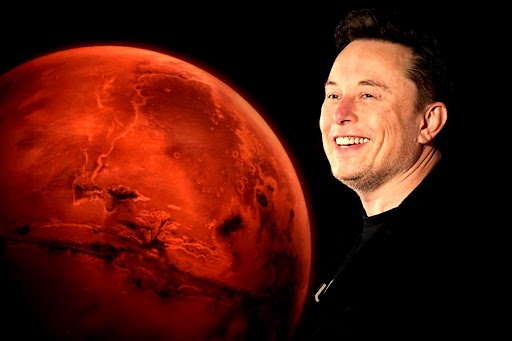
Imperator of Mars, Elon Musk Dream of a Red Planet Colony
Why in News?
Elon Musk has reignited the conversation about Mars colonization with his ambitious SpaceX plans. His recent public appearances and statements underscore his vision to make humans a multi-planetary species.
Introduction
On October 5th, Elon Musk made an appearance at a campaign rally alongside Donald Trump in Butler, Pennsylvania. Under his jacket, he sported a T-shirt emblazoned with the slogan “Occupy Mars,” symbolizing his unwavering focus on humanity’s future beyond Earth.
Musk’s SpaceX has delayed its eighth Starship rocket test due to technical issues, but the entrepreneur remains undeterred. His grand plan? To send humans to Mars by 2026 and establish a self-sustaining colony of a million inhabitants by 2050.
Key Features
SpaceX’s Mission to Mars
- SpaceX aims to put humans on Mars within the next few years.
- Musk envisions a city of one million people on Mars by 2050, potentially living under glass domes.
- The purpose is to safeguard humanity from existential risks like asteroid impacts, global wars, or ecological collapse on Earth.
The Population Collapse Theory
- Musk often warns of a “population collapse” on Earth, claiming that humanity’s survival may depend on colonizing Mars.
- His vision parallels various sci-fi narratives, such as James S.A. Corey’s The Expanse series, where humanity thrives beyond Earth.
Historical and Cultural References
- Musk changed his Twitter bio in 2021 to “Technoking of Tesla, Imperator of Mars.”
- In ancient Rome, “Imperator” referred to a military commander or emperor.
- Hollywood has explored similar ideas, such as Total Recall (1990) and Red Planet (2000), where Mars becomes a new home for humanity.
Specific Impacts or Effects
Economic and Logistical Challenges
- Establishing a Mars colony involves immense costs: transporting labor, capital, technology, and even basic necessities like air from Earth.
- Mars colonization would require reusable spacecraft and courageous explorers willing to risk their lives.
- In the near term, Mars may serve more as a tourist destination than a bustling economy.
Ethical and Social Considerations
- Critics like Bernie Sanders argue that the vast sums Musk proposes for Mars colonization could be better spent addressing urgent issues on Earth, such as poverty and hunger.
Challenges and the Way Forward
Challenges
- Reusable spaceship technology remains expensive and complex.
- Mars colonization involves substantial risks, including potential loss of life and enormous financial investment.
- Public interest is divided; many remain skeptical about leaving Earth for Mars.
Steps Forward
- Continued technological advancement in rocket reusability and life-support systems.
- Global discussions on ethical considerations and the future of humanity in space exploration.
- Greater collaboration between governments and private entities to balance Earth’s needs and space ambitions.
Conclusion
Elon Musk’s vision of colonizing Mars may seem like science fiction, but his determination has reignited dreams of interplanetary life. While challenges abound—from economics to ethics—Musk’s “Occupy Mars” slogan symbolizes humanity’s enduring quest to explore and survive beyond Earth. Whether or not Mars becomes humanity’s second home, the conversation about our future in space is here to stay.
Questions and Answers
1. What is Elon Musk’s vision for Mars?
To colonize Mars with a self-sustaining city of one million people by 2050.
2. When does Musk plan to send humans to Mars?
By 2026, according to his current goals.
3. Why does Musk believe Mars colonization is necessary?
He fears a population collapse and global catastrophic events on Earth.
4. What slogan did Musk wear at a recent rally?
“Occupy Mars.”
5. What historical reference did Musk make on Twitter?
He changed his bio to “Technoking of Tesla, Imperator of Mars.”
6. How have sci-fi stories inspired Musk’s ideas?
Novels like The Expanse and films like Total Recall depict similar Mars colonization themes.
7. What logistical challenges are involved in colonizing Mars?
Transporting essentials like labor, technology, and atmosphere from Earth is costly and risky.
8. What are the criticisms of Musk’s Mars project?
Critics argue funds should be used to address pressing Earth issues like poverty and hunger.
9. What percentage of Americans supported living on Mars in a YouGov survey?
About three-quarters of Americans surveyed in 2021 were interested if safety was assured.
10. What is the likely short-term role of Mars exploration?
It may primarily serve as a tourist attraction rather than an economic hub.

