
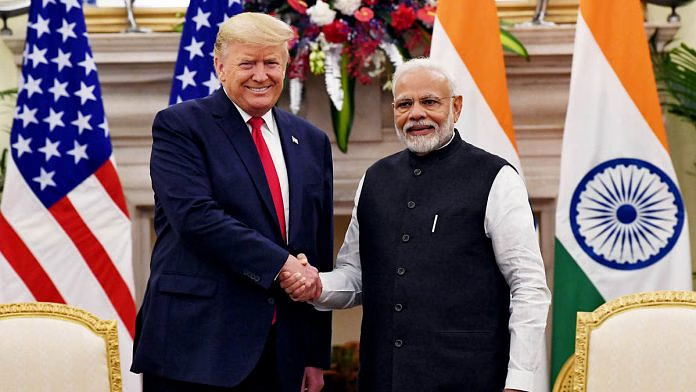
Of Trump, Kuhn, Thucydides, and India
Why in News?
Former US President Donald Trump’s political resurgence has sparked debates about the status quo of global politics. The article explores how Trump, Kuhn’s theory of paradigm shifts, Thucydides’ historical analysis, and India’s emerging role connect in today’s changing world order. 
Introduction
Donald Trump’s political influence persists as he continues to draw widespread support in the US despite criticism. His rise symbolizes larger global shifts, challenging old systems and raising questions about the established world order. Historical patterns suggest that every fifty years or so, there is a major transformation in global paradigms, as explained by thinkers like Thomas Kuhn and Thucydides.
Key Features
-
Trump’s Popularity: Despite being called divisive and controversial, Trump resonates with millions of Americans who feel disconnected from the current system.
-
Historical Examples of Change:
- Lenin in Russia, Mao in China, and Martin Luther in Europe sparked massive shifts.
- Leaders like Franklin Roosevelt and Mikhail Gorbachev marked the end of old eras and the beginning of new ones.
-
Thomas Kuhn’s Paradigm Shift:
- Kuhn argued that old systems resist change until they collapse under their own contradictions.
- New ideas emerge only through resistance and crisis, usually leading to revolutionary changes.
-
Thucydides’ Theory:
- Thucydides explained how fear and rising powers disrupt the status quo, leading to conflict and systemic change.
- The rise of countries like China and India challenges US dominance, just as new powers have risen throughout history.
-
Globalization and Its Limits:
- Free markets, open borders, and liberal immigration are under stress.
- Trump’s focus on protectionism, immigration control, and trade barriers reflects a reaction to the failures of globalization.
-
Patterns of Global Shifts:
- The first quarter of each new century tends to bring major systemic changes.
- The 20th century saw two world wars and the rise of America as a superpower (Pax Americana).
- The current century is witnessing new powers emerging, challenging US dominance.
Specific Impacts or Effects
- End of Unipolarity: The overwhelming global influence of one superpower (the US) is diminishing.
- Rise of New Powers: Countries like China, India, and Russia are asserting themselves economically and politically.
- Shift in Global Trade and Migration: Western countries are retreating from free trade and open migration policies.
- Impact on India: India must navigate between maintaining old alliances and embracing new global opportunities as it emerges as a key player in the new world order.
Challenges and the Way Forward
Challenges
- Global Instability: The decline of the old order creates uncertainty and potential conflict.
- Economic Slowdown: Protectionism and disrupted global trade may slow economic growth.
- Geopolitical Tensions: Power struggles between the US, China, Russia, and emerging powers like India may lead to conflicts.
Steps Forward
- Strategic Diplomacy: India must balance its relationships with major powers while asserting its own strategic interests.
- Economic Reforms: Strengthening the domestic economy will be essential for India to remain competitive.
- Global Cooperation: Despite rising nationalism, global challenges like climate change and security require cooperative solutions.
Conclusion
History shows that no world order lasts forever. The current shifts in global power dynamics, symbolized by leaders like Trump and theories from Kuhn and Thucydides, indicate a transition to a new paradigm. For India, this presents both opportunities and risks. The next fifty years will be shaped by how nations adapt to these changes.

