
Middle East at the Centre: Gaza Reconstruction and the Elusive Peace
Why in News?
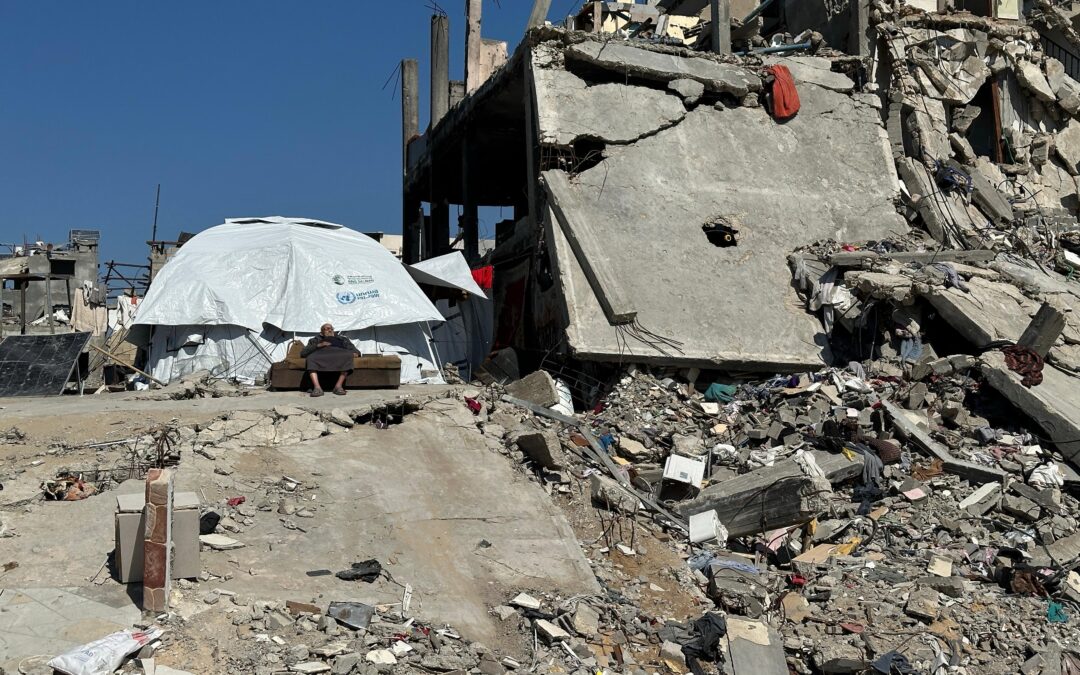
The Gaza Strip is once again at the centre of intense global diplomatic activity. A comprehensive reconstruction plan for Gaza, proposed by the United States and Arab states, highlights a critical standstill in the Israeli-Palestinian conflict. Despite the proposals and international engagement, a breakthrough remains elusive. The recent initiatives are an attempt to navigate a path toward peace and stability after the latest round of devastating hostilities between Israel and Hamas. 
A Region at Crossroads
Last month, when US President Donald Trump, Israeli Prime Minister Benjamin Netanyahu, and other leaders proposed a plan for Gaza, controversy erupted. Netanyahu announced that Palestinians could live amid war debris or leave the Gaza Strip altogether. His vision included establishing a “riviera” under US control. This extraordinary proposal was largely criticized by the international community. Palestinians and Arab stakeholders rejected it outright, seeing it as provocative and dismissive of Palestinian rights.
Netanyahu’s plan involved relocating Gazans and preparing for a post-Hamas phase, gaining attention in policy circles. It consolidated his support base on the political right and was seen by some as the “grand prize” following prolonged conflict with Hamas. Israel’s position on Hamas has since hardened. There are increasing calls for the immediate return of hostages and the destruction of Hamas before any movement toward a ceasefire or phased withdrawal of Israeli forces from Gaza.
US and Israeli intelligence agencies remain cautious, fearing Hamas could regroup. Secretary of State Marco Rubio later reiterated that the US proposal focused on encouraging countries with economic and technological capabilities to assist Gaza’s rebuilding. However, this came with the condition that Gazans might have to relocate temporarily, with discussions even hinting at stationing US troops in Gaza. The White House has not confirmed direct contact with Hamas, focusing instead on regional diplomacy.
The US, Arab States, and Reconstruction Plans
The United States, alongside Egypt and Jordan, proposed a reconstruction blueprint. Egyptian President Abdel Fattah El-Sisi emphasized the right of Palestinians to remain in their homeland, underlining sovereignty over their land as essential for any progress. This proposal was supported by Saudi Arabia, despite its cooling relations with the US on other matters. Crown Prince Mohammed bin Salman reportedly expressed his interest in joining reconstruction efforts, reflecting the shifting dynamics in Arab leadership.
The reconstruction plan envisions three phases lasting until 2030 at a projected cost of $53 billion. The first phase, covering six months, focuses on de-mining and clearing debris, while providing Palestinians with temporary camps within Gaza. Egypt would host an international funding conference to mobilize the necessary resources. The second phase, spanning three years, prioritizes public infrastructure development, housing, and livelihoods. The final stage includes enhancing connectivity and developing industries to stabilize Gaza’s economy. During this phase, the Palestinian Authority would gain autonomy over both Gaza and the West Bank.
A new governance structure is proposed to be established in Gaza, excluding Hamas, and focusing on an independent team of Palestinian experts and technocrats. The World Bank would supervise the fund’s disbursement, alongside the UN Security Council, which would oversee the deployment of international peacekeepers to maintain order and security.
Why the Plan Faces Resistance
The proposal has faced rejection from Hamas, Israel, and various stakeholders. Israel has firmly opposed the plan, citing security concerns and rejecting any role for Hamas in the process. Israel’s position hardens as it rejects the return of displaced Palestinians to their homes, criticizing both the Palestinian Authority and UNRWA. It accuses them of supporting Hamas and perpetuating hostility towards Israel.
Meanwhile, Hamas remains unyielding. It refuses to disband or accept its exclusion from governance in Gaza. Hamas fears losing its grip on power, and its leadership views the proposals as an existential threat.
A Fragile and Complex Equation
Despite these obstacles, the US and its partners view this proposal as a chance to break the deadlock in one of the world’s most intractable conflicts. There is broad recognition that humanitarian needs in Gaza are urgent. Hostilities have left homes, schools, and infrastructure destroyed. The return of hostages and prisoners, along with addressing the humanitarian crisis, remains central to any forward movement.
But the challenges are immense. Without a ceasefire and mutual acceptance between Israel and the Palestinians, progress is unlikely. The current reality is that any sustainable peace requires guarantees for Palestinian statehood and Israeli security. Both sides must navigate their existential fears to achieve peace. If not, the cycle of violence and retribution will continue, leaving Gaza and the wider Middle East in perpetual turmoil.
In the 21st Century: A New Leadership Imperative
In the 21st century, it is crucial to address regional conflicts with non-violent, inclusive solutions. The Middle East faces a crisis of leadership. Without creative diplomacy and good-faith initiatives, the cycle of violence between Israelis and Palestinians will persist.
The self-governance of Gaza and the West Bank, as envisioned in the Oslo Accords, must be realized to break the stalemate. Only a viable two-state solution can provide hope for Palestinians and ensure security for Israelis. If Arab states, Israel, and international actors commit to peace and justice, the region could move beyond the current impasse. However, failure to do so risks perpetuating a conflict that has already cost countless lives and resources.
The writer Sanjay Bhattacharyya concludes that, despite the mounting complexities, a clear leadership void remains at the heart of this enduring crisis. In his view, only courageous diplomacy and compromise can break the vicious cycle of mistrust and hostility.

