
Intuitive Machines and Firefly Aerospace Boost Lunar Exploration
Why in News?
Recently, two private US space companies, Intuitive Machines (IM) and Firefly Aerospace, successfully landed unmanned vehicles on the Moon. These historic milestones mark significant progress in the US-led efforts to return humans to the lunar surface under NASA’s Artemis program. The missions highlight the growing role of private industry in space exploration and aim to support future human settlements on the Moon. 
Introduction
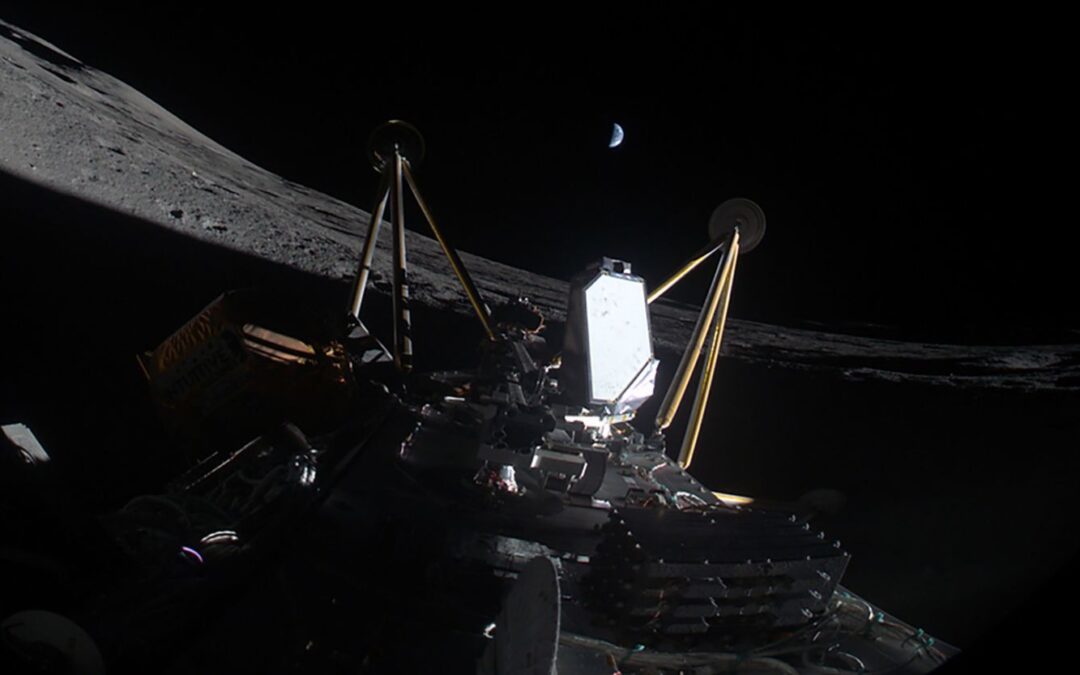
On Sunday, Firefly Aerospace became the second private company to reach the Moon by landing its Blue Ghost lander. Earlier, Intuitive Machines (IM) successfully landed its Athena vehicle, marking IM’s second lunar touchdown. These missions are part of NASA’s $2.6 billion Commercial Lunar Payload Services (CLPS) program, designed to leverage private companies to cut costs and speed up the return of astronauts to the Moon under the Artemis mission.
Mission Highlights
Intuitive Machines’ Athena Lander
- Athena is tasked with drilling in search of ice, testing a 4G mobile network, and launching three rovers alongside a new hopping drone named Grace Hopper, after the famed computer pioneer.
- IM’s earlier lander, Odysseus, landed on the Moon in February 2024 but had a rough touchdown.
- Both Athena and Odysseus are compact (4.8 meters tall and spindly), optimized for lunar gravity by maintaining a low center of gravity.
Firefly Aerospace’s Blue Ghost Lander
- The Blue Ghost mission focuses on delivering payloads of up to 150 kg to the lunar surface.
- This reusable module supports future manned missions, enabling extended stays for astronauts.
- Blue Ghost also deploys radiation-resistant computing equipment for testing.
Scientific Experiments & Technological Innovations
- NASA’s Lunar GNSS Receiver Experiment (LuGRE):
- Successfully received GPS signals from Earth’s orbit, proving the potential for lunar navigation systems.
- Aimed to map lunar locations with the precision of terrestrial GPS, though more complex.
- Retroreflector Arrays & Low-Frequency Radio Receivers:
- Help in bouncing lasers for distance measurement and detecting charged particles.
- 4G Network Deployment:
- Nokia routers are being used to link rovers and landers.
- Success would pave the way for mobile services on the Moon, aiding Artemis missions and establishing an orbital station and lunar surface labs.
- Grace Hopper Drone:
- A hopping drone that may provide the fastest lunar surface mobility.
- Intended to explore deep craters that have never seen sunlight.
- Could revolutionize lunar exploration and mapping tasks.
Key Features of the Missions
| Feature | Intuitive Machines (IM) | Firefly Aerospace |
|---|---|---|
| Vehicle | Athena | Blue Ghost |
| Focus | Ice drilling, 4G, rovers | Payload delivery, radiation-resistant computing |
| Unique Tech | Grace Hopper drone | Reusable delivery module |
| Program Affiliation | NASA CLPS | NASA CLPS |
| Impact | Supports Artemis & future human landings | Enables heavier, repeated deliveries to Moon |
The Big Picture: Artemis & Beyond
- Artemis Program aims to:
- Place humans in orbit around the Moon.
- Land a manned mission on the lunar surface by 2027 (though timelines may shift).
- SpaceX and ISRO are key players in Artemis’ future success.
- The Moon’s harsh conditions (no atmosphere, deep craters, and only 7% of Earth’s land area) make robotic and autonomous exploration critical.
Long-Term Prospects: Space, Science, and Economy
- Immediate Gains:
- Technologies from these missions already impact solar energy, robotics, global communications, hydroponics, autonomous vehicles, telemedicine, and climate science.
- Short-Term Economic Potential:
- Adaptation of technology for Earth applications.
- Better understanding of the lunar environment.
- Long-Term Opportunities:
- Space mining for resources.
- Permanent lunar habitats for extended missions.
- Enabling interplanetary travel.
Conclusion
Space exploration has always been a gift that keeps giving. The success of Intuitive Machines and Firefly Aerospace reflects the growing partnership between government and private industry in space missions. These efforts not only further scientific discovery but also lead to technologies with everyday applications, bringing benefits back to Earth. As Artemis progresses and private players take bold steps, the Moon is no longer a distant dream but a vital part of humanity’s future.

