
Impact of Natural Disasters
Why in News?
Recently, an avalanche struck Mana village in Uttarakhand, causing devastation at a Border Roads Organisation (BRO) construction site. This tragic event highlights the growing risks posed by natural disasters, especially in vulnerable Himalayan regions, and sparks discussions on the urgent need for better disaster preparedness and worker safety.
Introduction
Natural disasters, though often unpredictable, do not have to result in widespread tragedy. Avalanches, in particular, are a recurring threat in the Himalayan states. The latest incident at Mana village underscores the importance of proactive planning, worker education, and advanced safety infrastructure to minimize casualties and improve survival odds.
The Recent Incident at Mana Village
Earlier this week, Indian Army and Indo-Tibetan Border Police (ITBP) teams launched a major rescue operation after an avalanche buried workers under snow and ice at Mana village, Uttarakhand.
🔹 A total of 54 workers were housed in eight containers at the BRO site.
🔹 Eight workers died, while 23 were rescued after being trapped in rubble.
🔹 The rescue mission spanned 60 continuous hours, battling heavy snowfall at an elevation of 10,500 feet.
🔹 Helicopters from the Indian Army, Indian Air Force, and a civilian copter were deployed to evacuate survivors to Joshimath Army Hospital.
🔹 A drone-based detection system was used to locate containers buried under snow and ice, enhancing the efficiency of the mission.
Avalanches in the Himalayan Region
Avalanches in areas like Mana are common.
🔸 Mana is one of India’s last outposts, close to the border with China. 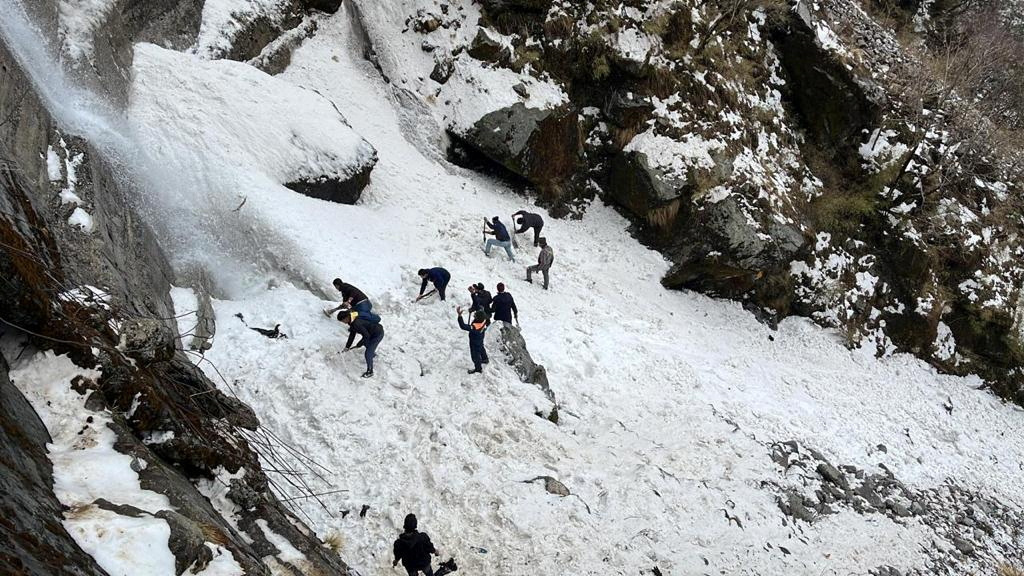
🔸 The local villagers are traditionally ‘winter migrants’, leaving the area after Badrinath temple closes in November and returning only in April or May.
🔸 Such seasonal migrations are a product of traditional wisdom, informed by generations of experience with disasters in high-altitude Himalayan zones.
Despite these precautions by residents, migrant workers often remain unaware of avalanche risks or the dangerous conditions they face while working in such remote locations.
Key Features and Learnings from the Incident
1. Challenging Rescue Operation
- Near-impossible conditions, including blocked roads, heavy snow, and high-altitude hypoxia.
- Required multi-agency coordination and technological support (drones, helicopters).
2. Historical Migration Practices
- Local populations have seasonal evacuation practices for safety.
- Migrant laborers, however, lack traditional knowledge and may not be prepared for winter hazards.
3. Inadequate Worker Awareness
- Raises the question: Were migrant workers properly briefed about the risks?
- There’s a need for safety education and training, particularly for migrant laborers.
4. Improved Disaster Preparedness
- Avalanches can’t be predicted with precision, but preventive measures can be taken.
- Containers and shelters can be redesigned for safety, similar to bomb shelters or Antarctic research stations.
- Survival odds can improve with better planning and infrastructure.
Steps Forward: What Needs to be Done?
✅ Design Safer Work Shelters: Containers should be reinforced to survive avalanches.
✅ Implement Worker Sensitization Programs: Educate workers on natural disaster risks.
✅ Develop Civil and Military Infrastructure: Improve road access for faster evacuations and rescue efforts.
✅ Learn from Global Best Practices: Study shelter design in harsh environments like Antarctica or conflict zones.
Conclusion
The Mana village avalanche is a tragic reminder that while natural disasters can’t be stopped, their impact can be controlled through proactive planning, technology use, and greater sensitivity toward worker safety.
We must move beyond viewing these events as inevitable consequences and instead work toward minimizing risk and protecting lives, particularly in hazard-prone regions like the Himalayas.

