
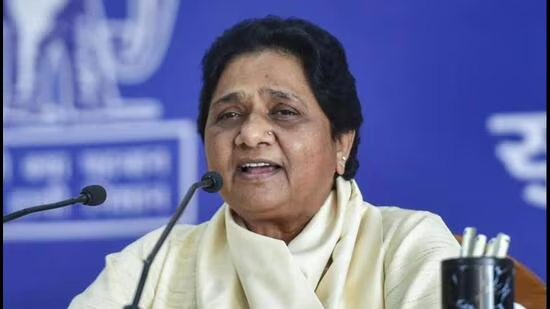
About The Diminishing Influence of the Bahujan Samaj Party (BSP):
The Bahujan Samaj Party (BSP), once a formidable force in Indian politics, finds itself in a precarious position. Its steady decline, shrinking electoral base, and internal discord paint a picture of a party struggling to stay relevant. The recent expulsion of Akash Anand, the nephew of party supremo Mayawati, has once again brought BSP’s internal troubles into the spotlight. This comes just a day after he was removed from his post as national coordinator for the second time in ten months.
Mayawati’s decision signals a deeper crisis within the party, highlighting its failure to sustain its radical promise of social justice, caste empowerment, and political representation of the marginalized. With the 2024 Lok Sabha elections approaching, the BSP faces an uphill battle to reclaim its lost ground and redefine its political identity in an ever-evolving landscape.
A Struggling Political Force
The BSP’s decline has been evident in recent years. Once a dominant political force in Uttar Pradesh, the party has suffered significant electoral setbacks. The loss of its core Dalit vote base, failure to adapt to changing political dynamics, and an outdated approach to identity politics have weakened its position.
The BSP’s political message, which once resonated through social engineering, now appears ineffective. Earlier, its rhetoric included terms like “bhaichara sammelans” (brotherhood meetings) and a shift from “bahujan to sarvajan” (broadening its base beyond Dalits). However, the party has been unable to adapt to contemporary political realities and the demands of a more competitive, media-driven political environment.
BSP’s Political Legacy and Challenges
The BSP made significant strides in Indian politics under Kanshi Ram’s leadership. In the 1980s, the BSP championed Dalit empowerment, leveraging Kanshi Ram’s image as a Dalit icon. The party played a crucial role in institutionalizing Dalit identity politics, ensuring that Dalit concerns were recognized in the mainstream. The installation of Ambedkar statues in public spaces and the political mobilization of Dalit communities were groundbreaking moves.
Under Mayawati’s leadership, the BSP peaked in 2007, when it secured a 30.46% vote share in Uttar Pradesh and formed a majority government. However, since then, it has witnessed a steady decline:
- In the 2012 Assembly elections, its vote share dropped to 91%.
- In the 2017 elections, it further declined to 23%, and the party failed to make a major impact.
- In the 2022 Assembly elections, the BSP saw its worst-ever performance, with just 99% vote share.
- Ahead of the 2024 Lok Sabha elections, it is projected to perform even worse.
The erosion of its support base, particularly among Dalits and Other Backward Classes (OBCs), has been a major challenge. Many traditional BSP voters have shifted towards the BJP and Samajwadi Party (SP), leaving the BSP struggling to remain politically relevant.
The Expulsion of Akash Anand: A Sign of Deeper Troubles
Akash Anand was widely seen as Mayawati’s political heir, and his removal from key positions within the party raises questions about BSP’s future leadership. This is the second time in less than a year that he has been removed from a crucial post, signaling internal instability.
While Mayawati’s control over the party remains unchallenged, the lack of a clear successor raises concerns. The BSP has failed to nurture a second-line leadership, making it heavily dependent on Mayawati’s decisions. The absence of strong regional leaders and the party’s inability to expand beyond Uttar Pradesh have further weakened its national presence.
Rise of Competitors and Changing Dalit Politics
The BSP is not only losing ground to mainstream parties like the BJP and SP, but also facing emerging Dalit political alternatives. The rise of leaders like:
- Chandrashekhar Azad Ravan (Bhim Army, Azad Samaj Party)
- Jignesh Mevani (Dalit leader from Gujarat)
- Prakash Ambedkar (Grandson of B.R. Ambedkar, leader of Vanchit Bahujan Aghadi)
These leaders have mobilized younger Dalit voters with progressive and aggressive political strategies, something the BSP has failed to do. Chandrashekhar Azad’s growing influence among Dalit youth, in particular, poses a direct challenge to BSP’s traditional voter base.
Conclusion: The Road Ahead for BSP
The BSP’s current predicament is a result of its failure to evolve with changing political realities. The expulsion of Akash Anand, instead of strengthening the party, reflects internal instability and leadership insecurity. With dwindling voter support, a shrinking influence in Uttar Pradesh, and growing competition, the BSP faces an existential crisis.
If Mayawati does not initiate major reforms, redefine BSP’s political message, and embrace modern electoral strategies, the party risks becoming obsolete. The 2024 elections will be a crucial test for the BSP—whether it can reclaim its lost ground or fade further into political irrelevance.

