
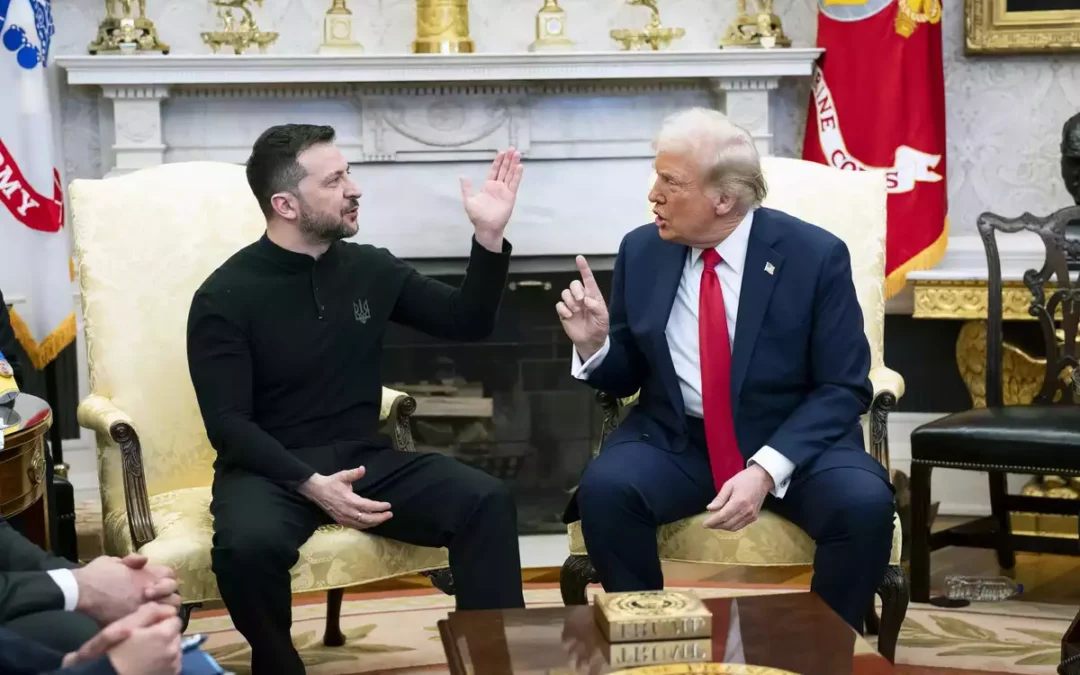
About Public Glare: The High-Stakes Oval Office Showdown and Its Global Implications:
Diplomacy in the Spotlight
Diplomacy often thrives behind closed doors, where leaders negotiate agreements and resolve disputes away from the public eye. However, on a recent occasion at the White House Oval Office, diplomacy was anything but discreet. The global stage witnessed a rare, intense moment where political, geopolitical, and personal differences were laid bare between US President Donald Trump, Vice President JD Vance, and Ukraine’s embattled leader, Volodymyr Zelenskyy. 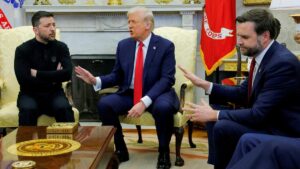
The key point of contention? US access to Ukraine’s rare earth minerals. This issue, which might have been handled delicately in private, became an open confrontation. Trump and Vance openly criticized Zelenskyy, accusing him of not being sufficiently grateful for US support while lamenting that Ukraine was not “holding the right cards” in negotiations.
Beyond the surface, this moment has significant geopolitical consequences, highlighting the ongoing power struggles involving Russia, Ukraine, the US, and European allies.
A Shift in US Foreign Policy: The Transatlantic Alliance in Uncertainty
One of the most striking developments has been the rapid shift in the US stance on Ukraine under Trump. His administration has suspended Washington’s previous positions on Ukrainian aid and downplayed the importance of the transatlantic alliance. This shift has left many Western allies stunned and uncertain about the future of their diplomatic relations with the US.
The public attack on Zelenskyy at the Oval Office is part of a larger political strategy by Trump and his allies, aiming to appeal to the “MAGA” (Make America Great Again) base. Trump’s supporters have long criticized US foreign interventions, arguing that American taxpayer money should not subsidize Ukraine’s war effort or Europe’s security needs.
Zelenskyy, once seen as a prime beneficiary of US support, now faces a much tougher diplomatic landscape. His portrayal as a leader seeking continuous financial and military assistance is being met with increasing opposition from Washington’s new administration. The Trump-Vance stance suggests that America may be stepping back from its global commitments, particularly in Europe.
This shift marks a rapid undermining of the transatlantic alliance, an alliance that has shaped global geopolitics since World War II. For decades, Europe has relied on US leadership and military support for stability and security, particularly in confronting threats from Russia. Now, that stability is being thrown into question.
Europe’s Dilemma: Finding an Alternative to US Leadership
With growing uncertainty about US commitment to Ukraine, European leaders are scrambling to find alternative security frameworks. After the tense White House meeting, Zelenskyy turned to Europe, participating in a high-level summit with key European leaders in London.
Notably, UK Prime Minister Keir Starmer and French President Emmanuel Macron have spearheaded discussions on creating an alternative European-led security framework for Ukraine. The urgency of these talks reflects the fact that European nations may need to take greater responsibility for Ukraine’s defense, rather than relying on the US.
To further address these concerns, a special summit on Ukraine and European defense is scheduled for March 6 in Brussels. However, even as Europe seeks greater autonomy, there are significant challenges:
- Financial and military limitations– Europe does not yet possess the same level of resources or capabilities as the US to provide large-scale military aid.
- Political divisions within Europe– Different nations have varying priorities and threat perceptions regarding Russia.
- Dependency on US strategic support– Despite shifts in Washington, Europe still depends on US intelligence, technology, and military coordination.
Thus, while Europe may explore alternative leadership, it cannot completely detach itself from US influence in security matters.
The Future of US-Ukraine Relations and Global Diplomacy
As the dust settles from this Oval Office diplomatic showdown, the path ahead remains uncertain for all players involved.
- For Ukraine: Zelenskyy must navigate an increasingly difficult geopolitical landscape, balancing relations with the US while strengthening European alliances.
- For Europe: The EU must determine how much responsibility it is willing and able to take on for Ukraine’s security without full backing from Washington.
- For the US: The Trump administration must decide whether it truly wants to reduce its global footprint or whether it will maintain a selective but strategic international presence.
The recent diplomatic tensions highlight a broader question about the future of global leadership:
- Will the US continue playing the role of the world’s primary security provider?
- Or are we witnessing the beginning of a more fragmented international order where multiple power centers emerge?
As this new era of diplomacy unfolds, one thing is clear: no nation can afford to be “everywhere” on the global stage. Instead, countries will need to strategically navigate their relationships while ensuring that critical diplomatic channels remain open across the Atlantic and beyond.
Conclusion: A High-Stakes Moment for Global Diplomacy
The Oval Office confrontation between Trump, Vance, and Zelenskyy has exposed deep geopolitical rifts and signaled a potential shift in international power dynamics.
With the US reconsidering its global commitments, Europe recalibrating its security strategy, and Ukraine struggling to secure stable alliances, the world is entering an era of heightened diplomatic uncertainty.
Going forward, leaders will need to adapt to these evolving realities, finding new ways to balance national interests with global stability. Whether this results in greater cooperation or deepening divisions remains to be seen—but the next few months will be crucial in shaping the future of international relations.

