
About Study Recommends 179 Communities for SC, ST, OBC Inclusion:
In one of the largest ethnographic studies conducted by the Anthropological Survey of India (AnSI) in collaboration with Tribal Research Institutes (TRIs), 268 denotified, semi-nomadic, and nomadic tribes have been comprehensively categorized for the first time.
- Key Findings:
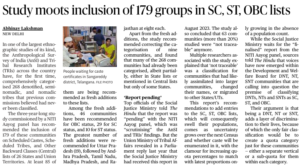
- This study, initiated in 2020 and completed by August 2022, was commissioned by a panel formed by NITI Aayog. The research aimed to address the long-standing issue of these tribes not being classified under the Scheduled Castes (SC), Scheduled Tribes (ST), and Other Backward Classes (OBC) categories, and propose appropriate classifications.
- Recommendations for Inclusion: The study has recommended the inclusion of 179 communities in SC, ST, or OBC lists across 26 states and union territories.
- Out of these, 85 are fresh additions
- 46 for OBC status,
- 29 for SC status,
- 10 for ST status
- Uttar Pradesh had the highest number of additions (19 communities), followed by Andhra Pradesh, Tamil Nadu, Madhya Pradesh, and Rajasthan (8 each)
- Corrections and Partially Classified Communities: Nine communities’ categorization was recommended for correction. Many communities, while studied, were found to have already been partially categorized in state lists or central lists for specific states.
- “Not Traceable” Communities: The study found 63 communities (over 20%) as “not traceable”. These are communities that have either assimilated into larger groups, changed their names, or migrated to other states or territories.
- Who Are the Scheduled Castes (SCs)?
- Scheduled Castes (SCs) refer to communities in India that have historically faced severe oppression, discrimination, and social exclusion, primarily due to the Hindu caste system.
- These communities were once known as “untouchables” and continue to experience marginalization, though affirmative actions have been introduced to improve their social and economic conditions.
- According to the Constitution Order of 1950,only marginalized Hindu communities can be categorized as SCs.
- They were traditionally outside the four main varnas (Brahmins, Kshatriyas, Vaishyas, and Shudras) in the Hindu social hierarchy and were often referred to as “avarnas” (those who don’t fit into the varna system).
- Who Are the Scheduled Tribes (STs)?
- Scheduled Tribes (STs) are indigenous communities that have historically faced oppression, marginalization, and struggle. Like SCs, STs are also categorized as “avarnas” but their identity is rooted in their distinct cultural practices, geographical isolation, and social structure.
- STs, also known as Adivasis, are the original inhabitants of India, often living in remote and isolated areas. They have distinct languages, customs, and cultures, and are often considered to be at a lower level in the social hierarchy due to their isolated way of life.
- What Are Other Backward Classes (OBC)?
- Other Backward Classes (OBC) is a term introduced by the Mandal Commission in 1980.
- These are castes that fall between the higher varnas (Brahmins, Kshatriyas, Vaishyas) and the marginalized groups (SCs and STs).
- OBCs benefit from affirmative action programs like reservations in education, government jobs, and political representation, but not to the same extent as SCs and STs.
1. What was the focus of the ethnographic study conducted by AnSI and TRIs?
The study aimed to categorize denotified, semi-nomadic, and nomadic tribes, recommending classifications for SC, ST, and OBC categories.
2. How many communities did the study recommend for inclusion in SC, ST, or OBC lists?
The study recommended the inclusion of 179 communities across 26 states and union territories.
3. Which state had the highest number of communities added to the SC, ST, or OBC lists?
Uttar Pradesh had the highest number, with 19 communities added.
4. What percentage of communities were found to be “not traceable”?
63 communities (over 20%) were found to be “not traceable” due to assimilation or migration.
5. What are the key differences between SCs, STs, and OBCs?
SCs face historical oppression and discrimination, STs are indigenous communities with distinct cultures, and OBCs are middle-tier castes benefiting from affirmative action but less than SCs and STs.

