
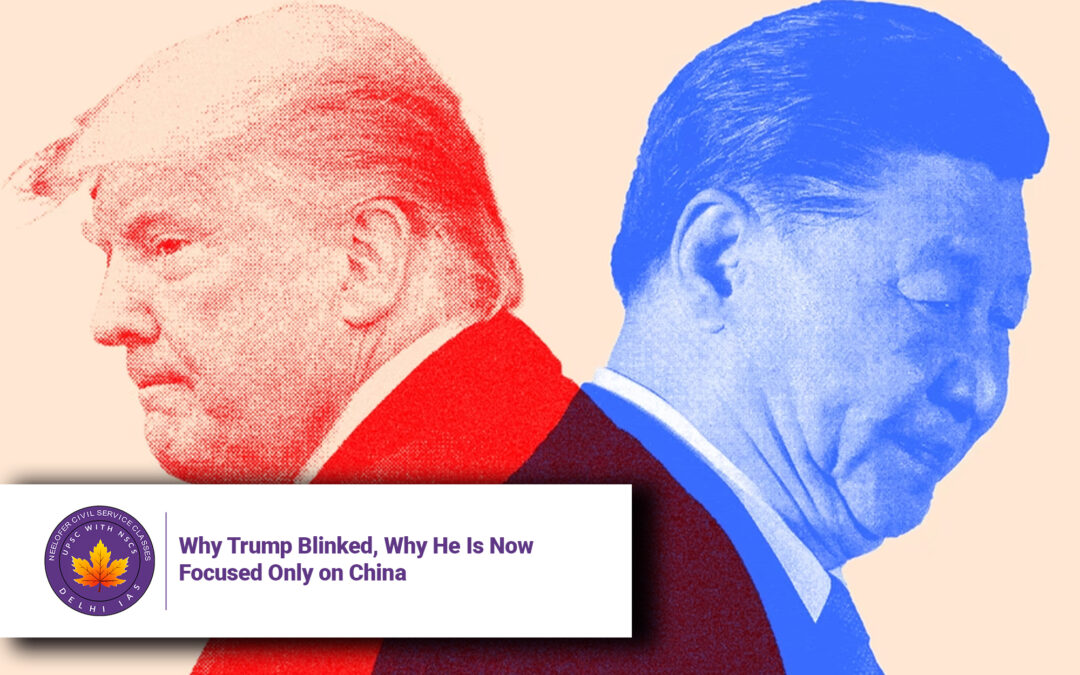
Why Trump Blinked, Why He Is Now Focused Only on China
Why in News?
President Donald Trump recently announced a 90-day pause on tariffs for 86 countries that had not retaliated against US tariffs. However, he excluded China from this pause and sharply increased tariffs on Chinese goods to 125%, showing a clear strategic shift in US trade policy.
Introduction
The US administration, under President Trump, is shifting its trade war focus solely to China while offering relief to other countries. The announcement came just hours after China retaliated with its own tariffs. This reflects Trump’s long-standing concerns over China’s economic practices and dominance in global manufacturing.

Key Issues and Background
1. The Reciprocal Tariff Pause
-
Trump announced a 90-day suspension of reciprocal tariffs for 86 countries.
-
India’s earlier reciprocal tariff of 26% is removed, but it still faces a 125% “baseline” tariff.
-
The pause does not apply to China, which is now under increased pressure.
2. China Becomes the Sole Target
-
Trump justified the move by pointing to China’s trade surplus and weak export competitiveness.
-
He posted on social media that the pause will not apply to any nation that had retaliated “in any way, shape, or form.”
-
China now faces 125% tariffs, the highest among all nations.
The Core of the Concern
1. Influence of Peter Navarro
-
Trump’s trade policy is influenced by Peter Navarro, author of “Crouching Tiger” and a known critic of China.
-
Navarro was appointed as Senior Counselor for Trade and Manufacturing in December 2024.
2. US Economic Structure
-
The US imports more than it exports, creating trade deficits.
-
Tariffs hurt domestic consumption and may slow economic growth.
-
The Federal Reserve may hesitate to raise interest rates due to low investment and growth, causing more uncertainty.
Key Observations
-
The trade shift reflects Trump’s mercantilist outlook—focus on reducing imports and boosting exports.
-
Trump’s inconsistency on tariffs is increasing unpredictability in global markets.
-
China’s reluctance to transition out of low-value manufacturing is another root cause of conflict.
-
The US economy may suffer more from these tariffs than gain, due to rising consumer costs and uncertain investor climate.
Conclusion
Trump’s latest tariff decision underscores a significant shift in US foreign trade policy — isolating China as the primary adversary while easing tensions with other nations. However, this move risks global economic disruption and raises questions about the long-term consequences of such targeted, unpredictable policy-making. India and others must watch closely and respond diplomatically and economically to these evolving trade dynamics.
Q&A Section
Q1. What did President Trump announce regarding tariffs?
He authorized a 90-day pause on tariffs for 86 countries but increased tariffs on China to 125%.
Q2. Why is China the only country excluded from the tariff pause?
Because China retaliated against US tariffs, and Trump sees China as the main cause of America’s trade deficits.
Q3. Who influenced Trump’s China-specific trade stance?
Peter Navarro, a trade advisor and author critical of China’s global manufacturing dominance.
Q4. What are the effects on the US economy?
The tariffs hurt consumption, reduce investment, and could force the Federal Reserve to delay interest rate hikes, slowing growth.
Q5. How is China reacting to the tariffs?
China retaliated with its own tariffs and continues to resist US pressure, refusing to change its manufacturing structure.

