
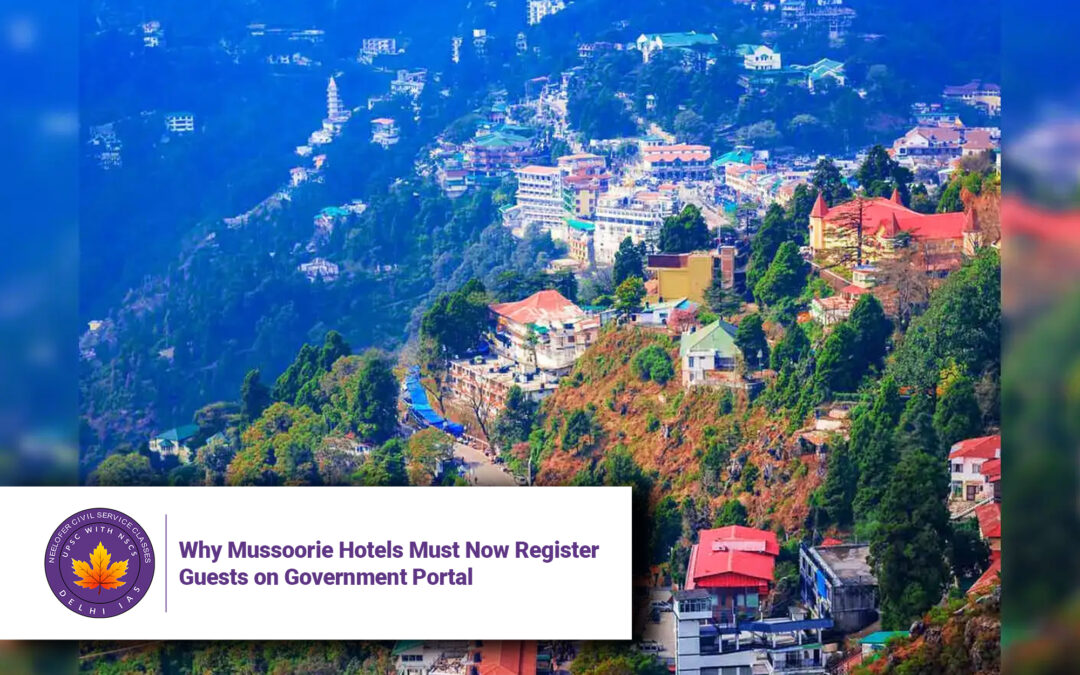
Why Mussoorie Hotels Must Now Register Guests on Government Portal
Why in News?
The Uttarakhand government has now made it mandatory for all hotels, guesthouses, and homestays in the popular hill station of Mussoorie to register their guests on an Internet portal operated by the Uttarakhand Department of Tourism. This directive is part of a series of preventive and remedial measures aimed at managing Mussoorie’s ecological balance, tourist load, and fragile environment. The move follows a 2023 report by a state-appointed committee and observations made by the National Green Tribunal (NGT) concerning the environmental vulnerabilities of the region.
Introduction
Mussoorie, nestled in the foothills of the Garhwal Himalayas, has long been a top tourist destination. However, its increasing popularity has led to severe environmental stress and infrastructural overload. The rising tourist numbers, unchecked construction, and waste mismanagement have resulted in significant degradation of the local ecology. To address these growing concerns, the Uttarakhand government is now enforcing a digital system for tourist registration to monitor and manage the region’s ‘carrying capacity’ — the maximum population the local ecosystem can handle without being damaged.
Key Issues
1. Fragile Environment and Ecological Stress
Mussoorie is located at an altitude of 2,005 meters above sea level and lies in the ecologically sensitive Seismic Zone IV, just below the most active Seismic Zone V. Its geology, consisting of highly jointed and fractured weathered carbonate rock mass, makes it particularly susceptible to landslides and structural collapses.
The town is built on steep slopes with heavy rainfall, making it unsuitable for extensive concrete-based construction. Despite these risks, over-construction has continued unabated. The NGT, in its 2023 ruling post the Joshimath land subsidence, observed that Mussoorie faces similar risks of land degradation and potential disaster.
2. Overwhelming Tourist Influx
Mussoorie has seen a dramatic increase in tourist footfall over the years. Historical data show:
-
1958: 1.5 lakh tourists
-
1966: 3 lakh tourists
-
2000: 8.5 lakh tourists
-
2019: Over 30 lakh tourists
As of 2023, the town has 303 hotels, 201 homestays, and six dharamshalas registered. These accommodations collectively have parking space for only 1,240 vehicles, while tourist inflow has far exceeded this capacity.
The enormous tourist numbers have overwhelmed the region’s physical infrastructure, particularly waste management, water supply, and traffic control. According to the Mussoorie Nagar Palika, the town receives only 7.69 million litres of water per day from six pumping stations and five gravity-based sources, clearly inadequate for the combined resident and tourist population.
3. Carrying Capacity and Urban Planning Challenges
The concept of “carrying capacity” refers to the maximum number of people or activities that an ecosystem can sustain without suffering ecological damage. In Mussoorie’s case, exceeding this capacity has already led to serious consequences:
-
Inadequate water supply
-
Traffic congestion
-
Pollution
-
Strain on solid waste disposal systems
-
Risk of landslides and subsidence due to over-concretization
This issue was first recognized in 2001 by the Lal Bahadur Shastri National Academy of Administration, which had warned against further constructions. The Wadia Institute of Himalayan Geology also supported this conclusion, citing the fragile condition of limestone rocks in the area, riddled with microcracks.
4. Policy Implementation Gaps
Although several expert bodies and institutions have raised alarms for years, practical policy interventions have been slow. For example, the 2011 Census recorded Mussoorie’s population at 30,118, and the 2023 committee projected a 23% population increase by 2037 and 52% by 2052, yet urban planning and infrastructure development haven’t kept pace.
Process of Registration
The latest step by the Uttarakhand government is a practical attempt to digitally regulate the tourist load by introducing real-time registration of visitors. According to the guidelines:
-
Owners of all accommodations (hotels, guesthouses, homestays) must register their units on the portal run by the Department of Tourism.
-
The registration includes details of available parking space, room availability, and carrying capacity.
-
Tourists will be registered in real time upon check-in, ensuring authorities have up-to-date data on the number of people currently in town.
-
A live demo and training session was organized to help property owners understand the registration process.
According to district tourism development officer Brijendra Pandey, this step is critical in promoting sustainable tourism and ensuring regulatory compliance.
Rising Tourism Pressure and Infrastructure Mismatch
The exponential growth in tourism has caused a serious mismatch between demand and infrastructure. Even in its off-season, Mussoorie now faces:
-
Overflowing traffic
-
Parking shortages
-
Unregulated waste dumping
-
Water scarcity
-
Inadequate sewage systems
The 2023 committee report suggested limiting tourist vehicle entry and expanding pedestrian zones to reduce pressure on narrow hill roads. It also recommended augmenting water supply via the Yamuna Water Supply Scheme.
Alternative Approaches
Apart from the guest registration system, other solutions discussed or proposed include:
-
Tourist Cap Systems: Limiting the number of tourists allowed per day through a quota system, similar to models used in Bhutan or certain European cities.
-
Green Tourism Policies: Incentivizing eco-friendly homestays, banning plastic usage, and enforcing strict rules on waste disposal and noise pollution.
-
Seasonal Restrictions: Limiting the number of vehicles and guests during peak months (April to June) and festivals to reduce environmental burden.
-
Infrastructure Upgrade: Modernizing sewage treatment plants, increasing the capacity of water supply, and expanding eco-parking facilities.
-
Revised Construction Laws: Enforcing a ban on high-rise and slope-incompatible construction under the Uttarakhand Building By-Laws Amendment 2021.
Challenges and the Way Forward
Key Challenges:
-
Resistance from Local Businesses: Hotel and guesthouse owners may resist regulations due to fears of reduced bookings.
-
Implementation: Enforcing digital compliance in remote areas may face connectivity and awareness issues.
-
Tourist Cooperation: Educating tourists about the necessity of regulation and getting their cooperation remains a challenge.
-
Monitoring and Penalties: Continuous oversight is needed to ensure accurate registration and to penalize non-compliance.
Way Forward:
-
The government must integrate the registration portal with broader state-level tourism data systems for transparency.
-
Investment in smart infrastructure, including AI-based traffic flow analysis and automated waste segregation, should be prioritized.
-
Public awareness campaigns through social media and tourism departments can help build a culture of responsible tourism.
-
Periodic review mechanisms should be established to evaluate the effectiveness of the guest registration system and other ecological measures.
-
A multi-stakeholder model, involving the government, environmentalists, locals, and tourists, can help build consensus and ensure long-term sustainability.
Conclusion
Mussoorie’s growing popularity as a hill destination comes at a significant ecological cost. The state government’s decision to mandate guest registration through a centralized portal is a long-overdue step toward controlling tourism-related stress on the region. However, this must be seen as part of a broader strategy that includes infrastructural upgrades, legal reforms, and the promotion of eco-conscious practices.
Only through coordinated action and sustained commitment can the natural beauty and ecological health of Mussoorie be preserved for future generations.
5 Key Questions and Answers
1. Why has the Uttarakhand government introduced a guest registration system in Mussoorie?
To monitor and manage the region’s tourist load and ensure that it does not exceed the ecological carrying capacity of the area.
2. What does ‘carrying capacity’ mean in the context of tourism?
It refers to the maximum number of people that an environment can support without suffering environmental degradation or infrastructure collapse.
3. What challenges does Mussoorie face due to tourism?
Water shortages, traffic congestion, waste mismanagement, risk of landslides, and infrastructure strain.
4. How will the registration system work?
Hotel and homestay owners will log guest details on an online portal in real-time as tourists check-in. The data will help authorities track and regulate tourist numbers.
5. What steps are recommended beyond registration?
Regulating construction, improving public utilities, limiting vehicles, promoting eco-tourism, and revising building by-laws.

