
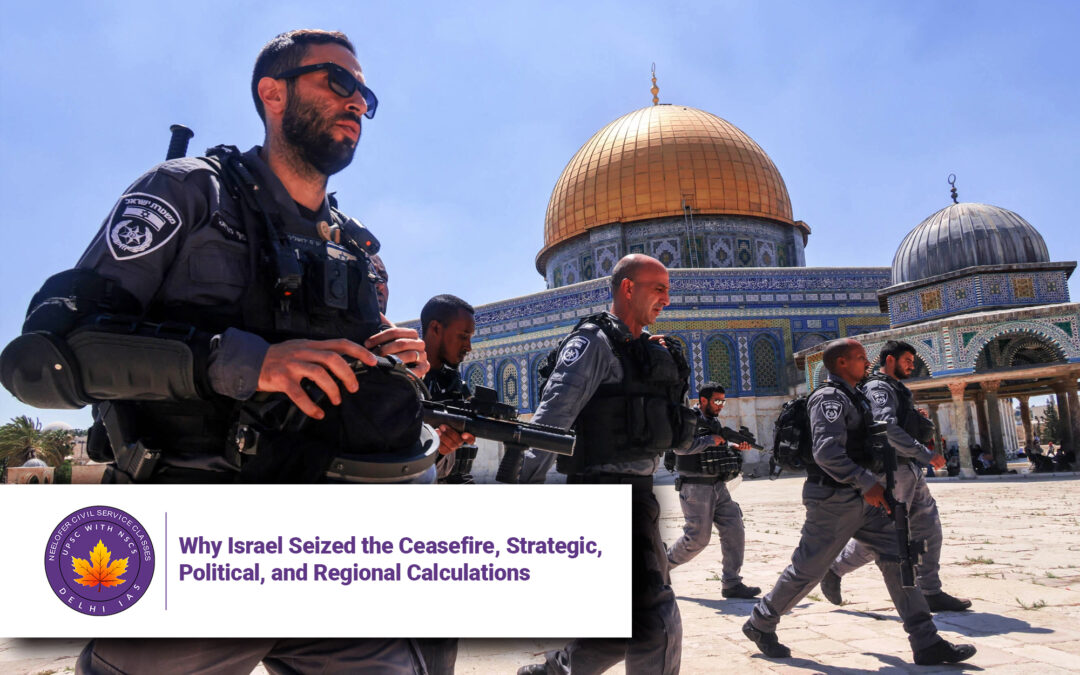
Why Israel Seized the Ceasefire, Strategic, Political, and Regional Calculations
Why in News?
Following weeks of conflict, Israel has agreed to a ceasefire starting June 24 with Hamas. This move came amid increasing civilian casualties in Gaza, mounting pressure from global allies, and a shift in regional political calculations. The ceasefire is being analyzed not just as a humanitarian decision but as a strategic pause beneficial to Israel’s military and political goals. 
Introduction
Ceasefires in prolonged conflicts often come loaded with silent motivations. Israel’s acceptance of a ceasefire now—after nearly 37 days of intense military action against Hamas—reflects not only a shift on the battlefield but also complex calculations involving international optics, domestic politics, and the growing threat of regional escalation, particularly from Iran-backed militias.
Key Developments
-
Biden’s Visit and Timing
-
US President Joe Biden visited Israel, prompting immediate speculation about American influence behind the ceasefire.
-
This aligns with the U.S.’s broader interest in de-escalating the region while dealing with the Ukraine war and tensions in the Indo-Pacific.
-
-
Iran’s Calculated Restraint
-
Despite fiery rhetoric, Iran avoided direct engagement even after the killing of its Islamic Revolutionary Guard Corps (IRGC) generals.
-
The U.S. responded with a highly publicized bombing campaign on Iranian-backed positions, signaling deterrence without further escalation.
-
-
Israel’s Military Goals
-
Israel successfully carried out targeted strikes, including a major hit on a Hamas military and communications facility in Khan Younis.
-
The war was used to degrade Hamas’s military capabilities and deliver a political message of deterrence to Hezbollah and Iran.
-
-
Public Sentiment in Israel
-
A 78.5% approval rating for Benjamin Netanyahu’s war leadership was recorded, as many Israelis viewed the campaign as necessary post-October 7 Hamas attacks.
-
However, the longer the war continued, the greater the cost in international legitimacy.
-
-
Hamas’s Position
-
Militarily weakened and with mounting civilian deaths in Gaza, Hamas accepted the ceasefire terms. Still, its propaganda machine continues to claim moral victory.
-
Strategic Takeaways
-
Israel achieved enough on-ground to justify ending combat while avoiding direct confrontation with Hezbollah or Iran.
-
The U.S. leveraged military action to push for de-escalation and refocus on its strategic theatre elsewhere.
-
Iran, faced with economic fragility and upcoming elections, chose calculated restraint over escalation.
Challenges and the Way Forward
Challenges:
-
The humanitarian crisis in Gaza remains dire.
-
The ceasefire may not hold if deeper political solutions aren’t pursued.
-
Iranian proxies, like Hezbollah, remain an active regional threat.
Way Forward:
-
Regional powers must push for multilateral dialogue.
-
Humanitarian aid must be urgently scaled up in Gaza.
-
The U.S. and EU must coordinate post-conflict reconstruction efforts to stabilize the situation and prevent future escalations.
Q&A Section
1. Why did Israel agree to a ceasefire now?
Israel agreed to a ceasefire after degrading Hamas’s military capacity, receiving strong domestic approval, and recognizing the rising international cost of continuing the offensive.
2. What role did the U.S. play in the ceasefire?
President Biden’s visit and the U.S. bombing of Iran-backed militia bases signaled strong deterrence and pushed Israel toward a ceasefire.
3. What was Iran’s response to the conflict?
Iran showed strategic restraint despite losing high-ranking IRGC officials, avoiding direct confrontation while supporting proxies rhetorically.
4. Was Hamas defeated militarily?
Hamas suffered serious military losses, especially in southern Gaza, but remains intact and is already spinning propaganda victories.
5. What’s next for Gaza and the region?
Without political reconciliation and humanitarian rebuilding, the ceasefire may be short-lived. Broader geopolitical efforts will be key to long-term peace.
Conclusion
The ceasefire between Israel and Hamas is more than a pause in hostilities—it’s a carefully calculated move influenced by international diplomacy, military tactics, and regional power play. Whether it will translate into lasting peace or remain another tactical truce depends on the will of global and regional actors to go beyond the battlefield.

