
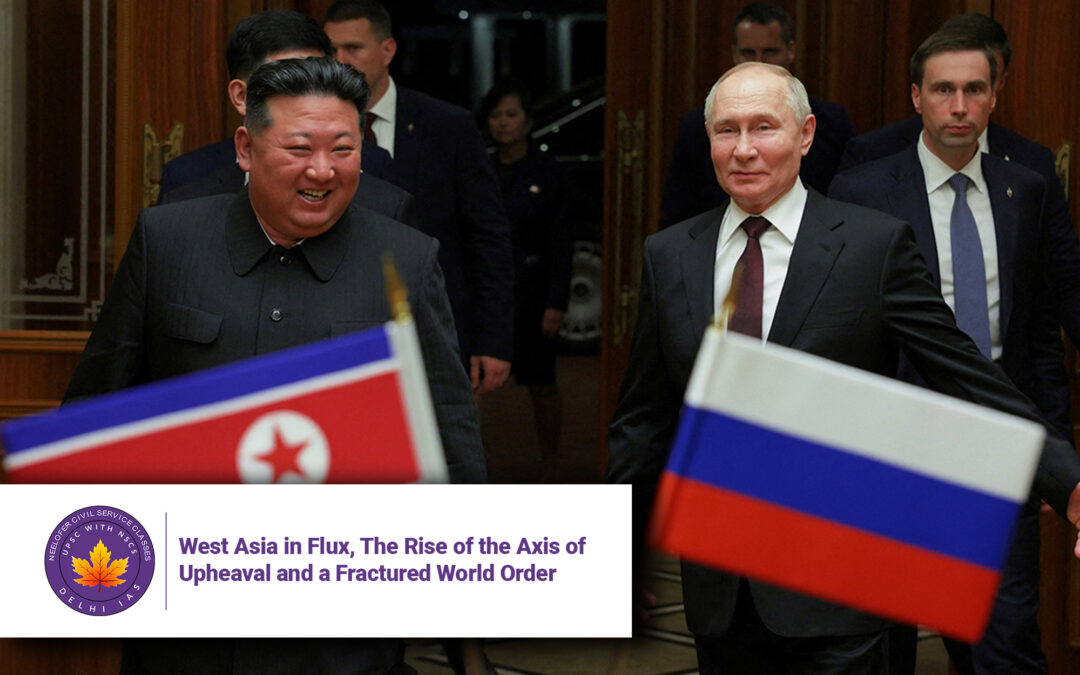
West Asia in Flux, The Rise of the Axis of Upheaval and a Fractured World Order
Why in News?
The recent ceasefire between Israel and Iran after intense military escalation has once again spotlighted West Asia’s fragile geopolitical balance. The emergence of a new strategic bloc — dubbed the ‘Axis of Upheaval’ — comprising Iran, China, and Russia, presents a dramatic shift in global alignments. 
Introduction
The world order shaped by the Cold War’s binary of Western and Soviet-led alliances is collapsing under modern geopolitical realignments. As the United States attempts to reassert its influence, nations like Iran are moving closer to new power centers in the East — particularly China and Russia. This alliance is seen as an attempt to challenge the US-led global dominance.
Key Highlights
-
Axis of Upheaval:
Coined by scholars Richard Fontaine and Andrea Kendall-Taylor, this term reflects an informal grouping of Iran, China, and Russia. Though these nations differ widely in internal governance and ambitions, they share a common goal: weakening U.S. influence globally. -
Military and Strategic Shift:
These powers are bound not by formal treaties, but by shared opposition to the West, especially the U.S. and NATO. Iran’s closer alignment with Russia and China gives it leverage against Western pressure and sanctions. -
New Age Cold War Dynamics:
Unlike the Cold War of the 20th century, the current geopolitical split doesn’t depend on ideological binaries but on nationalistic agendas, digital warfare, and economic sanctions. Groupings like the Shanghai Cooperation Organisation (SCO) and BRICS are growing in influence. -
Lack of Collective Security Mechanisms:
Despite claims of strategic unity, the ‘Axis’ lacks formal military alliances, joint defense systems, or comprehensive economic treaties. This weakens its global influence in structured diplomacy. -
India’s Calculated Neutrality:
India remains cautious and pragmatic. While it shares interests with both the U.S. and Russia, it refuses to be drawn into hard alliances. India’s position was highlighted by its silence on the Iran-Israel clash, maintaining focus on its regional stability and autonomy.
Challenges and Implications
-
For the West:
The U.S. is facing growing opposition to its unilateral dominance. The Axis’s expansion may limit American interventionist policies and military influence in West Asia and Eastern Europe. -
For West Asia:
Israel’s continued aggression and Iran’s resurgence have deepened regional instability. The risk of proxy wars remains high. -
For Global Order:
The world risks being split into fluid, interest-based camps rather than ideological coalitions. The absence of treaties means diplomatic unpredictability.
Conclusion
The Israel-Iran ceasefire may mark a temporary de-escalation, but the rise of the ‘Axis of Upheaval’ signifies a deeper, long-term transformation of global power centers. In this new multipolar world, strategic autonomy, unpredictable alignments, and fractured diplomacy are the new norm.
5 Questions & Answers
1. What is the ‘Axis of Upheaval’?
It refers to an informal alliance between Iran, Russia, and China aimed at countering Western dominance, particularly that of the United States.
2. Why is the alliance considered informal?
The three countries share strategic interests but lack formal military treaties, economic frameworks, or collective security arrangements.
3. How is India responding to the Iran-Israel conflict and the rise of the Axis?
India is maintaining a neutral and pragmatic stance, avoiding overt alignment while safeguarding its national interests.
4. What are the implications of this Axis on global security?
It could weaken American influence, disrupt global trade alignments, and increase instability, especially in West Asia and Eastern Europe.
5. Why is the current global divide different from the Cold War?
Today’s divide is based on strategic autonomy and national interest rather than rigid ideological blocs like capitalism vs. communism.

