
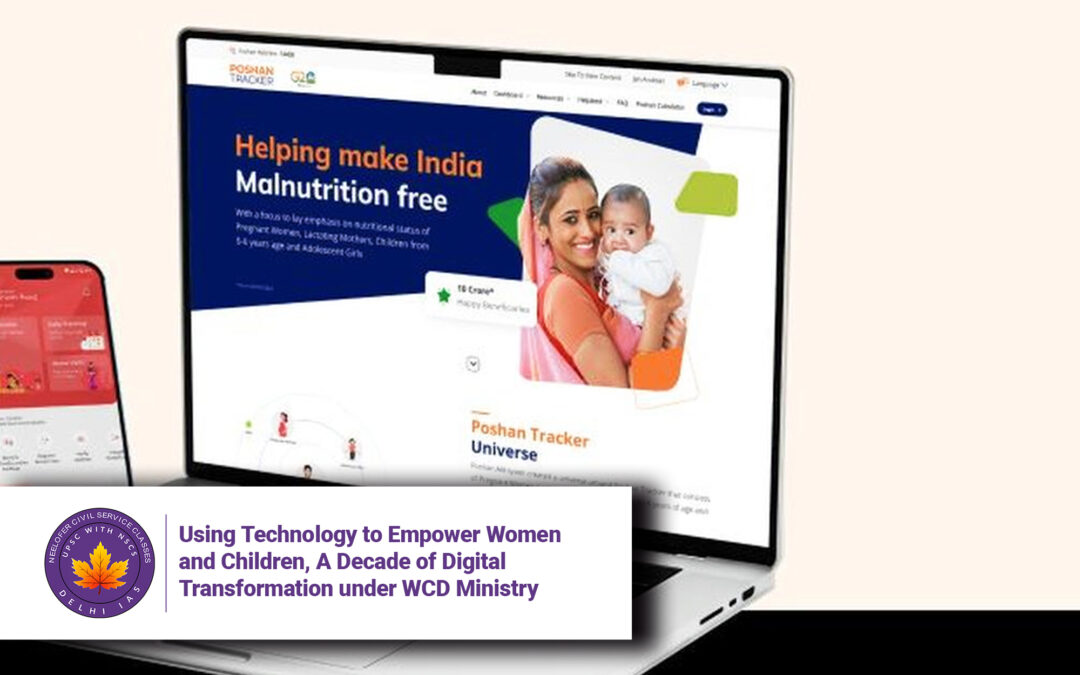
Using Technology to Empower Women and Children, A Decade of Digital Transformation under WCD Ministry
Why in News
Union Minister Annapurna Devi recently highlighted the transformative role of technology in empowering women and children under the Ministry of Women and Child Development (WCD). Over the last decade, digital tools and data-driven governance have become central to delivering nutrition, health, education, legal rights, and safety to millions across India.
Introduction
Empowerment begins with access — to rights, services, protection, and opportunity. Over the past ten years, under Prime Minister Narendra Modi’s vision of Viksit Bharat@2047, the WCD Ministry has integrated technology into its programmes to make service delivery faster, more transparent, and efficient. What was once aspirational is now operational — using digital public infrastructure, real-time monitoring, smart devices, and robust governance systems.
Key Issues and Background
-
The Ministry has modernized over 2 lakh Anganwadi centres, integrating:
-
Smart infrastructure
-
Digital devices
-
Innovative learning tools
-
Real-time monitoring through Poshan Tracker
-
-
Over 10.14 crore beneficiaries — including pregnant and lactating women, children under six, and adolescent girls — are now digitally tracked.
-
The Poshan Tracker initiative equips Anganwadi workers with smartphones and digital training to enhance service quality at the grassroots. It supports the Swasth Bharat, Suposhit Bharat vision and won recognition under the PM Awards for Excellence in Public Administration (2025).
-
The tracker includes Poshan Bhi, Padhai Bhi, which integrates early childhood education through digital training.
Specific Impacts or Effects
-
Nutrition and Leakage Prevention:
-
A facial recognition system is now used to ensure eligible beneficiaries receive nutritional supplements without leakages.
-
-
Women’s Protection & Legal Rights:
-
The She-Box portal offers a single-window grievance system under the Sexual Harassment of Women at Workplace Act, 2013.
-
The Mission Shakti dashboard and app connect women in distress to assistance via a digital one-stop centre now active in almost every district.
-
-
Maternal & Child Welfare Schemes:
-
PM Matru Vandana Yojana (PMMVY) has transformed maternity support, with pregnant women receiving ₹5,000 under PMMVY 2022 rules. Under Mission Shakti, the benefit extends to ₹6,000 for the second girl child — reinforcing support for daughters.
-
Over ₹19,000 crore has been disbursed through a paperless Direct Benefit Transfer (DBT) system.
-
-
Improved Health Indicators:
-
Sex Ratio at Birth increased from 918 (2014-15) to 930 (2022-24).
-
Maternal Mortality Rate (MMR) dropped to 97 per 1,000 births (2018-20) from 130 per 1,000 births (2014-16).
-
-
Child Welfare and Safety:
-
The Juvenile Justice Act (2015), Child Adoption Resource Information and Guidance System, and Mission Vatsalya dashboard ensure child protection, track orphan care, and improve adoption processing.
-
Challenges and the Way Forward
-
Bridging the Urban-Rural Digital Divide:
While smart devices are transforming urban centres, rural connectivity and digital literacy gaps remain a challenge. -
Sustaining Real-Time Monitoring:
Large-scale platforms like Poshan Tracker and PMMVY must continuously evolve to maintain accuracy, avoid data fatigue, and prevent misuse. -
Inclusive Technology Design:
More work is needed to ensure that disabled women, remote tribal populations, and non-literate users also benefit from digital platforms. -
Multi-Stakeholder Coordination:
The success of these initiatives requires consistent collaboration between centre, states, and grassroots workers.
Conclusion
India’s decade-long journey in digitally empowering women and children has redefined welfare delivery. With real-time dashboards, smartphone-enabled workers, grievance redressal portals, and targeted DBT schemes, governance is no longer confined to files — it’s live, measurable, and citizen-centric. As Union Minister Annapurna Devi notes, the Ministry has not just adapted to digital change but has championed it.
This is not just a story of technology — it is a story of justice, dignity, and inclusive growth. As we move towards Viksit Bharat@2047, India’s women and children are not being left behind. They are being brought to the centre of the digital revolution.
5 Questions and Answers
1. What is the Poshan Tracker, and how does it help?
The Poshan Tracker is a real-time data platform that helps Anganwadi centres deliver nutritional and education services efficiently by tracking over 10 crore women and children.
2. How is technology improving maternal health?
Through PMMVY and Mission Shakti, pregnant women receive DBT payments via Aadhaar-linked systems. These initiatives have contributed to lowering Maternal Mortality Rates.
3. What is She-Box and who can use it?
She-Box is an online grievance portal for complaints of sexual harassment at the workplace. It offers women employees a secure, single-window access to support.
4. How has the Sex Ratio at Birth improved?
Through schemes like Beti Bachao, Beti Padhao and targeted nutrition and financial incentives, the ratio has increased from 918 to 930 over a decade.
5. What legal acts support this digital transformation?
Key laws include the Juvenile Justice Act (2015) and the Sexual Harassment at Workplace Act (2013), both of which now integrate digital tracking and grievance systems.

