
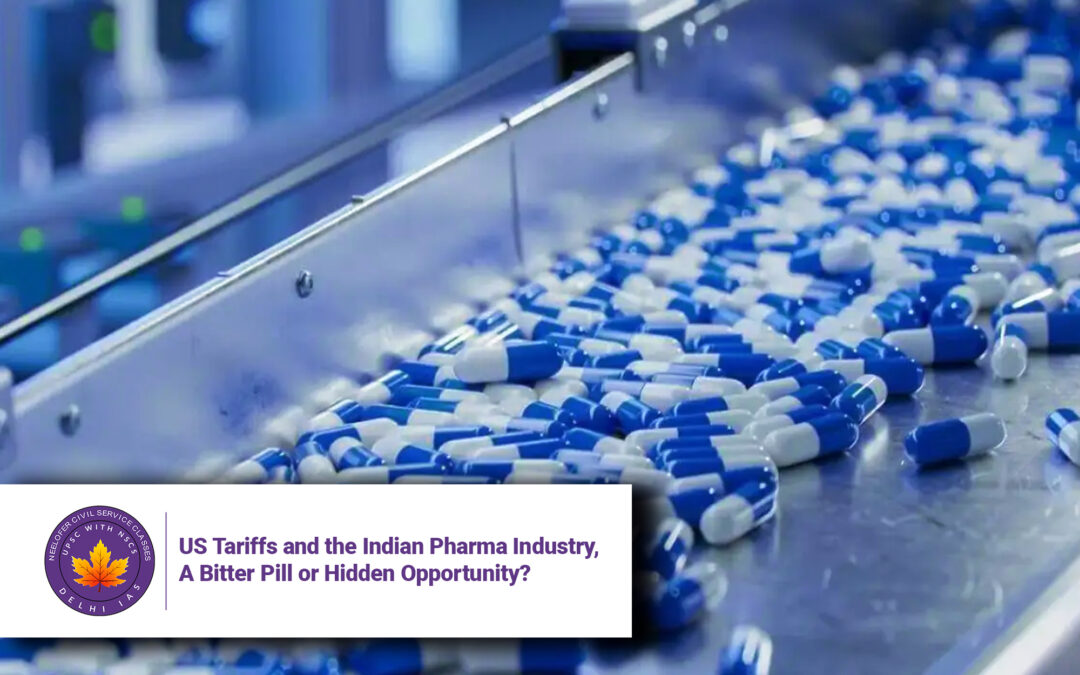
US Tariffs and the Indian Pharma Industry, A Bitter Pill or Hidden Opportunity?
Why in News?
Amid escalating trade tensions between the US and China, former US President Donald Trump’s proposed tariff hikes on several imports — potentially including pharmaceuticals — have sparked debate. A recent article explores how these tariffs could impact Indian pharmaceutical exports and the global generic drug supply chain. 
Introduction
The US is India’s largest export destination for pharmaceuticals, accounting for roughly one-third of India’s total pharma exports. India primarily supplies the US with low-cost generic medicines, making it a critical player in America’s healthcare affordability. The current discussion revolves around whether tariff hikes on imports will affect this relationship — especially given the US’s heavy dependence on Indian pharma products.
Key Issues & Insights
-
US Dependency on Indian Generics
India’s pharma exports to the US mostly consist of low-cost generic medicines. These have high price elasticity, meaning demand may not significantly reduce even if tariffs raise prices slightly. -
Limited Tariff Pass-Through
Tariff increases may not easily translate to higher consumer prices due to the way international trade operates, especially when it comes to intermediate goods like pharmaceutical ingredients or drugs already priced very low. -
Supply Chain Shifts Due to API Dependence on China
India imports a significant portion of its Active Pharmaceutical Ingredients (APIs) from China. Higher US tariffs on Chinese APIs could disrupt the cost structure for Indian exporters, but might also encourage domestic production, reducing long-term dependence on China. -
Tariffs Could Raise US Drug Prices
As US manufacturers source many drugs or components from abroad, tariffs could increase production costs, making healthcare more expensive domestically. Ironically, this might reinforce demand for cheaper Indian alternatives. -
Opportunity Through India’s PLI Scheme
India’s Production Linked Incentive (PLI) scheme could benefit from global trade reshuffling. Indian pharma companies may become more competitive as US importers look for non-Chinese, cost-effective partners.
Five Key Takeaways
-
Tariffs on Indian pharma are unlikely to drastically reduce US demand due to cost-effectiveness and necessity of medicines.
-
India’s heavy reliance on Chinese APIs makes its pharma exports vulnerable to trade tensions between the US and China.
-
Any price hike in US-manufactured drugs due to tariffs could strengthen India’s position as a low-cost generic supplier.
-
India can seize this moment to boost domestic API production through the PLI scheme and reduce its China dependency.
-
The impact on Indian pharma is expected to be limited in the short term and potentially positive in the long term.
Challenges and the Way Forward
-
Challenges:
-
Overdependence on Chinese APIs.
-
Potential for reduced price competitiveness if tariffs are too high.
-
Policy uncertainty in the US due to electoral cycles and political rhetoric.
-
-
Way Forward:
-
Strengthen domestic API manufacturing under the PLI scheme.
-
Diversify export markets to reduce dependence on the US alone.
-
Enhance bilateral trade dialogues with the US for pharma-specific carve-outs or exemptions.
-
Conclusion
While Trump-era tariff hikes may initially seem threatening to Indian pharma, they may have limited real impact due to the inelastic nature of drug demand and India’s dominant role in low-cost generics. Instead, they present India with an opportunity to restructure its supply chains, increase self-reliance in API production, and become an even more indispensable player in global healthcare.
Q&A Section
1. Why is the US heavily dependent on Indian pharmaceutical exports?
Because India provides a large share of low-cost, high-quality generic drugs, which are essential for making medicines affordable in the US healthcare system.
2. Will tariff hikes reduce US demand for Indian medicines?
Not significantly. Since these drugs are relatively inelastic goods (necessities), demand is unlikely to fall even with moderate price increases due to tariffs.
3. How does China factor into the situation?
India imports many Active Pharmaceutical Ingredients (APIs) from China. US tariffs on Chinese APIs can increase production costs for Indian pharma but also push India toward self-reliance.
4. What role does the Production Linked Incentive (PLI) scheme play?
The PLI scheme supports domestic API manufacturing and helps Indian companies reduce dependence on Chinese imports, making them more competitive globally.
5. Could higher tariffs in the US backfire domestically?
Yes. If drug manufacturing in the US becomes more expensive due to higher input costs, it could lead to higher healthcare prices, making imports from India even more necessary.

