
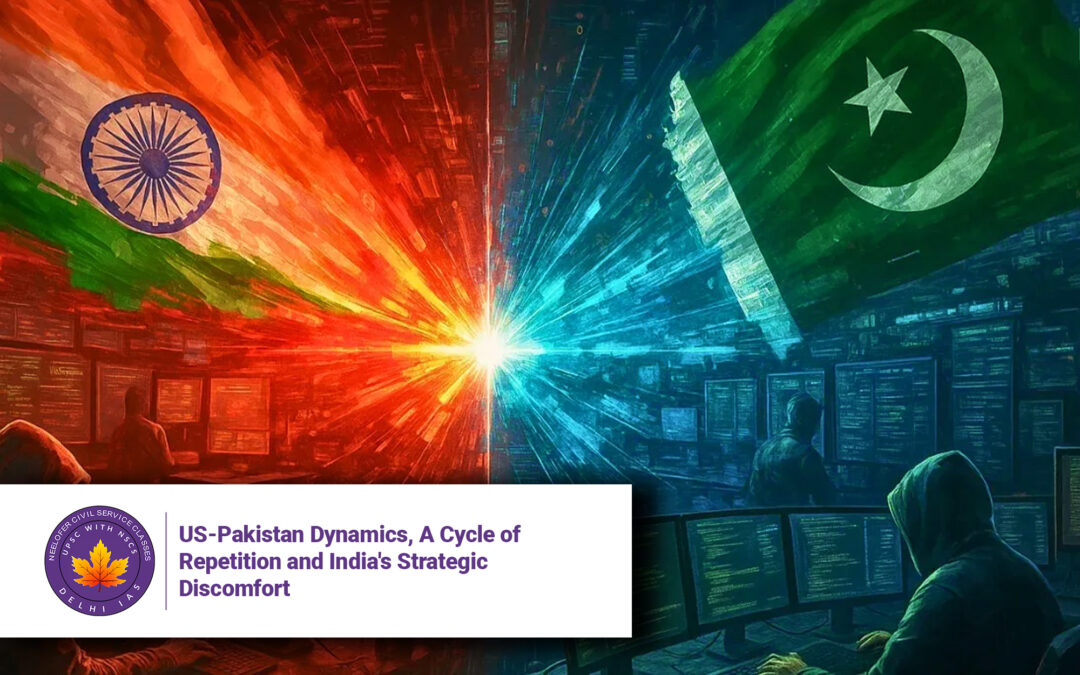
US-Pakistan Dynamics, A Cycle of Repetition and India’s Strategic Discomfort
Why in News?
The US once again played the role of last-minute peacemaker between India and Pakistan, prompting debate over Washington’s predictable pattern of engagement in South Asian conflicts and India’s growing frustration with American duplicity. 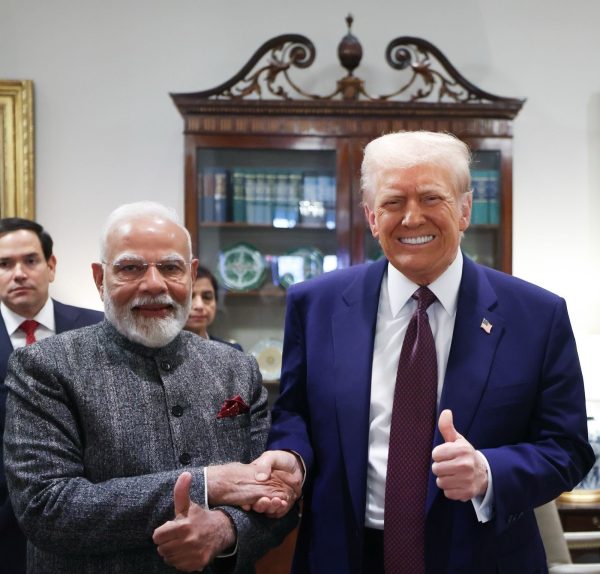
Introduction
The recent ceasefire agreement between India and Pakistan bore traces of a familiar narrative. Washington stepped in at the last moment, hailed its success in preventing war, and ignored deeper systemic problems like cross-border terrorism. For India, this event repeats a long-standing pattern: US intervention that protects its strategic partner Pakistan while undercutting India’s regional concerns.
Key Issues and Institutional Concerns
1. US Mediation: A Script Replayed
-
Former US President Trump’s intervention in a near-war situation between India and Pakistan echoed past instances where America projected itself as a “peace broker.”
-
American generals announced a de-escalation effort as a major achievement, deflecting from a potential nuclear standoff.
2. The “Do Your Thing” Strategy
-
Trump’s reported command—“If you won’t stop it, we’re going to do it our way”—forced Pakistan to back down.
-
Though hailed in the West, this approach largely served US optics and political interests while ignoring India’s underlying security concerns.
3. America’s Tactical, Not Strategic, Focus
-
Experts cited US indifference to India’s core concern: terrorism originating from Pakistan.
-
US engagement often helps de-escalate tensions but does little to ensure long-term accountability for Pakistan’s actions.
4. India’s Diplomatic Dilemma
-
Statements by Indian leaders, including PM Modi, make it clear: India will not engage Pakistan until cross-border terrorism ends.
-
Despite repeated betrayals, the US still views India-Pakistan through a Cold War lens—ignoring India’s growing economic and strategic clout.
5. Domestic Politics and Optics
-
The timing of ceasefire announcements often coincides with US political cycles or diplomatic strategies.
-
For example, Trump gained politically with his base by “saving the world,” while India had to manage the ground-level reality of border skirmishes and proxy attacks.
Conclusion
India’s frustration with the US’s cyclical engagement with Pakistan is deepening. As America continues to downplay terrorism and focuses on short-term diplomatic optics, India must navigate this geopolitically sensitive terrain with a clear red line: no dialogue without accountability. While US support is important, India is increasingly prepared to act unilaterally in defense of its interests.
Q&A Section
Q1. What prompted this editorial?
A ceasefire between India and Pakistan, with behind-the-scenes mediation by the US, sparked this critique of Washington’s repeated and superficial role in South Asian diplomacy.
Q2. Why is India frustrated with the US?
Because the US often ignores terrorism originating from Pakistan, focusing instead on symbolic peace deals that benefit American optics more than Indian security.
Q3. How does the US gain from such interventions?
It enhances its global image as a peace broker, wins diplomatic praise, and deflects attention from its own strategic indecision in South Asia.
Q4. What is India’s stated position on talks with Pakistan?
India has made it clear that talks will only resume if Pakistan stops supporting cross-border terrorism, especially in Jammu & Kashmir.
Q5. How has the US administration responded?
The Biden administration, like previous ones, shows limited interest in holding Pakistan accountable and lacks a coherent South Asia policy focused on India’s security concerns.

