
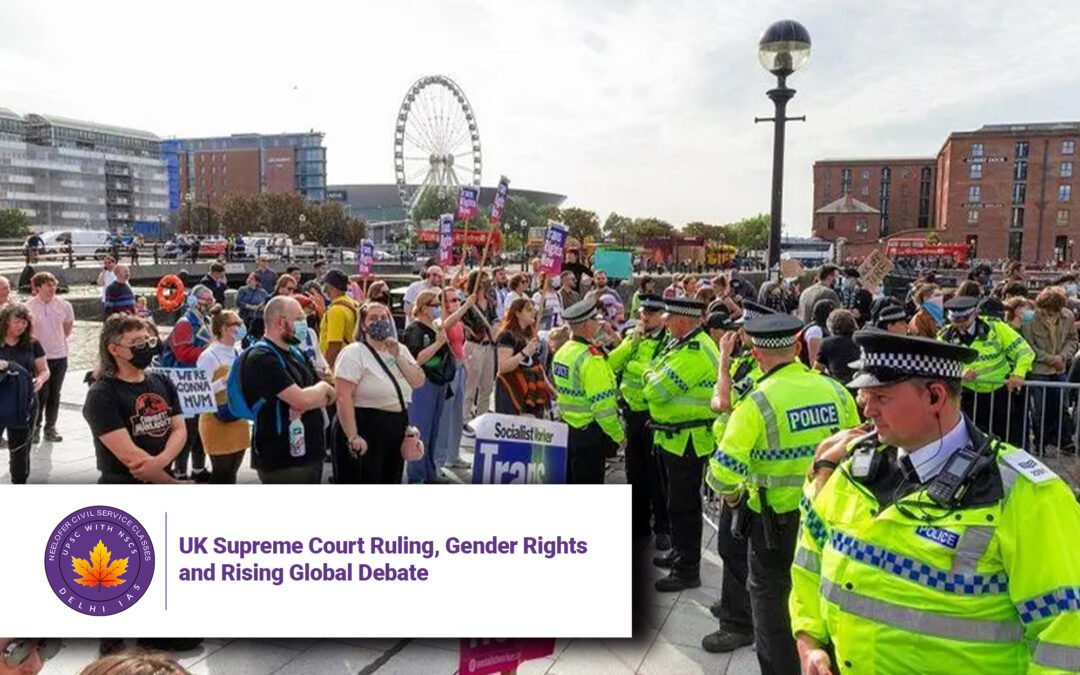
UK Supreme Court Ruling, Gender Rights and Rising Global Debate
Introduction
In a time of intensifying debates over gender rights, the U.K. Supreme Court has issued a major ruling that has further polarized opinions. At the center of the controversy is the legal definition of a “woman” and “sex” under Britain’s Equality Act 2010, especially concerning the rights of transgender individuals.
Key Highlights
-
In an 88-page judgment, five Supreme Court judges unanimously ruled that the terms “woman” and “sex” under the Equality Act 2010 refer only to a biological woman and biological sex.
-
A transwoman — even with a gender reassignment and certificate — would not be treated as a biological woman for certain legal protections.
-
The case was brought by For Women Scotland, an organization partly supported by gender-critical voices like J.K. Rowling.
-
While supporters of the verdict celebrated it as a win for “biological clarity,” many trans rights activists criticized it as a setback for inclusion.
Background and Context
-
The Scottish government had earlier pushed reforms to allow gender recognition certificates to offer trans people the same rights as biological women. However, backlash intensified after a transwoman, convicted of rape when identifying as a man, was sent to a women’s prison.
-
The resignation of Scottish First Minister Nicola Sturgeon in 2023 was partly attributed to these gender law reforms.
Implications of the Judgment
-
The Gender Recognition Act 2004 still grants legal recognition to transgender individuals for marriage, pensions, retirement, and social security.
-
However, under the new clarity, only biological women can use women’s single-sex spaces such as changing rooms, toilets, hospital wards, and women-only sports.
-
The Equality and Human Rights Commission (EHRC) emphasized that institutions must also create unisex or neutral spaces to accommodate trans people.
-
This ruling could impact areas like athletics, cycling, aquatics, and broader public planning in institutions such as offices, hospitals, and schools.
Conclusion
The U.K. Supreme Court’s ruling marks a significant shift towards defining legal rights around biological sex, affecting transgender individuals’ access to certain spaces. While some celebrate it as legal clarity, it highlights the urgent need for careful, inclusive planning to ensure the rights and dignity of all groups are protected in a polarized society.
5 Important Q&A
Q1: What did the UK Supreme Court rule about the definition of ‘woman’ under the Equality Act 2010?
A: The court ruled that ‘woman’ and ‘sex’ refer only to biological women and biological sex, not to transwomen even if they have a gender recognition certificate.
Q2: Who celebrated the verdict, and why?
A: For Women Scotland and supporters like J.K. Rowling celebrated it as a victory for “biological clarity” and women’s rights.
Q3: What are some areas affected by this ruling?
A: Women-only toilets, hospital wards, changing rooms, and sporting events, which are now restricted to biological women.
Q4: What protections do transgender people still have under UK law?
A: They retain legal rights related to marriage, pensions, retirement, and protection from discrimination under the Gender Recognition Act 2004.
Q5: What additional steps did the EHRC suggest after the ruling?
A: The EHRC recommended that institutions also create unisex or neutral spaces to ensure trans people have access to necessary facilities.

