
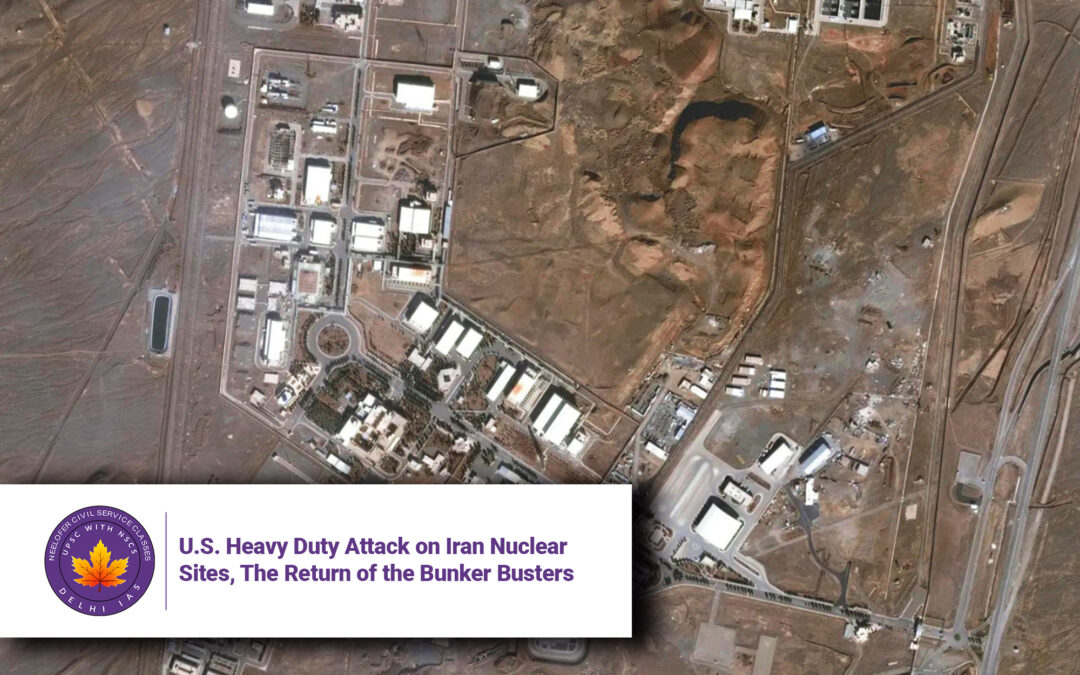
U.S. Heavy Duty Attack on Iran Nuclear Sites, The Return of the Bunker Busters
Why in News?
On January 12, 2024, U.S. President Donald Trump confirmed a high-stakes military strike targeting key Iranian nuclear facilities located in Fordow, Natanz, and Isfahan. The strikes included the use of Massive Ordnance Penetrator (MOP) “bunker buster” bombs, dropped by B-2 Spirit stealth bombers. The attacks aimed at destroying underground enrichment facilities suspected of nearing weapons-grade uranium capability. 
Introduction
The strike on Iran marks a significant moment in military tactics and geopolitics. The Fordow nuclear enrichment site, buried deep in a mountain, presented a particularly difficult target due to its hardened underground structure. This necessitated the use of the GBU-57 MOP—an advanced, deep-penetration bomb weighing approximately 13,600 kg, designed specifically to destroy fortified subterranean structures.
This marks the first known operational use of the GBU-57 since its development, signaling a renewed focus on deep-strike capabilities and deterrence strategies amid rising tensions in the Middle East.
Key Issues and Institutional Concerns
1. Why the B-2 and the MOP Were Deployed
The GBU-57 MOP is one of the most powerful conventional weapons in the U.S. arsenal. Released from high altitude, it is GPS-guided and capable of penetrating up to 60 meters of reinforced concrete before detonation. The B-2 Spirit stealth bomber, with its low radar signature and ability to avoid sophisticated Iranian air defenses, was the only aircraft capable of delivering the MOP.
2. Strategic Targeting of Fordow
The Fordow facility is estimated to be buried over 80 meters underground. Its strategic importance is elevated by its use for uranium enrichment—potentially weapons-grade. U.S. intelligence assessed that Fordow, if left intact, could soon surpass agreed enrichment limits under defunct nuclear deals.
3. Maintenance Challenges of the B-2
The B-2 stealth bomber is known to be extremely maintenance-intensive, requiring climate-controlled hangars and significant upkeep to preserve its stealth coating. As per 2020 Congressional Budget Office reports, the cost per flight hour exceeded $150,000. Only 20 aircraft exist in the fleet, and 19 remain operational.
4. Impact of the Strike
Reports suggest that the facility at Fordow was not fully destroyed but significantly damaged, disabling its centrifuge capabilities and delaying enrichment operations. However, Iranian state media called the operation a “provocation” and vowed a “measured response.”
5. Signals of a Changing Military Doctrine
The U.S. has demonstrated a renewed emphasis on long-range precision attacks, reduced troop footprints, and reliance on next-generation weapons like hypersonics and bunker busters. Northrop Grumman is reportedly working on a new stealth bomber—the B-21 Raider—to eventually replace the B-2 by 2040.
Challenges and the Way Forward
-
Geopolitical Fallout: The strike may derail ongoing diplomatic efforts to restore the Iran Nuclear Deal (JCPOA). It has already strained relations with NATO partners and regional actors like Turkey and Qatar.
-
Technological Dependence: Reliance on aging but effective platforms like the B-2 highlights the need for modernization. Programs like the B-21 aim to address future capability gaps.
-
Global Nuclear Policy: This incident underscores the fragility of nuclear non-proliferation agreements. Greater multilateral engagement and modernization of diplomatic frameworks are required to prevent escalation.
Conclusion
The U.S. airstrike on Iran’s hardened nuclear sites using B-2 stealth bombers and MOP bunker busters underscores a high-tech, low-footprint approach to deterrence. While tactically successful in delaying Iran’s nuclear trajectory, the strike has reignited debates on sovereignty, military overreach, and global nuclear stability. As the U.S. signals its intent to maintain military supremacy through technology, the world watches anxiously.
Q&A Section
1. What weapon was used by the U.S. to target Iran’s Fordow site?
The GBU-57 Massive Ordnance Penetrator (MOP), a 13,600 kg bunker buster capable of destroying deeply buried targets.
2. Why was the B-2 Spirit used for this operation?
Its stealth capabilities and long-range allow it to avoid enemy radar and deliver precision strikes undetected.
3. Was the Fordow facility completely destroyed?
No. Reports suggest it was severely damaged but not destroyed, enough to disable enrichment operations temporarily.
4. What are the maintenance challenges of the B-2 bomber?
It requires climate-controlled hangars, high upkeep, and has extremely high operating costs, limiting its availability.
5. Is the U.S. building new stealth bombers?
Yes. Northrop Grumman is developing the B-21 Raider to replace the B-2 fleet starting by 2030.

