
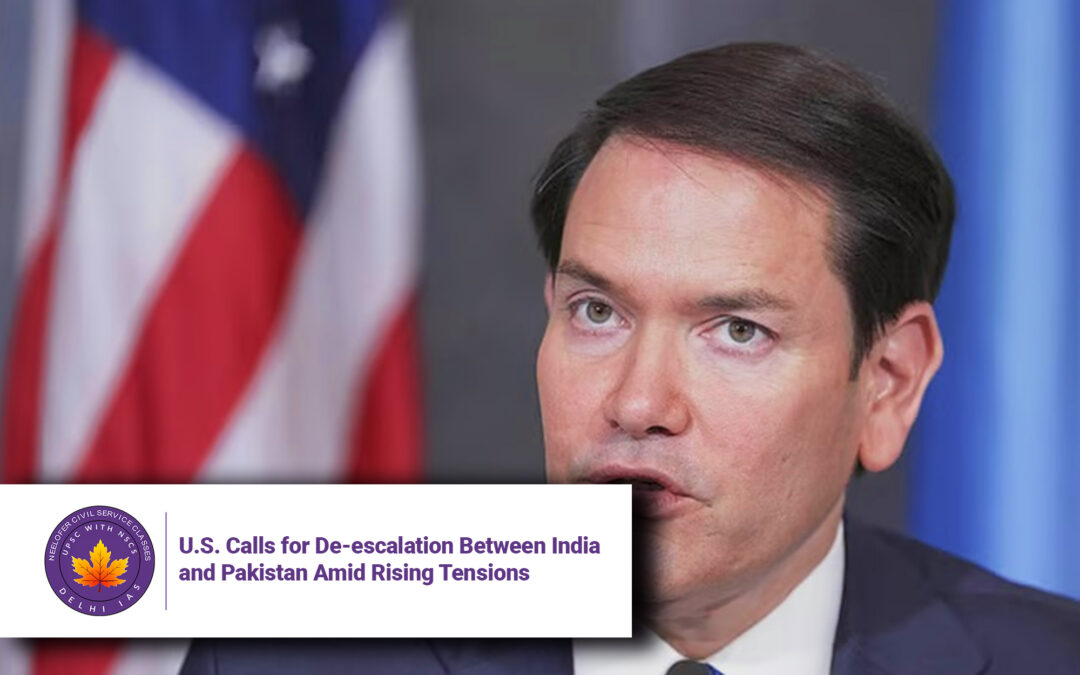
U.S. Calls for De-escalation Between India and Pakistan Amid Rising Tensions
Why in News?
Amid escalating tensions following the Pulwama terror attack, the United States has called upon both India and Pakistan to exercise restraint and avoid further conflict, urging both nations to de-escalate the situation diplomatically.
Introduction
The diplomatic spotlight has once again turned to South Asia as India and Pakistan face a tense standoff in the aftermath of the Pulwama terror attack. The U.S. government, expressing concern over potential military escalation, has urged both nations to engage in dialogue and avoid provocative actions.
Key Issues and Background
1. U.S. Diplomatic Outreach
U.S. State Department spokesperson Robert Palladino confirmed that Washington has been in contact with both New Delhi and Islamabad, encouraging both sides to avoid any further deterioration in the situation. The statement called for de-escalation and urged constructive dialogue.
2. Senator Marco Rubio’s Role
U.S. Senator Marco Rubio reached out to Pakistani Prime Minister Shehbaz Sharif via a telephone call, in which the senator emphasized the need for Pakistan to act responsibly and curb escalation. According to reports, Rubio was expected to address U.S. concerns regarding security and stability in the region during his engagements.
3. Pakistan’s Response
Prime Minister Sharif responded by accusing India of “escalatory and provocative behavior.” According to his office, he briefed Rubio on Pakistan’s version of events and expressed concern about India’s intentions.
4. Threat of Retaliation
In a bold statement, Pakistan’s Information Minister Ataullah Tarar claimed the country had credible intelligence that India was preparing for a retaliatory military strike within the next 36 hours. This has heightened fears of direct conflict between the two nuclear-armed neighbors.
The Core of the Concern
With both nations blaming each other for rising hostilities and Pakistan issuing warnings of military retaliation, the international community is increasingly concerned about the risk of conflict spiraling out of control.
Key Observations
-
The U.S. has maintained a neutral but firm tone, emphasizing dialogue and peace.
-
India has not officially responded to Pakistan’s claim of a planned strike.
-
The region remains volatile, and international mediation is being considered as a preventive step.
Conclusion
The situation between India and Pakistan remains fragile. The U.S. intervention highlights the seriousness of the crisis and the urgent need for restraint, diplomacy, and peaceful resolution. As both nations face pressure from global powers, the coming days will be crucial in determining whether diplomacy or confrontation prevails.
5 Questions and Answers
Q1. What prompted the U.S. to call for de-escalation between India and Pakistan?
Answer: Rising tensions after the Pulwama terror attack.
Q2. Who from the U.S. government contacted Pakistan regarding the situation?
Answer: U.S. Senator Marco Rubio.
Q3. What was Pakistan’s accusation against India?
Answer: Pakistan accused India of “escalatory and provocative behavior.”
Q4. What claim did Pakistan’s Information Minister make?
Answer: He claimed that India was planning a military strike within the next 36 hours.
Q5. What is the stance of the U.S. on the issue?
Answer: The U.S. has urged both nations to avoid escalation, act responsibly, and resolve the matter diplomatically.

