
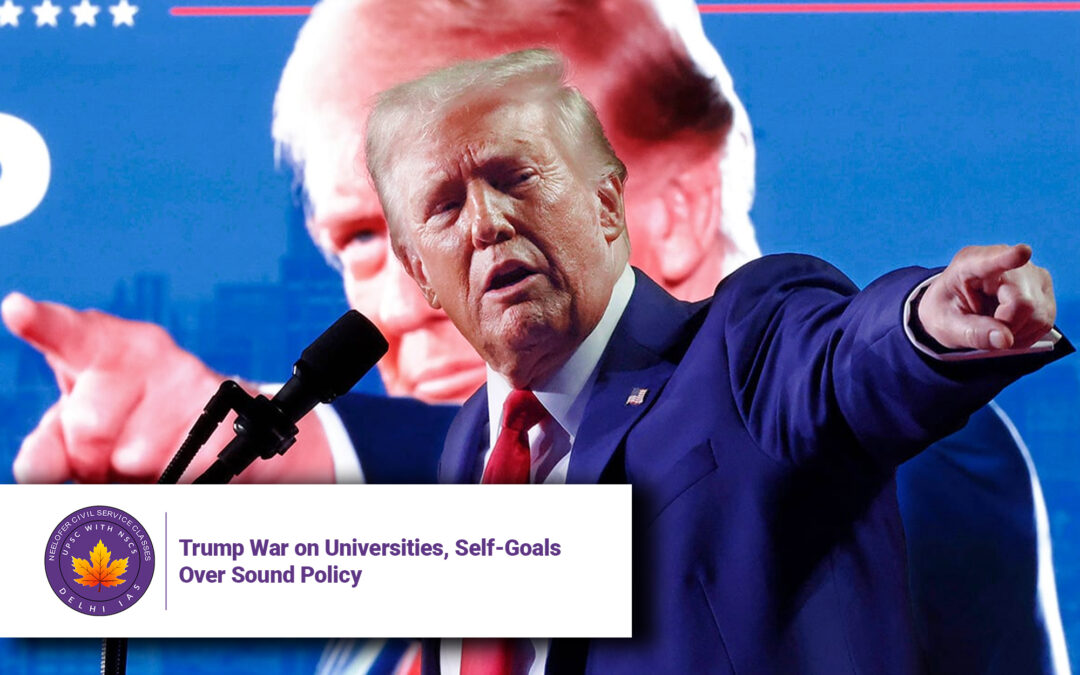
Trump War on Universities, Self-Goals Over Sound Policy
Why in News?
Former President Donald Trump’s recent campaign attacks against Harvard and other elite U.S. universities have sparked national debate. His rhetoric against these institutions reflects deeper political motivations rather than concrete policy goals. 
Introduction
Donald Trump’s crusade against prestigious American universities, particularly Harvard, marks a continuation of his long-standing culture war. The aim, critics say, is not to reform but to punish institutions perceived as liberal strongholds. This has raised serious concerns about academic freedom, institutional autonomy, and the politicization of education.
Key Issues and Background
Targeting Harvard Over Israel-Palestine Protests
-
Trump has criticized Harvard for how it handled student protests regarding the Israel-Gaza conflict.
-
The administration previously demanded Harvard revoke student visas of pro-Palestinian demonstrators.
-
Harvard refused, citing legal obligations and the need for evidence of law-breaking.
Financial and Legal Threats to Universities
-
The Trump administration issued a list of demands to Harvard, most notably to return $300 million of its endowment.
-
Critics see this as a punitive move based on ideological reasons rather than any financial wrongdoing.
Pattern of Attacks
-
This is not an isolated incident. Trump has targeted other elite universities like Columbia, Yale, and Penn.
-
Attacks are largely political, aiming to paint universities as elitist and “un-American.”
-
His previous administration attempted to restrict Chinese student visas and ban diversity training.
The Core of the Concern
The editorial argues that Trump’s war on universities is not about reform or policy—it’s about punishing institutions that do not align with his political views. This vendetta threatens freedom of expression, especially as universities are centers for research, debate, and dissent.
Key Observations
-
Harvard’s Global Standing: Harvard is one of the most globally recognized educational institutions. Weakening its influence could harm U.S. educational prestige internationally.
-
Anti-Intellectual Populism: Trump’s attacks reflect a broader anti-intellectual agenda aimed at rallying his political base rather than solving real problems.
-
Rhetoric Over Reality: The policies and threats posed do not appear to serve any national interest but aim to intimidate.
-
Danger to Democracy: Weakening higher education institutions undermines one of democracy’s pillars—free thought and informed debate.
Conclusion
Trump’s attacks on elite educational institutions like Harvard serve no practical purpose. They do not enhance American competitiveness or solve systemic issues. Instead, they are ideological weapons aimed at punishing dissent and rallying political support. As the U.S. navigates polarized politics, the autonomy and freedom of universities must be protected to preserve democratic values and innovation.
Q&A Section
-
Why is Donald Trump targeting universities like Harvard?
He sees them as liberal institutions that oppose his ideology and wants to punish them for perceived political bias. -
What triggered the latest attacks?
Harvard’s handling of student protests regarding the Israel-Gaza conflict and refusal to revoke visas of student protesters. -
What were the administration’s demands?
Return of $300 million in endowments and other punitive financial measures. -
Is there any policy benefit from these actions?
No. The article argues that these are self-serving political moves, not aimed at solving any national issues. -
What’s the risk of such attacks on academia?
It endangers free speech, academic independence, and weakens U.S. higher education on a global scale.

