
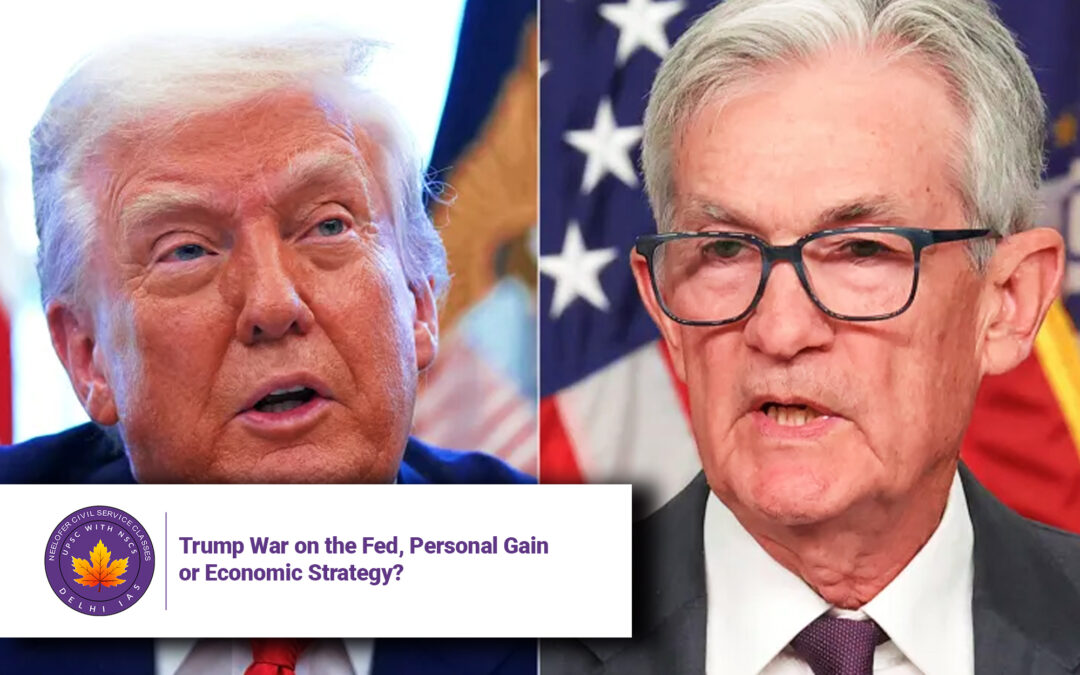
Trump War on the Fed, Personal Gain or Economic Strategy?
Why in News
Former U.S. President Donald Trump has recently intensified his public criticism of Federal Reserve Chair Jerome Powell. Despite Powell’s term lasting until May 2026, Trump drafted a letter seeking his removal and demanded a 300 basis point rate cut. These actions have raised concerns over the politicisation of central bank independence and sparked debates over the true motivations behind Trump’s attacks on the Fed.
Introduction
Monetary policy in the U.S. has traditionally operated independently of political whims. However, Donald Trump’s persistent and pointed critiques of the Federal Reserve, especially of its chair Jerome Powell, challenge this foundation. His demand for sharply lower interest rates — often contradicting economic logic — has led to speculation that such calls are motivated more by personal political gain than economic necessity.
Key Issues and Background
Trump vs. Powell: A Pattern of Pressure
-
Trump’s attacks on Powell date back to his presidency and have continued even after leaving office.
-
Despite the Fed’s legal insulation from political interference under the 1913 Federal Reserve Act, Trump’s rhetoric attempts to publicly pressure the central bank to act in his interest.
The Politicisation of the Fed
-
Historically, U.S. presidents avoid commenting on Fed decisions to maintain credibility and stability.
-
Trump, breaking with tradition, frequently used social media and public platforms to criticise Fed policy, especially during the run-up to elections.
-
On 129 occasions between January 2018 and June 2025, Trump criticised the Fed, mostly for keeping interest rates “too high.”
Specific Impacts or Effects
Public Confidence and Market Reactions
-
Constant presidential pressure undermines trust in the Fed’s independence.
-
Market volatility can increase when investors perceive that central banks are influenced by political actors.
The “Trump Rule” for Monetary Policy
-
Unlike the Taylor Rule used by most central bankers, Trump seems to follow no economic formula.
-
His demands for lower interest rates appear driven by self-interest, particularly during election cycles.
Research Insights: Is Trump Self-Serving?
-
Economist Jeffrey Frankel and research collaborator Shoib Nasir used regression models to test whether Trump’s critiques were politically motivated.
-
Using both linear probability (OLS) and Firth’s penalised logistic regression models, they found a high correlation between Trump’s Fed critiques and periods when he was in office.
-
The key finding: whether Trump is in office explains 76% of the variation in his criticisms — far outweighing any macroeconomic factors like inflation or unemployment.
Challenges and the Way Forward
For U.S. Institutions
-
Reaffirming the Federal Reserve’s independence is crucial.
-
Legal safeguards must be supported by political restraint — something increasingly absent in Trump’s playbook.
For Future Presidents
-
Political leaders must resist using monetary policy for electoral advantage.
-
Encouraging transparency in economic decision-making and reducing public pressure on technocrats should be a norm.
Conclusion
In Trump’s world, monetary policy follows no rulebook — only a demand for lower rates when it benefits him. The empirical evidence is clear: Trump’s criticism of the Fed is largely self-serving, aimed at short-term political gains. This undermines decades of institutional wisdom that prioritises stable, inflation-targeted monetary policy. As 2026 approaches and the Powell era nears its end, preserving the Fed’s autonomy has never been more important.
5 Questions and Answers
-
Why has Trump criticised Fed Chair Jerome Powell?
Trump believes Powell has kept interest rates too high and has demanded large rate cuts, possibly for personal political gain. -
What is the main finding of the research by Frankel and Nasir?
Trump’s status as president explains 76% of the variation in his Fed critiques, suggesting his criticisms are politically motivated. -
What is the Taylor Rule, and how does it contrast with Trump’s approach?
The Taylor Rule provides a systematic formula for setting interest rates based on inflation and output. Trump appears to have no such economic basis and pushes for lower rates at his convenience. -
What dangers arise from politicising the Fed?
It undermines trust, increases market volatility, and erodes the institution’s ability to manage inflation and ensure economic stability. -
What safeguards exist to protect the Fed from political interference?
The Federal Reserve Act of 1913 grants the Fed operational independence, and traditionally, U.S. presidents refrain from public comment on Fed decisions.

