
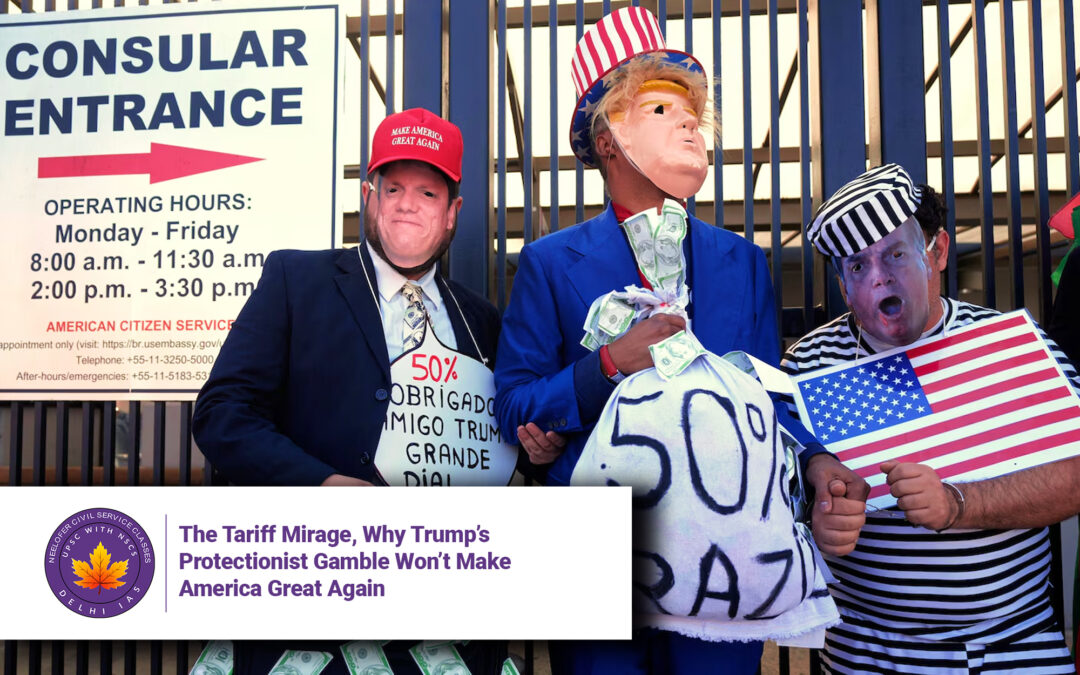
The Tariff Mirage, Why Trump’s Protectionist Gamble Won’t Make America Great Again
Introduction
In his relentless pursuit of “America First” economics, former President Donald Trump has doubled down on reciprocal tariffs, imposing steep trade barriers on imports from China, India, and other nations. His argument? That tariffs will revive U.S. manufacturing, create millions of jobs, and restore American industrial dominance.
But does the math actually add up?
A closer examination reveals a flawed economic experiment—one that benefits political rhetoric more than American workers. Historical data, wage disparities, and global supply chain realities suggest that Trump’s tariff strategy is doomed to fail, hurting U.S. consumers, exacerbating inflation, and failing to bring back low-wage manufacturing jobs.
This article explores:
-
The economic fallacy behind Trump’s tariff policy
-
Why U.S. wages make reshoring low-tech jobs impossible
-
How China’s manufacturing scale still dominates
-
The hidden costs for American consumers
-
What this means for global trade wars and inflation
Why in News?
-
Trump enforces new “reciprocal tariffs”, targeting imports from China, India, and others.
-
Claims it will “rebuild American greatness” by reviving manufacturing jobs.
-
Reality check:
-
2018 tariffs on China failed to boost U.S. employment (Brookings study).
-
China’s retaliatory tariffs hurt U.S. exporters (soybeans, automobiles).
-
U.S. consumers pay the price via higher costs on electronics, medicines, and cars.
-
-
Global wage gap:
-
U.S. minimum wage ($7.25/hr) vs. China ($374/month), India ($277/month), Vietnam ($189/month).
-
Reshoring low-tech jobs (textiles, shoes) is economically unviable.
-
Key Issues and Analysis
1. The Myth of Tariff-Driven Job Creation
Trump’s Promise:
-
“New American industrialism will create millions of jobs.”
Reality:
-
2018 tariffs on steel and aluminum did not increase U.S. manufacturing employment (Brookings Institution).
-
China’s retaliatory tariffs cost 245,000 U.S. jobs (U.S. Chamber of Commerce).
-
Automation means fewer jobs even if production returns (e.g., Foxconn’s Wisconsin plant).
Why Tariffs Fail to Reshore Jobs:
-
Labor cost disparity:
-
U.S. worker: $1,160/month (federal minimum) vs. Vietnamese worker: $189/month.
-
Jeans stitched in Bangladesh for $0.22/hr vs. $15/hr in the U.S.
-
-
Supply chain dependencies:
-
Apple still makes 95% of iPhones in China despite Trump’s push.
-
Corning produces glass in Kentucky but relies on 21 Chinese plants for global supply.
-
2. China’s Unbeatable Manufacturing Advantage
Scale & Efficiency:
-
China produces 80% of the world’s solar panels, 70% of lithium batteries, 50% of EVs.
-
Foxconn’s Zhengzhou factory makes 500,000 iPhones/day—no U.S. plant can match this.
Why Tariffs Can’t Break China’s Dominance:
-
Decades of infrastructure investment (ports, highways, power grids).
-
Skilled labor at 1/5th U.S. wages.
-
Complete supply chain ecosystems (batteries, semiconductors, textiles all in one region).
Case Study: Apple’s “Made in USA” Failure
-
Trump touted Apple’s Texas Mac Pro plant as a success.
-
Reality: Only final assembly happens in the U.S.; all parts are imported from China.
3. The Hidden Cost: Inflation & Consumer Pain
Tariffs = Tax on U.S. Consumers
-
25% tariff on Chinese goods → 10-15% price hike on electronics, appliances.
-
India’s retaliatory tariffs on U.S. apples, almonds hurt farmers.
Inflation Risks:
-
If India stops buying Russian oil (as Trump demands), oil prices could spike.
-
U.S. inflation, already at 3.4%, may worsen.
Who Really Pays?
-
Low-income Americans (higher prices for essentials).
-
Small businesses (costlier imported materials).
4. The Geopolitical Fallout: Trade Wars Without Winners
Trump’s Ultimatums Backfire:
-
Demanding India cut Russian oil imports risks $118B trade relationship.
-
EU retaliated with tariffs on Harley-Davidson, bourbon in 2018.
Global Supply Chain Shifts:
-
Companies aren’t returning to U.S.—they’re moving to Vietnam, Mexico, India.
-
Biden’s CHIPS Act lured semiconductor plants, but most advanced chips still made in Taiwan.
The Way Forward: A Smarter Trade Policy
1. Accept Reality: Low-Tech Jobs Aren’t Coming Back
-
Focus on high-value manufacturing (semiconductors, aerospace, AI).
-
Invest in workforce upskilling, not protectionism.
2. Negotiate Better Trade Deals, Not Tariffs
-
Leverage U.S. market access for fairer terms.
-
Example: USMCA improved auto rules but didn’t spark mass reshoring.
3. Reduce Dependency on China—But Gradually
-
Incentivize production in friendly nations (India, Vietnam, Mexico).
-
Build strategic reserves for critical goods (rare earths, pharma APIs).
4. Prepare for Inflation Mitigation
-
Release oil reserves if energy prices spike.
-
Subsidize essential goods (medicines, food) during trade shocks.
Conclusion: Trump’s Tariffs Are a Political Stunt, Not an Economic Strategy
The numbers don’t lie:
-
Tariffs didn’t bring back jobs in 2018.
-
U.S. wages make low-tech manufacturing uncompetitive.
-
Consumers pay the price via inflation.
Instead of nostalgic protectionism, America needs forward-looking industrial policy:
✔ Invest in automation and AI to compete globally.
✔ Strengthen alliances to counter China, not alienate them.
✔ Accept that the future of work is in tech, not textiles.
Trump’s tariffs may win votes, but they won’t make America great again—just more expensive.
5 Key Questions & Answers
Q1: Did Trump’s 2018 tariffs bring back manufacturing jobs?
A1: No. Studies show no net job gains in protected sectors.
Q2: Why can’t the U.S. compete with China on low-cost manufacturing?
A2: U.S. wages are 10-20x higher, and China has decades of infrastructure advantage.
Q3: Who pays for Trump’s tariffs?
A3: American consumers via higher prices on electronics, clothes, and cars.
Q4: Are companies leaving China because of tariffs?
A4: Some are shifting to Vietnam/Mexico, but most stay due to China’s supply chain dominance.
Q5: What’s a better alternative to tariffs?
A5: Trade deals that open foreign markets to U.S. tech & services, not punitive tariffs.

