
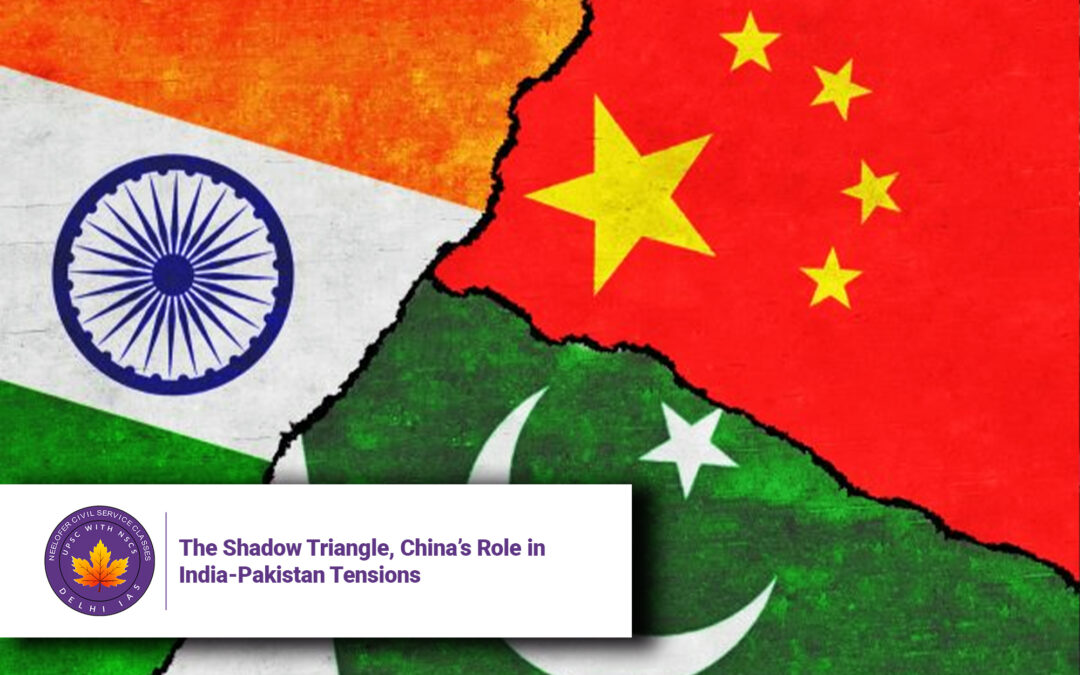
The Shadow Triangle, China’s Role in India-Pakistan Tensions
Why in News?
The latest India-Pakistan hostilities have renewed focus on South Asia’s fragile security dynamics. What’s structurally different this time is China’s embedded role, reshaping strategic equations and giving rise to a new triangular contest in the region.

Introduction
Tensions between India and Pakistan have long been viewed through a bilateral lens. However, with China’s growing strategic involvement in Pakistan and the region, the conflict now reflects a broader trilateral dimension—with India, Pakistan, and China forming a new shadow triangle of influence, confrontation, and competition.
Key Issues and Background
Shift in U.S. Strategic Focus
-
The U.S. no longer acts as a consistent crisis manager in South Asia.
-
It now views India as a strategic partner in the Indo-Pacific rather than an equidistant mediator.
-
This shift has left India to manage confrontations without reliable third-party de-escalation support.
China’s Expanding Role in Pakistan
-
China has become deeply integrated into Pakistan’s military, technological, and economic structures, including:
-
CPEC (China-Pakistan Economic Corridor)
-
Joint development of weapons systems
-
Technology transfers in defense and surveillance
-
India’s Strategic Challenges
-
India must now manage crises on two fronts: one with Pakistan and another with China.
-
The traditional framework of conflict resolution is eroding, as diplomatic space shrinks and escalation ladders shorten.
The Core of the Concern
-
The “hyphenation” of India-Pakistan relations is reappearing, where global actors again view India and Pakistan in a linked framework.
-
This undermines India’s long-term strategy of dehyphenation—being viewed independently on the global stage.
-
India is now challenged by a two-front risk: direct conflict with Pakistan and the possibility of Chinese involvement or signaling during such crises.
Key Observations
-
China’s role introduces strategic opacity—it is a rule-based power in trade but a revisionist actor in geopolitics.
-
The US’s current stance, although aligned with India, remains restrained, often marked by delayed or ambiguous responses in times of active confrontation.
-
The recent activation of the Advanced HQ-9 air defense system by China in Pakistan signals deeper strategic planning and integrated war-readiness.
Conclusion
India must prepare for a world where triangular rivalries are the new norm. The conflict spectrum in South Asia is now multi-layered, with China’s embedded role in Pakistan creating unpredictable outcomes. A clearer and more multilateral response strategy is essential to safeguard India’s long-term geopolitical interests.
5 Questions and Answers
Q1: What is the ‘shadow triangle’ referred to in the article?
It refers to the evolving strategic dynamic among India, Pakistan, and China, where China’s growing involvement in Pakistan creates a triangular contest.
Q2: Why is the U.S. no longer playing crisis manager in South Asia?
The U.S. now prioritizes its Indo-Pacific strategy and partnership with India, reducing its mediating role between India and Pakistan.
Q3: How is China involved in Pakistan’s strategic landscape?
Through military cooperation, infrastructure investment (CPEC), and joint defense programs including air defense and missile systems.
Q4: What does ‘hyphenation’ mean in this context?
It refers to the diplomatic trend of linking India and Pakistan as a single regional problem, rather than treating India as an independent global actor.
Q5: What is the biggest risk in the current scenario for India?
The simultaneous threat of conflict with Pakistan and the strategic ambiguity posed by China’s embedded role.

