
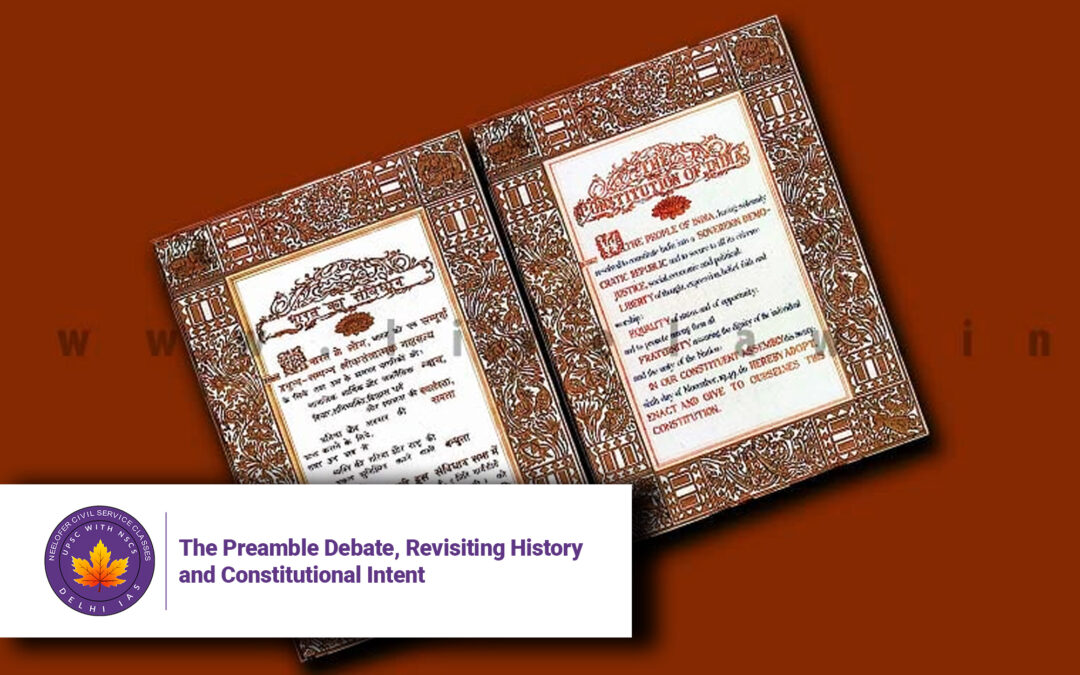
The Preamble Debate, Revisiting History and Constitutional Intent
Why in News?
The controversy over the inclusion and possible removal of the words “Socialist” and “Secular” from the Preamble of the Indian Constitution has once again taken center stage. This debate resurfaced after the Congress raised alarms over the Government’s alleged attempt to alter the Preamble by removing these two words, invoking concerns about the sanctity and foundational vision of the Constitution.
Introduction
The Indian Constitution’s Preamble serves as its ideological backbone, offering a snapshot of the values upon which the Republic is built. Among these, the terms “Socialist” and “Secular” have remained highly contentious. The recent uproar began with allegations that the ruling Government intends to alter the Preamble, removing these two words that were added during the Emergency in 1976 through the 42nd Constitutional Amendment. This has reignited a long-standing debate over whether the insertion of these terms was an authentic reflection of the constitutional spirit or an authoritarian imposition that contradicted the democratic ethos of India. 
This issue not only demands legal and historical scrutiny but also raises important political and moral questions about the future direction of India’s democracy.
Key Issues and Historical Context
-
Emergency and the 42nd Amendment
The terms “Socialist” and “Secular” were not part of the original Constitution adopted in 1950. They were inserted in 1976 during the Emergency imposed by Prime Minister Indira Gandhi, a period marked by authoritarianism, suspended civil liberties, and the absence of democratic processes. Critics argue that inserting these terms during such a time lacked democratic legitimacy. -
Ambedkar’s Original Vision and Caution
Dr. B.R. Ambedkar, a principal architect of the Constitution, warned against embedding specific ideological terms like socialism into the Constitution. He believed it would restrict flexibility and introduce dogmatism into governance. Instead, the Constituent Assembly chose ideological neutrality, allowing future governments the freedom to evolve with changing socio-economic contexts. -
Nehru and Ambedkar’s Approach to Secularism and Socialism
While both Nehru and Ambedkar accepted the values of socialism and secularism, they deliberately left them out of the Preamble. Their intent was not to enshrine ideological commitments but to uphold substance over symbolism. Nehru famously rejected the idea of doctrinaire socialism, while Ambedkar argued that religious and economic ideologies should be left to the political domain, not constitutional mandate. -
The Debate Over Ideological Neutrality
The inclusion of the terms in 1976 has been criticized for upsetting the ideological neutrality of the Constitution. Indian socialism, as per the amendment, emphasized state-led welfare programs and nationalization, a policy direction that saw limited success and economic stagnation. The liberalization reforms of the 1990s, which marked a shift away from state socialism, exposed the dissonance between constitutional wording and real policy direction. -
Political Expediency vs Democratic Ideals
Critics argue that the 42nd Amendment prioritized political expediency over democratic values. The amendment weakened judicial oversight and legislative checks and balances, reducing the space for civil liberty. By altering the foundational document of the Republic without wide public discourse, it undermined Ambedkar’s emphasis on transparent, participatory lawmaking.
Five Key Observations
-
The Terms Were Added, Not Original
“Socialist” and “Secular” were not included in the 1950 Preamble. Their addition in 1976 was not a natural evolution of constitutional thinking but a top-down imposition during an anti-democratic Emergency. -
Ambedkar Opposed Ideological Rigidity
Dr. Ambedkar explicitly argued against inserting ideological terms into the Constitution. He foresaw that such labels could restrict the flexibility required for a living document like the Constitution to respond to future needs. -
The Preamble Was Deliberately Kept Neutral
The Constituent Assembly consciously refrained from labeling the Republic with rigid ideological terms, thereby preserving the ideological neutrality that could adapt to different social and economic contexts. -
The 42nd Amendment Was Politically Motivated
The context of the Emergency, marked by suppression of civil liberties, censorship, and unilateral decision-making, delegitimizes the process through which the terms were added. -
Revisiting the Preamble Today Reflects a Larger Constitutional Question
The current debate is not merely about two words but about preserving the original spirit of constitutionalism. It asks whether the foundational values should be dictated by political ideologies or remain open and inclusive to change.
Challenges and the Way Forward
Challenge 1: Misinterpretation of Intent
The removal of the terms may be interpreted as a rejection of secularism and socialism as values, rather than as a restoration of constitutional neutrality. This risks political polarization and public confusion.
Challenge 2: Politicization of the Constitution
Turning constitutional amendments into political talking points can erode faith in the sanctity of the document. The Preamble should not be used as a battleground for party ideologies.
Challenge 3: Judicial Scrutiny and Legitimacy
Any changes to the Preamble must undergo strict judicial scrutiny to ensure that they don’t violate the “basic structure doctrine” laid down by the Supreme Court, which holds that the core principles of the Constitution cannot be amended.
Challenge 4: Ignoring the Spirit of the Constitution
The danger lies in reducing the Constitution to a document reflecting only temporary political trends, rather than enduring values that transcend governments.
Challenge 5: Lack of Public Discourse
Debates about constitutional amendments require broad public engagement and parliamentary discussion, not executive overreach or unilateral decisions. A comprehensive constitutional review may be warranted, but it must include participation from all stakeholders.
Conclusion
On the 50th anniversary of the Emergency, the nation finds itself debating once more the meaning of “socialism” and “secularism” in the Constitution’s Preamble. While these ideals are noble in themselves, their presence in the Preamble through an undemocratic process remains questionable. Removing or retaining them must not be driven by political interests, but by a thorough understanding of constitutional history and intent.
The Preamble is not just a set of words; it is a moral vision for the country. Any attempt to alter it must be justified not by temporary political advantage but by the long-term interests of constitutional democracy. The core question remains: do these terms enhance or limit our constitutional flexibility and unity?
India stands at a crucial crossroads. A nuanced, transparent, and participatory approach is needed to address this sensitive matter. Revisiting the Constitution must be guided not by slogans or suspicion, but by a sincere commitment to the democratic and pluralistic values that underpin our Republic.
5 Important Questions & Answers
Q1: Were the words “Socialist” and “Secular” originally part of the Indian Constitution’s Preamble?
A1: No. These words were added in 1976 during the Emergency through the 42nd Amendment. They were not present in the original Constitution adopted in 1950.
Q2: Why did the Constituent Assembly avoid including these words in the original Preamble?
A2: The Constituent Assembly, guided by leaders like Dr. B.R. Ambedkar and Jawaharlal Nehru, believed in ideological neutrality. They felt the Constitution should not bind future governments to a fixed ideology and should remain flexible to changing circumstances.
Q3: What is the criticism against the 42nd Amendment?
A3: Critics argue that the amendment was made during an authoritarian period without democratic debate or scrutiny. It compromised judicial independence, curtailed civil liberties, and prioritized political expediency over constitutional ethics.
Q4: Does removing these words mean India is no longer secular or socialist?
A4: Not necessarily. The principles of secularism and socialism are embedded in the Constitution through various articles and laws. Their presence or absence in the Preamble does not by itself determine state policy unless backed by comprehensive legal changes.
Q5: What should be the ideal approach moving forward on this issue?
A5: Any decision to modify the Preamble should involve broad-based consultations, judicial scrutiny, and democratic debate. The process must prioritize constitutional sanctity, not political convenience, ensuring that the foundational ideals remain inclusive, flexible, and democratic.

