
The Politics of UN Terror Proscriptions
Why in News?
A recent opinion piece has reignited debate around the highly political and often irrational nature of how the United Nations (UN), particularly its Security Council, handles the listing and sanctioning of global terrorists. This includes India’s efforts to label Pakistani-based terrorists and the persistent blocks by China and others on such designations. 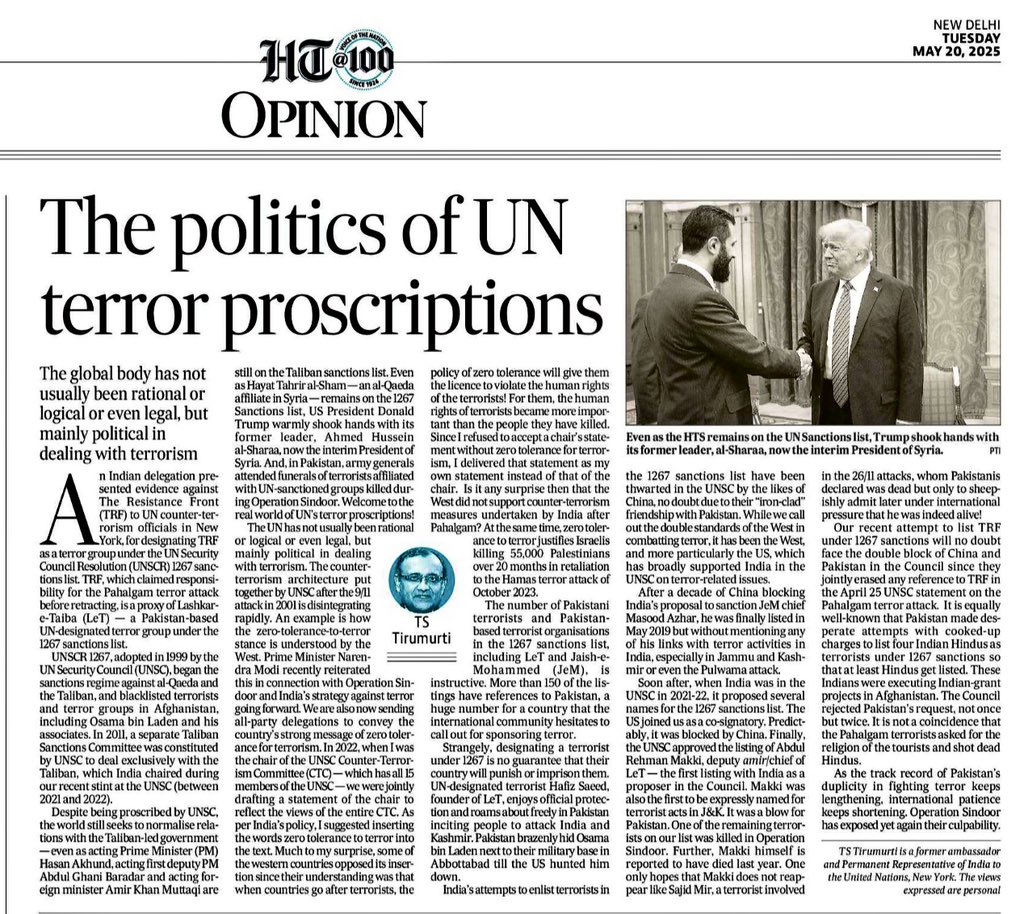
Introduction
The global counterterrorism mechanism, especially the 1267 UN Sanctions Committee, has often been criticized for being driven more by geopolitical interests than facts or justice. Despite strong evidence and global pressure, key terrorists with known links to Pakistan have repeatedly evaded UN listing due to political considerations. This highlights the flawed global consensus on fighting terrorism.
Key Issues and Background
1. India’s Persistent Push
-
India has consistently submitted evidence to the 1267 Sanctions Committee to proscribe terrorists like Abdul Rehman Makki, Masood Azhar, and Sajid Mir.
-
These individuals have direct links to globally recognized terror acts, including the 26/11 Mumbai attacks.
2. China’s Repeated Blocks
-
China has put “technical holds” on these listings, essentially stalling the process.
-
This tactic is used by nations to protect their strategic allies—Pakistan in this case—even if it undermines the global fight against terrorism.
3. Double Standards by Global Powers
-
The article points out how even terrorists on the UN’s sanctions list have been treated hypocritically by some powerful countries.
-
Example: The U.S. President once shook hands with designated terrorists like Anas al-Shara (interim president of Syria’s HTS) and Saddam Hussein in different political contexts.
4. Political Interests Over Justice
-
While India has suffered from Pakistan-sponsored terrorism, Pakistan continues to shelter wanted terrorists and use them as strategic assets.
-
The inconsistency in listing JeM (Jaish-e-Mohammed) and LeT (Lashkar-e-Taiba) operatives highlights the misuse of veto powers for national gain.
5. Impact on Global Peace Efforts
-
When terrorism is politicized, real victims are ignored and impunity is rewarded.
-
The world must understand that selective targeting of terrorism weakens global institutions and encourages extremist ideologies.
Specific Impacts or Effects
-
Undermines the credibility of the UN Security Council.
-
Weakens trust in global counter-terror frameworks.
-
Emboldens state-sponsored terrorism.
-
Erodes international cooperation and victim justice.
-
Fosters political manipulation of humanitarian issues.
Challenges and the Way Forward
Challenges:
-
Veto powers misuse their influence for strategic allies.
-
Lack of objective listing criteria.
-
No transparency in the functioning of the 1267 Committee.
Steps Forward:
-
Reforms in the UNSC’s decision-making process, especially related to sanctions.
-
Establish objective and transparent procedures for terror listing.
-
Encourage broader multilateral cooperation beyond the UN where required.
-
Use evidence-based approaches rather than strategic convenience.
Conclusion
The politics of UN terror listings reveal a grim reality: terrorism is often filtered through the lens of geopolitics rather than justice. India’s struggle to hold Pakistan-based terrorists accountable is a stark example of how international bodies fall short. If the global community is serious about eliminating terrorism, it must begin by depoliticizing its core institutions.
5 Questions and Answers
Q1: What is the 1267 Sanctions Committee?
A: It is a UN Security Council body responsible for listing individuals and entities associated with Al-Qaeda, ISIS, and other terrorist groups.
Q2: Why is India frustrated with the UN’s terror proscription process?
A: Despite providing strong evidence against Pakistani-based terrorists, India’s proposals are often blocked by China through technical holds.
Q3: What are some examples of hypocrisy in UN terror listings?
A: Some terrorists on UN sanctions lists have been politically engaged by global powers—e.g., the U.S. meeting with Anas al-Shara and Saddam Hussein.
Q4: How do these blocks affect global anti-terror efforts?
A: They weaken international consensus, damage the credibility of the UN, and enable terrorism to flourish through impunity.
Q5: What reforms are needed in the UN sanctions process?
A: Transparent and objective procedures, limits on veto misuse, and stronger accountability measures for member states.

