
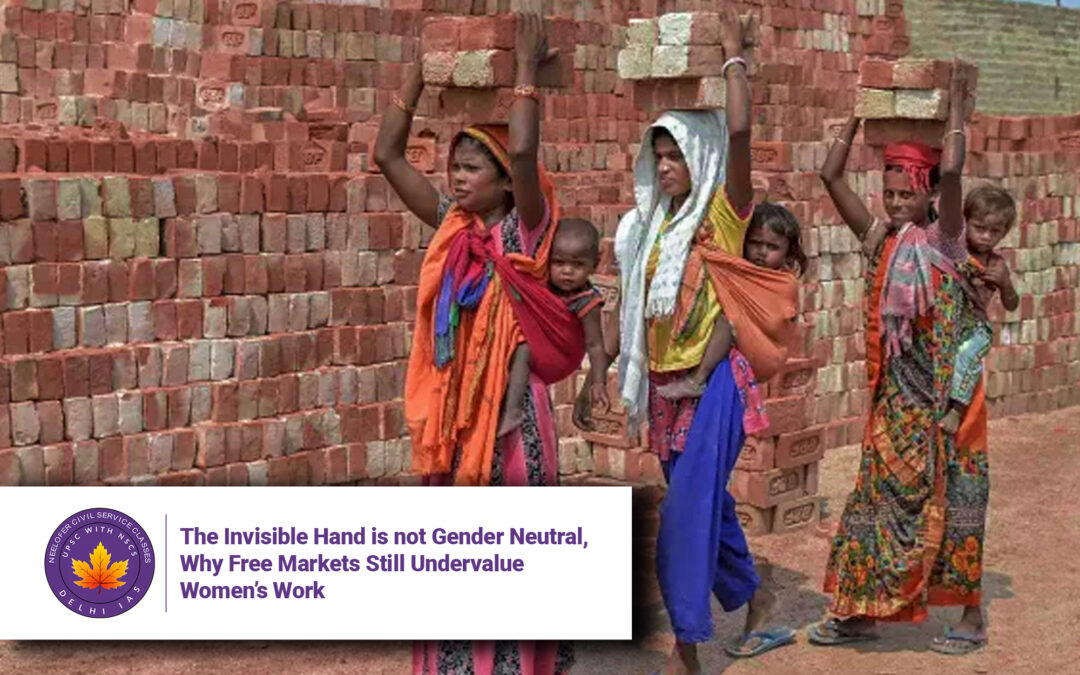
The Invisible Hand is not Gender Neutral, Why Free Markets Still Undervalue Women’s Work
Introduction
Adam Smith’s metaphor of the “invisible hand” in The Wealth of Nations (1776) has long served as a cornerstone of economic thought. It symbolizes the self-regulating nature of markets, where individuals pursuing their own interests unintentionally contribute to the collective good. However, as economist Aakash Dev highlights, this elegant metaphor conceals a persistent blind spot: it fails to fully account for the work of women — particularly unpaid care work and informal labor — which sustains both households and economies but rarely gets counted as “productive” in official statistics.
This is not a minor oversight. In India today, the economic invisibility of women’s labor is both a gender equality issue and a serious economic inefficiency. While the invisible hand might move markets, it doesn’t necessarily move societies toward fairness, nor does it correct biases that distort economic outcomes.
I. The Scope of the Problem: India’s Gender Gap in Economic Participation
India ranks 131st out of 146 countries in the Global Gender Gap Index 2025, with women’s economic participation rate at a mere 40.7% — one of the lowest globally. This isn’t just a matter of representation in formal employment; it reflects the deep structural undervaluation of women’s contributions.
According to the National Sample Survey Office (NSSO) and related reports:
-
Women in India perform, on average, 289 minutes (4.8 hours) of unpaid domestic work daily compared to 88 minutes (1.5 hours) by men.
-
If this unpaid care work were monetized, it would represent a significant share of national GDP.
However, because it generates no direct market transactions, it remains unaccounted for in GDP calculations, leading to policy neglect and underinvestment in supportive infrastructure.
II. Labour, Values, and Gender Bias: Theoretical Roots
In The Wealth of Nations, Smith identified productive labour as the source of wealth — labour that results in goods or services sold in the market, generating profit. This framework historically excluded large swathes of women’s work — from caregiving to subsistence farming — because they didn’t fit the market-based definition of productivity.
This exclusion isn’t merely theoretical; it shapes how economies function. Tasks like caring for children, tending to the elderly, and managing households are essential for sustaining the labor force and social stability. Yet, because they are not exchanged in markets, they are treated as having no economic value.
III. Free Markets, Unequal Outcomes
Smith celebrated markets for their ability to self-regulate and promote collective prosperity, but that logic assumes that all participants enter the market on equal footing. In reality, women face:
-
Restricted mobility
-
Social stigma in certain occupations
-
Lack of access to formal employment opportunities
-
Discrimination in pay and promotions
Data from India’s Periodic Labour Force Survey (PLFS) 2022-23 shows that nearly 80% of working women are engaged in informal employment, often without contracts, benefits, or legal protections. In comparison, only 72% of men are in informal employment.
These structural inequalities mean that even when women work, they are disproportionately concentrated in low-paid, insecure, and unprotected jobs.
IV. The Invisible Hand’s Blind Spot in Policy
Because unpaid and care work is invisible in economic statistics, it rarely informs policy design. This leads to a vicious cycle:
-
Lack of Measurement →
Unpaid care work isn’t systematically quantified in national accounts. -
Underinvestment in Support Systems →
Few childcare centers, eldercare facilities, or flexible working arrangements. -
Barriers to Women’s Participation →
Women are unable to take paid jobs due to caregiving burdens. -
Reinforcement of Gender Roles →
Women’s work remains undervalued and underpaid.
This is not just a matter of fairness but of economic efficiency. When half the population is underutilized in the labor market, the economy operates below potential.
V. Reimagining the Invisible Hand: Policy Solutions
The article calls for a gender-conscious reinterpretation of value and productivity. Some policy measures include:
1. Recognizing Unpaid Care Work
Countries like New Zealand and Sweden have begun incorporating unpaid care work into economic measurements and policy planning. This recognition changes budget priorities, leading to:
-
Better public childcare facilities
-
Affordable eldercare
-
Flexible work arrangements
-
Safer transport and women’s hostels
2. Strengthening Labour Laws and Protections
This means:
-
Raising minimum wage standards
-
Expanding maternity and paternity leave
-
Extending legal protections to informal workers
-
Ensuring equal pay for equal work
3. Education and Skill Development
Targeted interventions to address occupational segregation include:
-
Encouraging women’s entry into STEM, construction, manufacturing, and entrepreneurship
-
Providing technical training linked to market demand
-
Removing gender bias in vocational education
4. Infrastructure Investments
Physical and social infrastructure can reduce the unpaid work burden:
-
Reliable public transport
-
Access to clean water and energy
-
Community kitchens and shared services
5. Shifting Social Norms
Beyond economics, policy must engage with culture:
-
Public campaigns to promote equal household responsibilities
-
Encouraging men to participate in care work
-
Addressing gender stereotypes in media and education
VI. International Comparisons and Lessons for India
Countries like Sweden and Iceland lead in gender parity partly because they have:
-
Universal childcare
-
Subsidized parental leave for both parents
-
Active policies to reduce occupational segregation
For instance, Sweden’s policy of “use-it-or-lose-it” paternity leave has significantly increased fathers’ participation in childcare, helping balance unpaid work.
By contrast, India has yet to institutionalize such policies at scale. While schemes like the Pradhan Mantri Matru Vandana Yojana offer maternity benefits, they don’t address the broader structural issue of unpaid care distribution.
VII. Why This Matters Beyond Gender Equality
-
Economic Growth:
McKinsey Global Institute estimates that closing the gender gap in labor force participation could add $770 billion to India’s GDP by 2025. -
Demographic Dividend:
As India’s working-age population peaks, maximizing participation rates is essential to harness its economic potential. -
Social Stability:
Greater female economic participation correlates with better health, education, and social outcomes for families.
VIII. Conclusion
Adam Smith’s invisible hand is a powerful metaphor, but it cannot fix what it does not see. The market undervalues women’s work not because it is unimportant, but because it doesn’t pass through monetary transactions. To fully realize economic potential, India needs to:
-
Measure unpaid care work
-
Invest in supportive infrastructure
-
Reform labour laws with a gender lens
-
Change social norms about who does what work
Only by making women’s contributions visible — both in data and policy — can the promise of markets be truly inclusive.
5 Key Q&A for Understanding
Q1. What is the main argument against the “invisible hand” in the context of women’s work?
The argument is that while the invisible hand may regulate markets, it overlooks unpaid and informal labor — mostly done by women — which is essential for society but excluded from market-based definitions of productivity.
Q2. How much unpaid domestic work do women perform in India compared to men?
On average, women perform about 289 minutes (4.8 hours) of unpaid domestic work daily, compared to 88 minutes (1.5 hours) by men.
Q3. What percentage of working women in India are in informal employment?
Nearly 80% of working women in India are in informal jobs, compared to 72% of men, often without contracts, benefits, or legal protections.
Q4. What policy measures can help value women’s unpaid work?
Measures include incorporating unpaid care work into GDP estimates, expanding childcare and eldercare infrastructure, strengthening labour laws, encouraging women in non-traditional fields, and promoting equal household responsibilities.
Q5. Which countries have successfully integrated care work into economic policy, and what have they done?
Countries like New Zealand and Sweden have recognized unpaid care work in national accounts and invested in supportive infrastructure such as universal childcare, parental leave for both parents, and affordable eldercare, leading to higher female workforce participation.

