
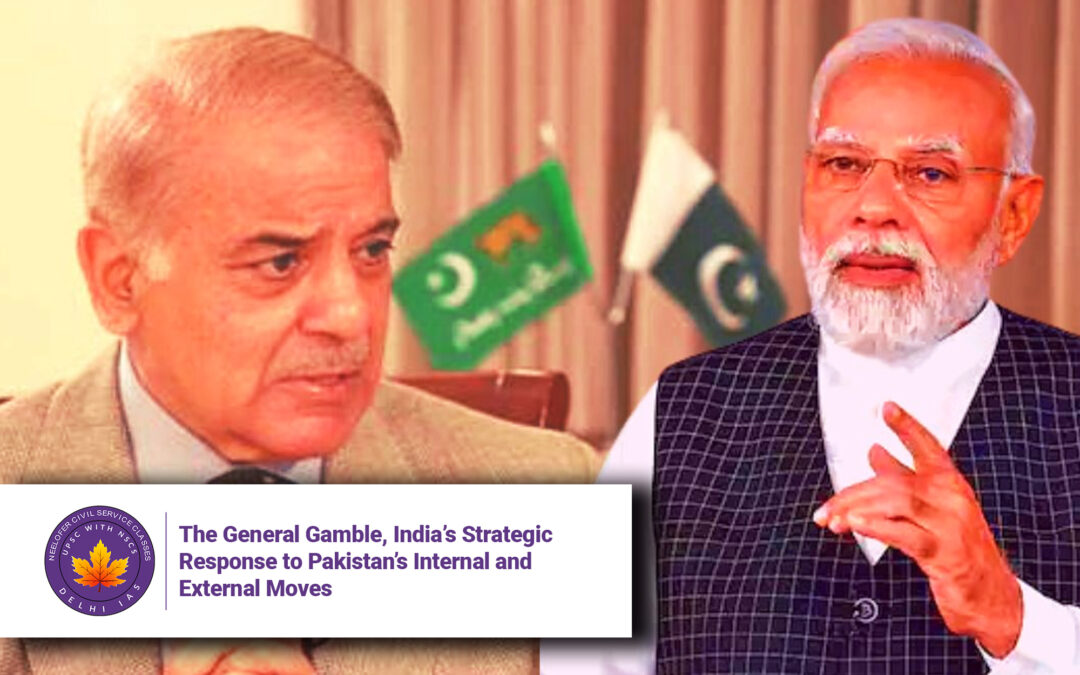
The General Gamble, India’s Strategic Response to Pakistan’s Internal and External Moves
Why in News?
General Asim Munir, Pakistan’s army chief, has taken a calculated risk by escalating confrontation with India through diplomatic, military, and ideological moves. India must counter these actions by preserving internal unity and mounting a coordinated domestic and international response. 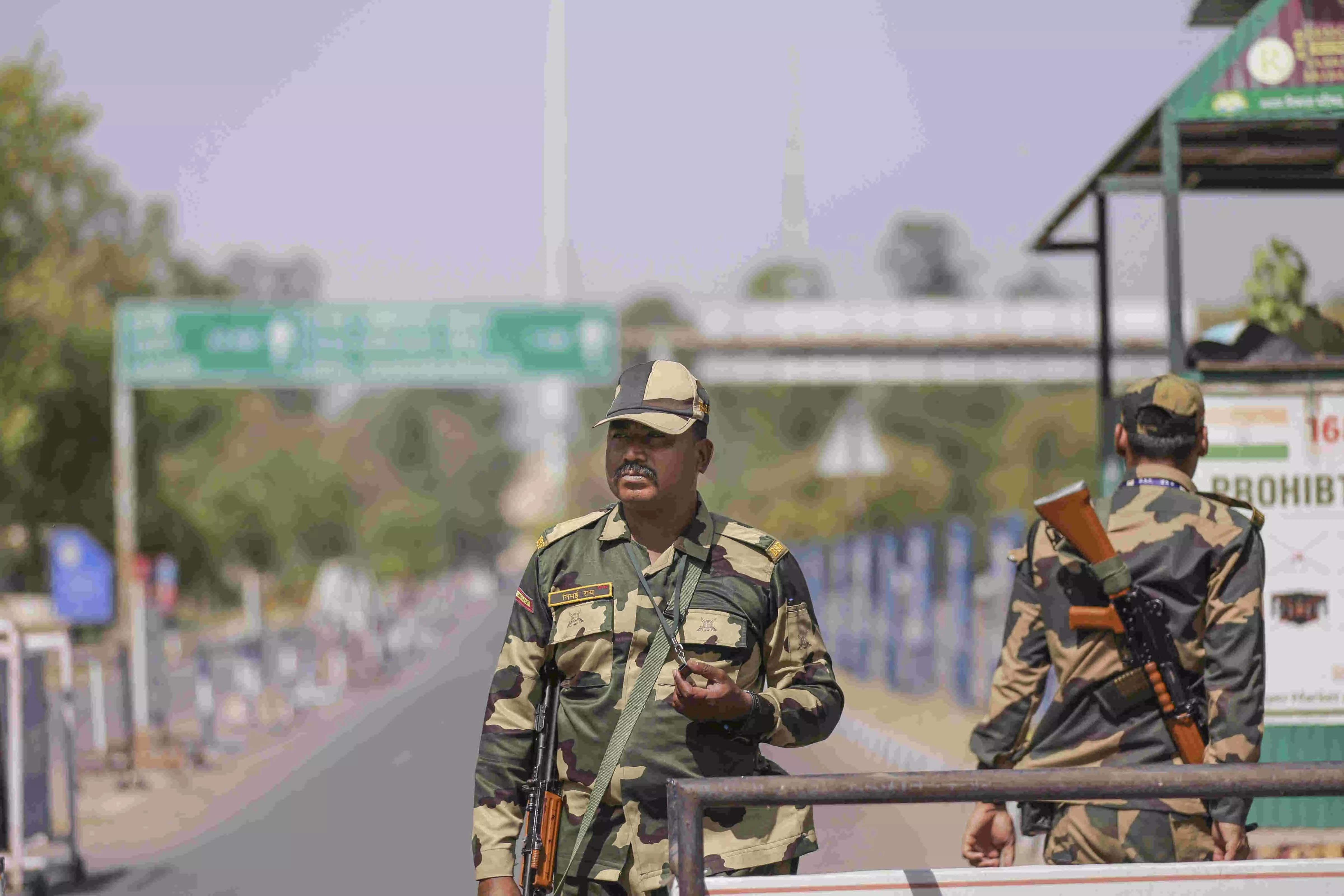
Introduction
As Pakistan faces internal economic collapse and political instability, its military leadership under General Asim Munir is shifting focus outward — reviving confrontation with India, seeking international support, and stirring ideological narratives. India, in turn, must develop a cohesive response to prevent regional instability and protect national interests.
Key Issues and Background
1. Munir’s Escalating Strategy
General Munir’s leadership comes at a turbulent time, with Pakistan’s economy experiencing only modest growth and international backing fading. Faced with instability, he has chosen to invoke anti-India rhetoric and the two-nation theory to rally domestic support and distract from internal failures.
2. Pakistan’s Internal Challenges
-
Relations with the Taliban-led Afghanistan remain volatile.
-
The Tehrik-e-Taliban Pakistan (TTP) continues attacks on the Pakistani state.
-
Balochistan, Khyber Pakhtunkhwa, and Gilgit-Baltistan face unrest.
-
Imran Khan’s support base, including overseas Pakistanis, adds pressure on the regime.
3. Strategy Against India
Munir’s calculus involves:
-
Raising nuclear escalation threats to attract international attention.
-
Pressuring India on Kashmir.
-
Influencing global perception by portraying India as an aggressor, especially towards Muslims and Kashmiris.
-
Seeking to exploit domestic discord in India, including communal tensions and electoral divisions.
4. India’s Strategic Positioning
India must avoid reacting solely through military means. It should:
-
Maintain a unified domestic front.
-
Leverage global partnerships (e.g., with the US, Gulf, and Europe).
-
Highlight Pakistan’s continued use of terrorism.
-
Push for international recognition of India’s role in regional stability.
5. The Diplomatic Front
India should continue to:
-
Resist any international mediation on Kashmir.
-
Use international forums to expose Pakistan’s duplicity on terrorism.
-
Watch China’s role closely while continuing to deepen ties with the US, Gulf nations, and Europe.
The Core of the Concern
Pakistan’s military establishment is attempting to provoke India into a confrontation to divert attention from its internal crises. The threat lies not only in military actions but also in ideological and psychological warfare.
Key Observations
-
General Munir’s approach includes both internal repression and external agitation.
-
India’s best defense is a strong, stable democracy with firm global alliances.
-
Delhi must not fall into the trap of reactive aggression.
-
A shift in Western policy now favors India more due to shared concerns on terrorism and China.
Conclusion
As Pakistan’s generals gamble on confrontation, India must rely on strategic patience, internal cohesion, and diplomatic strength. Defeating this new wave of Pakistan’s hybrid aggression requires not just military deterrence but smart global positioning and firm internal stability.
5 Questions and Answers
Q1. Who is the central figure in Pakistan behind the renewed confrontation with India?
A) Imran Khan
B) General Asim Munir
C) Nawaz Sharif
D) Shahbaz Sharif
Answer: B) General Asim Munir
Q2. What is the core idea behind Munir’s strategy toward India?
A) Launching a trade war
B) Improving India-Pakistan relations
C) Provoking conflict to unite Pakistan and attract global attention
D) Seeking a joint Indo-Pakistan army
Answer: C) Provoking conflict to unite Pakistan and attract global attention
Q3. What should be India’s primary response according to the article?
A) Immediate military retaliation
B) Internal division
C) Preserving a united domestic front and engaging global allies
D) Ignoring the situation
Answer: C) Preserving a united domestic front and engaging global allies
Q4. Which ideological concept is being revived by Munir to justify actions against India?
A) Secularism
B) Gandhian philosophy
C) Two-nation theory
D) Federalism
Answer: C) Two-nation theory
Q5. What external diplomatic actions is India encouraged to take?
A) Withdraw from international talks
B) Use forums like the UN to blame Afghanistan
C) Leverage partnerships with US, UAE, Europe against Pakistan’s terrorism
D) Cut ties with all Muslim-majority countries
Answer: C) Leverage partnerships with US, UAE, Europe against Pakistan’s terrorism

