
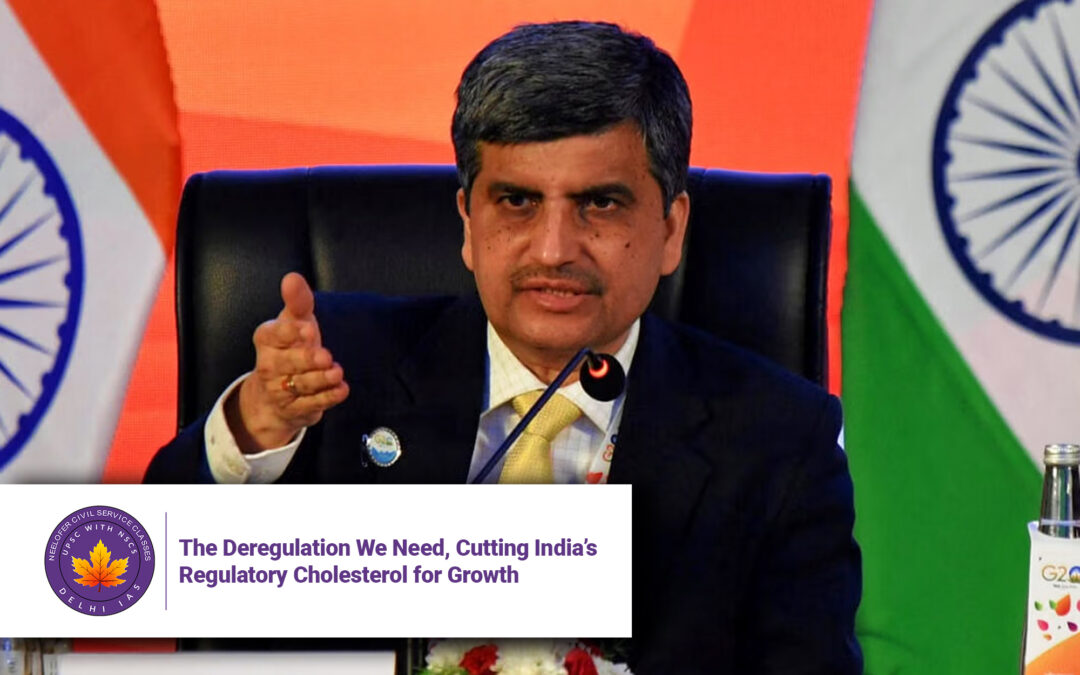
The Deregulation We Need, Cutting India’s Regulatory Cholesterol for Growth
Why in News?
India’s regulatory burden—a legacy of overregulation, red tape, and fragmented governance—is increasingly being recognized as a major barrier to economic growth, job creation, and global competitiveness. In this context, Manish Sabharwal’s editorial calls for a massive overhaul of India’s regulatory architecture to unleash the country’s full potential. 
Introduction
Despite impressive increases in per capita income since 1990, India’s growth has been slower than peer economies like China. While China’s GDP has grown 42 times since 1990, India’s growth has been about 10 times. This discrepancy is linked not only to investment but also to India’s over-regulated business environment, which stifles productivity, innovation, and scale.
Key Issues and Institutional Concerns
1. Regulatory Overload
Since 1990, government spending in India has increased 100 times—but regulations and compliance burdens have exploded as well. Employers today face thousands of laws, compliances, and criminal provisions, many of which are outdated or contradictory.
2. Comparison with China and Others
China reduced its “regulatory cholesterol” through simplified procedures, defense reform, and pro-employment strategies. In contrast, India has retained a top-down bureaucratic approach, making it harder for businesses to scale or for factories to compete globally.
3. Poor Labor Efficiency
India’s labor productivity is hampered by archaic laws. For example, Indian factory workers lose 70 hours/month due to poor regulatory conditions. Setting up a business takes 150-164 fewer hours in Singapore than in Noida, India.
4. Centre-State Governance Gap
Centralized governance from Delhi cannot meet the needs of a diverse nation. The editorial urges that functions, funds, and functionaries be devolved to state capitals and cities, allowing for more localized solutions.
5. Reimagining the State
Instead of more rules, India needs a government that enables rather than controls. The Hayekian idea of “enablers” must replace the command-and-control attitude to unlock economic potential and prosperity.
Conclusion
To achieve mass prosperity and meet aspirations like Bharat@2047, India must cut the fat of outdated regulations, empower states, modernize compliance, and create a freer, faster, and fairer economic environment. Otherwise, India risks missing the demographic dividend and falling behind in the global economic race.
Q&A Section
Q1. What is meant by ‘regulatory cholesterol’ in the context of India?
It refers to excessive and outdated regulations that burden employers and entrepreneurs, hindering economic growth and productivity.
Q2. How does India’s economic performance compare to China since 1990?
China’s GDP has grown 42 times since 1990, while India’s GDP has grown only about 10 times, partly due to overregulation and inefficient governance.
Q3. Why is decentralized governance important for India?
India’s diversity makes it impractical to run everything from Delhi. Devolving funds, functions, and functionaries to states and cities can ensure better governance and outcomes.
Q4. What changes are proposed to improve labor efficiency in India?
The article advocates simplifying labor laws, enabling flexible work hours, and reducing compliance-related delays to boost factory productivity.
Q5. What is the suggested approach to reform India’s economy?
The editorial suggests moving away from the top-down, rule-based system to one focused on enabling innovation, trusting entrepreneurs, and replacing control with coordination.

