
The Battle Over the Preamble, Socialism and Secularism Under Fire
Why in News?
A fresh wave of controversy has emerged in Indian constitutional discourse following renewed demands by the Rashtriya Swayamsevak Sangh (RSS) to remove the words ‘socialism’ and ‘secularism’ from the Preamble of the Indian Constitution. This demand, which echoes the divisive narratives of past political episodes like the Emergency, has reignited the debate on the foundational principles of the Indian Republic. The recent statements by RSS leaders have not only questioned the validity of these terms in the current political climate but have also challenged the very spirit of India’s constitutional framework. These remarks come amid broader concerns about ideological shifts, democratic backsliding, and the reinterpretation of constitutional morality in India.
Introduction
India’s Constitution, one of the world’s lengthiest and most detailed founding documents, was designed not only as a legal manuscript but as a vision of the Republic’s soul. Crafted in the aftermath of a prolonged anti-colonial struggle, it embodies the ideals of liberty, equality, fraternity, justice, and democracy. Central to this vision are the principles of socialism and secularism, which were explicitly inserted into the Preamble during the 42nd Constitutional Amendment in 1976 during the Emergency era. However, these principles were not alien to the Constitution before the amendment—they were deeply embedded in the Directive Principles of State Policy, Fundamental Rights, and its very structure.
The recent call by the RSS to excise these terms from the Constitution must be seen not merely as a semantic issue but as a direct political and ideological challenge to the secular, inclusive, and welfare-oriented nature of the Indian state.
Key Issues and Constitutional Concerns
1. The Preamble and Its Spirit
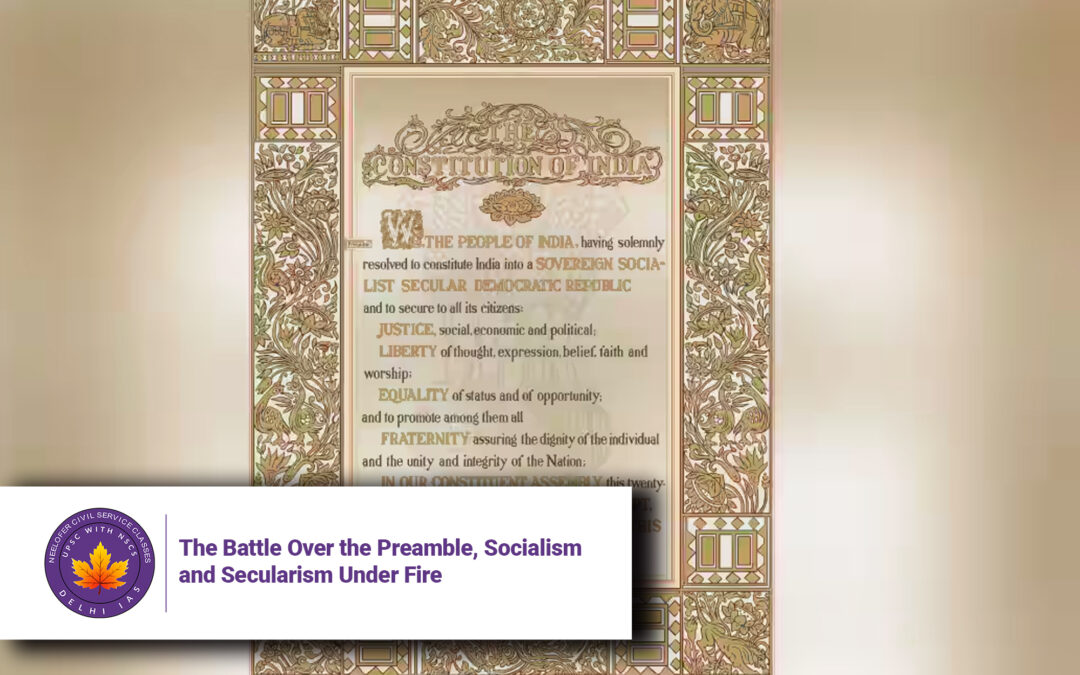
The Preamble of the Indian Constitution reflects its foundational philosophy: “Justice—social, economic and political; Liberty—of thought, expression, belief, faith and worship; Equality—of status and opportunity; and Fraternity—assuring the dignity of the individual and the unity and integrity of the nation.”
The terms socialism and secularism were added during the Emergency through the 42nd Amendment, but their inclusion was merely a formal recognition of values already present throughout the text. Even prior to the amendment, India’s commitment to economic justice (through Directive Principles) and religious neutrality (through Fundamental Rights) formed the backbone of its constitutional ethics.
2. RSS’s Ideological Stance
The RSS’s recent statement seeks to discredit the 42nd Amendment by referring to it as a product of political manipulation during the Emergency. However, critics argue that this is an opportunistic attempt to undermine egalitarian and pluralist values. The real goal is seen as replacing the secular, democratic ethos of the Constitution with a ‘Hindu Rashtra’ model, thereby majoritarianising Indian democracy.
3. Secularism in Constitutional Jurisprudence
Secularism in Indian constitutional law does not mean irreligion but equal treatment of all religions by the state. The Indian Supreme Court has consistently upheld secularism as part of the Constitution’s “basic structure,” particularly in the landmark Kesavananda Bharati judgment (1973). Even prior to the insertion of the term in 1976, Articles 25 to 28 had already guaranteed the right to freedom of religion, non-discrimination, and state neutrality in religious matters.
4. Socialism and Economic Justice
India’s commitment to socialism was never about Marxist doctrine but about ensuring equity, the reduction of economic disparity, and the welfare of the marginalized. The Directive Principles of State Policy speak clearly of securing a just social order, adequate means of livelihood, and minimizing inequalities in income, wealth, and status. Removing the word socialism would risk weakening the moral compass for socio-economic rights.
5. Dr. B.R. Ambedkar’s Warning and Relevance Today
Dr. B.R. Ambedkar, in his final address to the Constituent Assembly in 1949, emphasized the importance of fraternity, equality, and liberty, underscoring how the absence of one could destroy the others. Today, when caste-based violence, religious intolerance, and economic disparity are on the rise, his warning appears prophetic. Attempts to dilute constitutional values undercut the unity of the Republic and betray the very freedom struggle that birthed it.
Challenges and the Way Forward
1. The Political Motivation Behind the Demand
The timing and ideological undertone of the RSS’s demand raise serious concerns. Critics argue that it is a calculated move to foster a majoritarian, authoritarian state. It attempts to delegitimize the legacy of India’s pluralistic nationalism and overwrite it with a monolithic cultural identity.
2. Preserving the ‘Basic Structure’
The Supreme Court has consistently upheld the inviolability of the basic structure of the Constitution, which includes principles like the rule of law, judicial independence, secularism, federalism, and democracy. Any attempt to remove socialism or secularism could invite constitutional challenges and risk destabilizing the legal foundations of the Republic.
3. Educating the Public
There is an urgent need for greater civic education about the Constitution’s values. The ideas of secularism and socialism have often been misrepresented or misunderstood. A comprehensive public discourse is required to underline their true meanings and significance.
4. Strengthening Institutional Guardrails
The independence of institutions like the Election Commission, judiciary, and Parliament must be reinforced to protect against ideological distortions. Safeguards must be placed to prevent the misuse of constitutional amendments for political gain.
5. Reclaiming the Republic’s Soul
India’s identity as a secular, socialist republic is not merely textual—it is moral, historical, and existential. To dilute it is to risk dividing its people, weakening its democracy, and abandoning the vision of its founding fathers.
Conclusion
The RSS’s demand to remove socialism and secularism from the Preamble is not just a linguistic or legal proposition—it is an ideological assault on the inclusive and egalitarian foundations of the Indian state. The Constitution of India is a living document, designed to adapt but never to compromise on its core principles. While terms may be debated, their spirit must remain inviolable.
As India celebrates 75+ years of independence, it is crucial that we reaffirm our commitment to a constitutional vision that cherishes diversity, promotes equity, and safeguards liberty. We must recognize that socialism and secularism are not outdated relics—they are shields against tyranny, ladders to justice, and bridges to unity.
Question & Answer Section
Q1: Why are the words ‘socialism’ and ‘secularism’ in the Indian Constitution’s Preamble?
A1: These words were added during the 42nd Amendment in 1976, during the Emergency. However, their principles were already embedded throughout the Constitution—in the Directive Principles of State Policy and the Fundamental Rights. Socialism reflects the state’s commitment to economic justice, while secularism ensures religious neutrality and equal treatment of all faiths.
Q2: What is the significance of the ‘basic structure doctrine’ in this context?
A2: The basic structure doctrine, established in the Kesavananda Bharati case (1973), asserts that certain essential features of the Constitution cannot be amended or destroyed, even by Parliament. Secularism is part of this doctrine. Attempts to remove it from the Preamble could be legally challenged as unconstitutional.
Q3: Why is the RSS seeking to remove these words now?
A3: Critics argue that the RSS’s demand is ideologically driven, aiming to reshape India’s secular and welfare-oriented identity into a majoritarian, culturally homogeneous state. The move is seen as part of a broader political effort to redefine Indian nationalism and reduce the influence of the anti-colonial, pluralistic legacy of the Constitution.
Q4: Were secularism and socialism new concepts in 1976?
A4: No, these were not new concepts. Even before their formal addition to the Preamble, India’s Constitution reflected these values. Articles 25-28 ensured religious freedom, and Articles 38-39 promoted social justice and economic equity. The amendment simply codified what was already being practiced.
Q5: What can be done to protect the spirit of the Constitution?
A5: Several steps can be taken: uphold the basic structure doctrine through judicial oversight; strengthen democratic institutions; increase public awareness and civic education about constitutional values; and resist ideological attempts to dilute its inclusive vision. Active participation by civil society and the public in defending these values is critical.

