
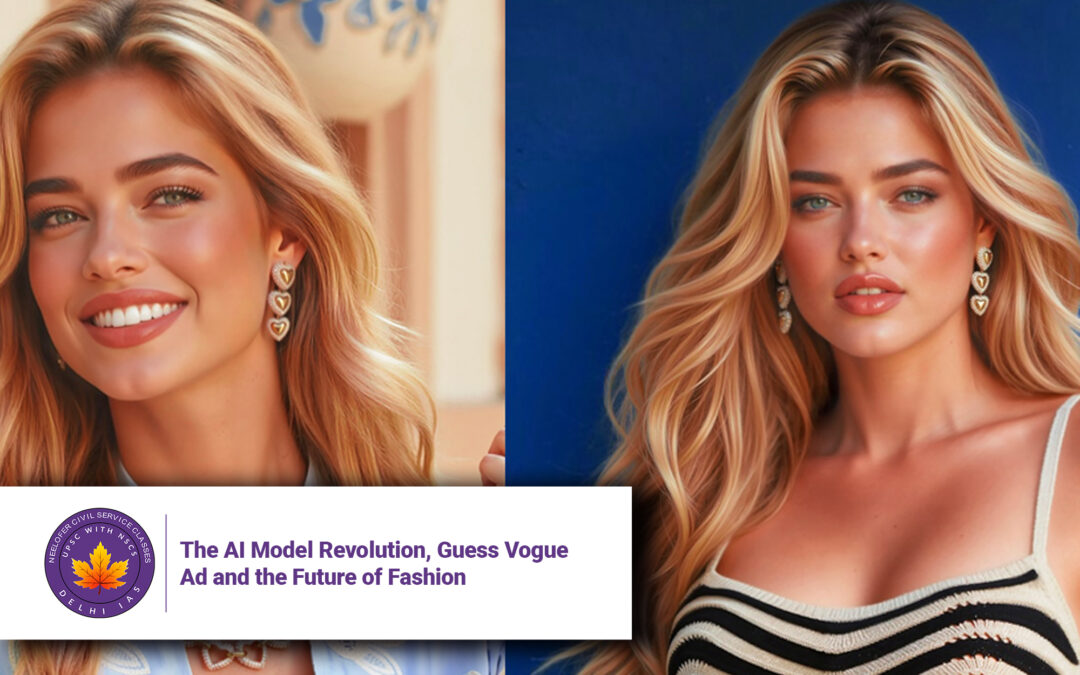
The AI Model Revolution, Guess Vogue Ad and the Future of Fashion
Why in News?
The fashion industry is witnessing a paradigm shift with the introduction of AI-generated models, as exemplified by Guess’ recent two-page advertisement in Vogue’s August print issue. Featuring a “picture-perfect” blonde model promoting a striped maxi dress and floral playsuit, the ad disclosed in fine print that the image was “produced by Seraphime Vallora on AI.” This landmark moment has ignited intense debate on social media and within the industry, raising questions about the future of real models, photoshoots, and the very essence of creativity in fashion. While AI promises cost savings and efficiency, it also threatens jobs, diversity, and authenticity. This article explores the implications of AI’s incursion into fashion, from ethical concerns to broader societal impacts, and examines whether this technology will augment or replace human artistry.
Introduction
Fashion has always been a dynamic intersection of art, culture, and commerce, reflecting societal values and pushing boundaries. From the iconic covers of Vogue to the rebellious statements of streetwear, the industry thrives on creativity and human expression. However, the advent of artificial intelligence is poised to disrupt this landscape. Guess’ AI-generated model in Vogue represents a tipping point, blurring the lines between reality and simulation. While AI offers exciting possibilities for innovation, it also challenges traditional norms around beauty, diversity, and employment. This article delves into the ramifications of this technological leap, exploring its impact on models, designers, consumers, and the broader cultural narrative.
Key Issues and Background
1. The Guess Ad: A Watershed Moment
Guess’ advertisement in Vogue marks the first time a major brand has used an AI-generated model in a high-profile print publication. The model, embodying the “ideal blonde” archetype, was created by Seraphime Vallora, an AI marketing agency. This move signals a shift towards digital realism in fashion marketing, with potential savings on model fees, photoshoot costs, and logistics.
2. Economic Implications
The use of AI models could significantly reduce costs for brands:
-
Model Fees: Eliminating payments to modeling agencies and individuals.
-
Photoshoots: Reducing expenses related to photographers, stylists, and locations.
-
Logistics: Avoiding travel, accommodation, and other overheads.
However, this threatens the livelihoods of countless professionals in the fashion ecosystem.
3. Ethical and Social Concerns
-
Unrealistic Beauty Standards: AI models can perpetuate idealized, unattainable beauty norms, exacerbating issues like body dysmorphia and low self-esteem.
-
Diversity and Representation: While AI can be programmed to represent diverse body types and ethnicities, there is a risk of homogenization if algorithms are biased.
-
Consent and Ownership: The use of AI likenesses, as highlighted in the Black Mirror episode “Joan is Awful,” raises questions about intellectual property and consent.
4. Creative Autonomy
AI tools can enhance creativity by generating novel designs, patterns, and concepts. However, over-reliance on algorithms may stifle human ingenuity and lead to formulaic outputs.
5. Industry Responses
-
Resistance: Organizations like the Writers Guild of America (WGA) and Screen Actors Guild (SAG-AFTRA) have protested AI’s encroachment on creative jobs.
-
Acceptance: Some industry leaders, like Condé Nast CEO Roger Lynch, advocate for embracing AI to “meet audiences where they are.”
6. Psychological and Cultural Impact
AI’s influence extends beyond fashion into human relationships, as seen in cases like Rosanna Ramos, who married an AI robot. This blurring of lines between human and machine interactions challenges traditional notions of intimacy and emotion.
Specific Impacts or Effects
1. On Employment
AI models could displace human models, photographers, makeup artists, and stylists, leading to job losses and economic instability in the industry.
2. On Consumer Behavior
Consumers may gravitate towards AI-generated campaigns for their perfection, but this could also lead to disillusionment with authenticity and realness.
3. On Sustainability
AI reduces the carbon footprint associated with photoshoots (travel, production, etc.), aligning with fashion’s growing emphasis on sustainability.
4. On Legal Frameworks
New regulations will be needed to address intellectual property, consent, and accountability in AI-generated content.
Challenges and the Way Forward
Challenges
-
Job Displacement: Protecting livelihoods in the face of automation.
-
Bias in AI: Ensuring algorithms promote diversity rather than stereotypes.
-
Authenticity: Balancing AI efficiency with human touch and emotional resonance.
-
Regulatory Gaps: Developing laws to govern AI use in creative industries.
Steps Forward
-
Hybrid Models: Combining AI efficiency with human creativity to enhance rather than replace.
-
Ethical AI: Implementing guidelines to ensure diversity, equity, and inclusion in AI-generated content.
-
Upskilling: Training professionals to work alongside AI tools.
-
Consumer Education: Raising awareness about AI’s role in fashion to manage expectations.
-
Legal Reforms: Establishing clear frameworks for IP and consent in the digital age.
Conclusion
The integration of AI into fashion is inevitable, but its trajectory will depend on how the industry balances innovation with ethics. Guess’ Vogue ad is a harbinger of change, offering both opportunities and challenges. While AI can democratize creativity and reduce costs, it must not come at the expense of human jobs, diversity, and authenticity. The future of fashion lies in a symbiotic relationship between human artistry and artificial intelligence, where technology amplifies rather than diminishes our creative spirit. As we navigate this new frontier, the industry must prioritize inclusivity, sustainability, and ethical practices to ensure that fashion remains a reflection of our humanity.
5 Questions and Answers
Q1: What was significant about Guess’ Vogue advertisement?
A: It featured an AI-generated model, marking a first for a major brand in a high-profile print publication.
Q2: How does AI impact employment in the fashion industry?
A: It threatens jobs for models, photographers, stylists, and other professionals by reducing the need for human involvement in photoshoots.
Q3: What are the ethical concerns with AI models?
A: They can perpetuate unrealistic beauty standards, reduce diversity, and raise issues of consent and intellectual property.
Q4: How can the fashion industry address AI’s challenges?
A: By adopting hybrid models, ensuring ethical AI practices, upskilling workers, and implementing regulatory frameworks.
Q5: What is the long-term outlook for AI in fashion?
A: AI will likely become integral to design and marketing, but its success will depend on balancing efficiency with creativity and ethics.

