
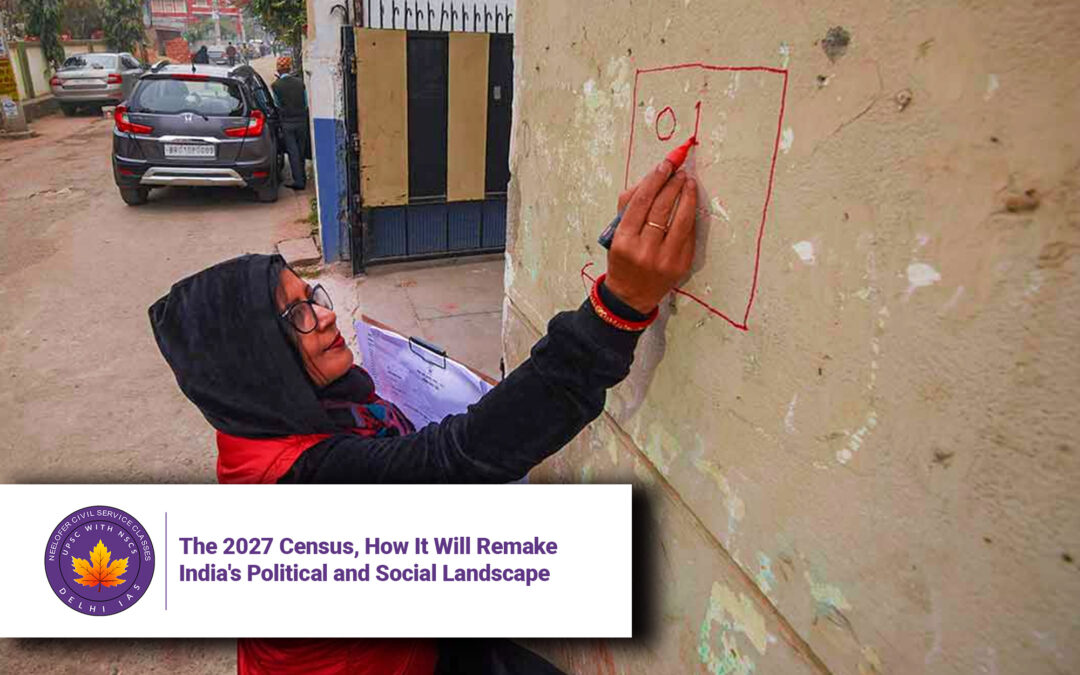
The 2027 Census, How It Will Remake India’s Political and Social Landscape
Why in News?
India’s upcoming 2027 Census will be the most consequential population exercise in a century. More than just a headcount, it will trigger political realignments, redistribution of parliamentary seats, a national caste census, and affect revenue-sharing mechanisms, making it a landmark event in reshaping Indian democracy. 
Introduction
Census operations go far beyond statistics — they define political identities, influence resource allocation, and shape electoral boundaries. The delayed 2021 Census, now set to be conducted digitally in 2027, will usher in a new era of demographic politics. It will reflect migration trends, caste identities, urbanization, and the economic divide — all of which will deeply impact how Indians are governed and how they see themselves as “a people.”
Key Features
● First Fully Digital Census
-
Data will be collected and processed digitally, reducing the processing time to months instead of years.
-
Real-time analysis and faster results may accelerate policy decisions and delimitation exercises.
● Inter-State Parliamentary Redistribution
-
According to Article 81 of the Constitution, the next redistribution of Lok Sabha seats will be based on the first census post-2026.
-
The delay in the 2021 census means delimitation could happen before 2031, possibly affecting the 2029 general elections.
● First Full Caste Census Since 1931
-
For the first time in independent India, all castes — not just SCs and STs — will be enumerated.
-
This could prompt calls to remove the 50% ceiling on reservations and reshape the national discourse on social justice.
● One-third Reservation for Women
-
The new delimitation will allocate 33% of parliamentary and assembly seats to women, marking a historic change in representation.
● Push for Simultaneous Elections
-
The government plans to use this census as a foundation to introduce simultaneous elections for the Lok Sabha and State Assemblies.
Specific Impacts or Effects
● Shift in Political Power
-
States with lower population growth but higher economic output (like Kerala, Tamil Nadu) may lose representation.
-
States with higher population growth and weaker economies (like Bihar, Uttar Pradesh) may gain seats, shifting power to the north and central regions.
● Migration Patterns and Urban Growth
-
The Census will map increasing migration to southern and western India for jobs, putting stress on urban services.
-
Regions like Delhi NCR, despite being overcrowded, continue to attract migrants due to economic opportunities.
● Tension Between Identity and Democracy
-
Census data on caste, religion, and language will redefine group identities and political mobilization.
-
The census will reinforce the importance of identity politics in India’s electoral landscape.
Challenges and the Way Forward
Challenges:
-
Delimitation based purely on population could spark inter-state resentment.
-
Caste enumeration may intensify demands for reservation beyond the current 50% limit.
-
Digital data collection raises questions of accuracy and inclusion, especially in remote and rural areas.
Way Forward:
-
Ensure transparency and political consensus in the delimitation process.
-
Frame data privacy laws to manage digital census information securely.
-
Use caste data to expand targeted welfare programs, not just electoral arithmetic.
-
Promote national unity by balancing identity-based representation with economic fairness.
Conclusion
The 2027 Census is not just a counting of citizens — it is a redefinition of who “the people” are. With its deep political, social, and economic implications, it will transform how India allocates power and resources. From delimitation to caste justice and gender representation, the census will be a mirror to the nation’s evolving identity. India must navigate this carefully to balance its diversity with unity, and fairness with federal strength.
Q&A Section
Q1. What is the significance of the 2027 Census?
It will determine parliamentary seat redistribution, conduct a full caste count, and enable faster policy decisions via digital data.
Q2. Why could delimitation based on population be controversial?
It may reduce seats in states with low population growth, affecting southern and western states, and increase seats in the north, altering political power balance.
Q3. What is the impact of including caste data?
It could strengthen demands for increased reservation, affect party strategies, and change welfare delivery frameworks.
Q4. How is the 2027 Census different from earlier ones?
It will be fully digital, include all castes, and be tied to parliamentary restructuring and simultaneous elections.
Q5. What is the role of the Finance Commission in this context?
The 16th Finance Commission will recommend revenue-sharing mechanisms, which, alongside the census, could reshuffle resource distribution across states.

