
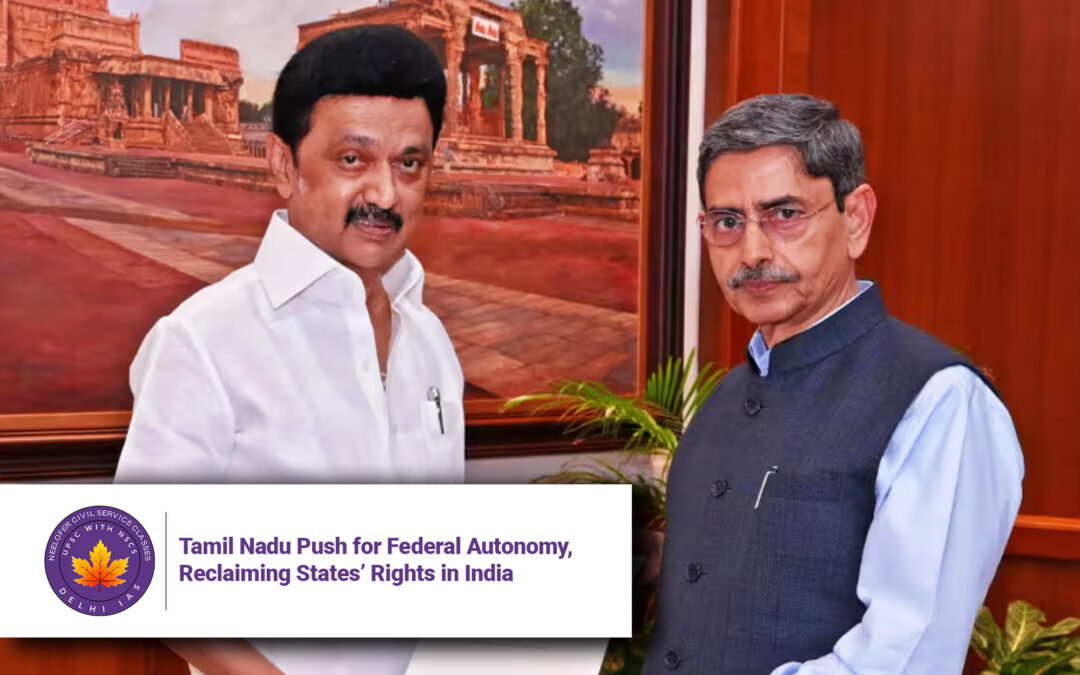
Tamil Nadu Push for Federal Autonomy, Reclaiming States’ Rights in India
Why in News?
Tamil Nadu Chief Minister M.K. Stalin has announced the formation of a three-member high-level committee to review the Constitution’s provisions on Centre-State relations and suggest steps to strengthen State autonomy and ensure a fair federal balance. This step comes in response to growing centralisation under the current Union government. 
Introduction
For decades, the Dravidian movement has emphasized decentralisation and development led by States. Tamil Nadu is once again spearheading the cause for federal fairness in India, aiming to protect its rights from the increasing encroachment of the Union into State powers.
Key Issues and Background
Constitutional Framework and Federal Imbalance
-
The Preamble of the Constitution describes India as a Union of States, with distinct powers assigned to the Union and States through the Union List, State List, and Concurrent List.
-
However, over time, powers from the State List and Concurrent List have been increasingly centralised, shifting authority to the Union.
Encroachment by the Union Government
-
The BJP-led Union Government has:
-
Encroached into State List subjects.
-
Blocked legislative efforts of States using Governor’s and President’s powers.
-
Imposed central policies like the National Education Policy (NEP) and three-language formula, pushing Hindi at the cost of regional languages.
-
Tamil Nadu’s Legal and Political Actions
-
Tamil Nadu won a recent Supreme Court case that removed unconstitutional blocks imposed by the Union.
-
It has firmly rejected the NEP and retained autonomy in school education policies, including the exemption from NEET.
The Core of the Concern
Federal Rights Under Threat
-
States like Tamil Nadu are demanding:
-
The right to legislate and govern in their constitutionally mandated areas.
-
Protection from central overreach.
-
Greater fiscal and functional autonomy.
-
-
The Union’s delimitation exercise, based on population size, may punish southern States for performing well in population control, which is seen as unfair and undemocratic.
Key Observations
-
A collective struggle is emerging among like-minded States to defend federal values.
-
Tamil Nadu envisions an inclusive, plural, and progressive India where regional diversity is respected, not suppressed.
Conclusion
The time has come to restore balance in Centre-State relations. Tamil Nadu’s initiatives may set the stage for a broader national movement to reclaim federal rights and ensure that Indian democracy remains inclusive, decentralised, and pluralistic. As in the past, Tamil Nadu stands firm in its fight—and this time, other States may join in.
Q&A Section
Q1. Why has Tamil Nadu formed a high-level committee on Centre-State relations?
Ans: To review constitutional provisions and recommend ways to reclaim State autonomy and ensure a fair federal balance.
Q2. What are Tamil Nadu’s major concerns regarding Union overreach?
Ans: Encroachment into State List subjects, misuse of Governor’s powers, imposition of NEP, and centralisation in policymaking.
Q3. What is Tamil Nadu’s stance on the National Education Policy (NEP)?
Ans: Tamil Nadu rejects the NEP for pushing Hindi, being elitist, and not aligning with the State’s inclusive education values.
Q4. How has Tamil Nadu challenged Union actions legally?
Ans: By securing a Supreme Court judgment to remove blocks on State laws and asserting its rights through judicial channels.
Q5. What broader implications does this issue have for Indian democracy?
Ans: It raises crucial questions about federalism, regional autonomy, and the need to protect the Union of States from becoming overly centralised.

