
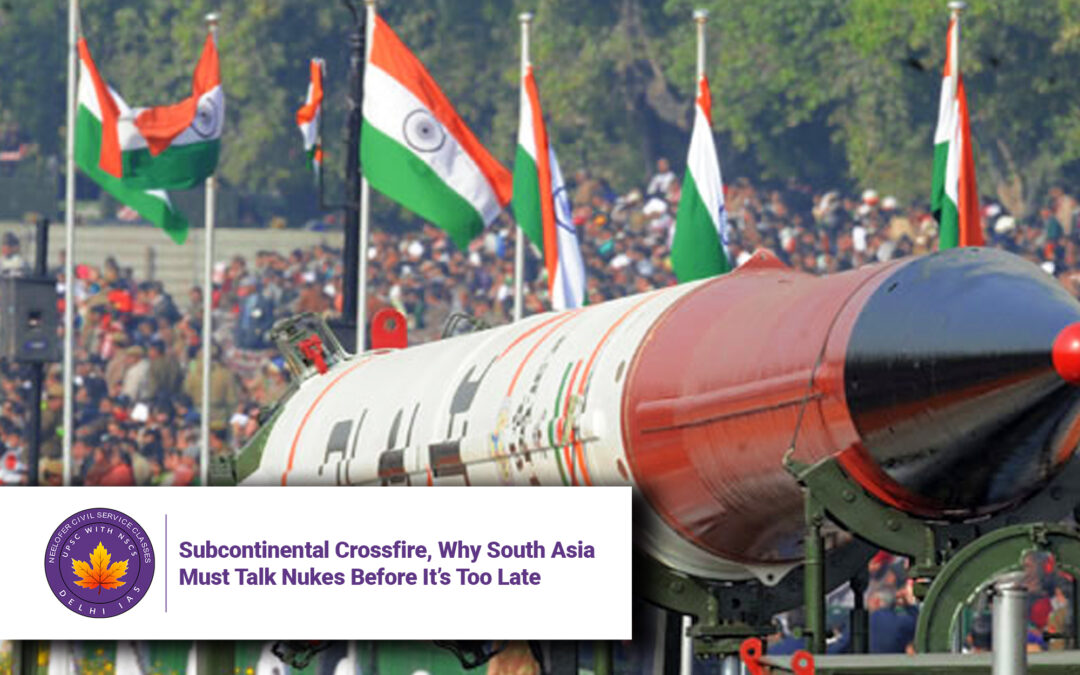
Subcontinental Crossfire, Why South Asia Must Talk Nukes Before It’s Too Late
Introduction
In the simmering heat of South Asian geopolitics, where every diplomatic slight or military maneuver is scrutinized through the lens of long-standing enmities, the need for mature, apolitical dialogue on nuclear weapons has never been more urgent. The recent parliamentary debate in India following Operation Swift Retort (Op Sindoora) — a simulated strike on terrorist camps across the border — brought nuclear rhetoric back to center stage. Prime Minister Narendra Modi’s references to “nuclear threats” and “nuclear blackmail” reminded the region and the world of the inherent dangers in allowing atomic diplomacy to rest solely in political hands.
In his hard-hitting analysis, former Indian Navy chief Admiral Arun Prakash dissects these developments with a clear warning: the time has come for India and Pakistan — and by extension, China — to initiate an honest, structured, and sustained nuclear dialogue. Not out of weakness, but as a display of strategic maturity in an increasingly complex regional and global security environment.
Rhetoric vs Reality: The Politics of the Bomb
India’s verbal response to Pakistan’s repeated invocation of its nuclear capabilities following Op Sindoora is not new. Nuclear rhetoric has long been a tool used by South Asian nations to convey strength and deterrence. However, Admiral Prakash rightly points out that these exchanges are often politically motivated and strategically shallow.
This political gamesmanship undermines the “No First Use” (NFU) doctrine, the very pillar upon which India’s nuclear policy rests. While India has consistently projected its nuclear arsenal as a defensive deterrent — and maintained a stance against initiating conflict — Pakistan, on the other hand, has shifted its nuclear posture from “minimum credible deterrence” to “full spectrum deterrence,” allowing it to deploy tactical nukes for battlefield use.
As a result, the traditional nuclear equilibrium is becoming increasingly fragile, giving rise to misinterpretation, miscalculation, and unauthorized escalation.
Emerging Technologies and the Erosion of Deterrence
Perhaps the most dangerous development in this nuclear age is the blurring of lines between conventional and nuclear weapons. China, for example, is rapidly expanding its nuclear arsenal and delivery systems, developing high-speed hypersonic missiles, advanced AI-enabled targeting systems, and dual-use launch platforms.
The People’s Liberation Army Rocket Force (PLARF) is deploying missiles like the DF-17 and DF-41, capable of carrying nuclear or conventional warheads. The J-20 fighter jets and H-6N bombers are believed to be nuclear-capable. These assets significantly complicate threat perception because the same platform can carry either a conventional or a nuclear payload, thus reducing the nuclear threshold.
India and Pakistan are not far behind in these technological advancements. Pakistan is reportedly developing sea-based nuclear platforms, such as nuclear-armed submarines, in addition to its land-based ballistic and cruise missiles.
Strategic Instability and the “Use-it-or-Lose-it” Dilemma
Admiral Prakash introduces an essential point that should worry security planners: the shortened decision-making window caused by ambiguous dual-use capabilities.
For example, a missile launched from a dual-capable platform could easily be misinterpreted. Is it carrying a conventional warhead? Or a nuclear one? If the receiving nation assumes the worst and retaliates with a nuclear strike, the situation escalates uncontrollably. The result: catastrophic conflict based not on intent, but confusion.
This scenario becomes more probable when both India and Pakistan maintain hair-trigger alert postures with pre-delegated launch authority in the event of incapacitated leadership.
Past Agreements and the Need for New Dialogue
Despite the bleak picture, South Asia has a history of nuclear restraint mechanisms, including:
-
The 1999 Lahore Memorandum of Understanding (MoU)
-
The 2005 Agreement on Nuclear Risk Reduction
-
The 2007 Agreement on Reducing the Risk of Accidents
However, none of these agreements provide a mechanism for real-time communication, joint assessment of technological changes, or crisis de-escalation protocols in the age of hypersonics, AI, and cyber warfare.
What’s missing, Admiral Prakash argues, is a sincere, institutionalized, apolitical dialogue that can address these modern threats head-on — independent of political compulsions or party posturing.
Beyond Deterrence: The Threat of Tactical Use
Pakistan’s evolving nuclear posture now includes low-yield tactical weapons that could be deployed in active war zones, especially if its conventional defenses fail. This introduces an alarming possibility — nuclear use on the battlefield — which carries not only military consequences but also global diplomatic fallout.
Further, the ambiguity surrounding India’s retaliatory strategy could push decision-makers into adopting counterforce doctrines (targeting enemy weapons) over countervalue doctrines (targeting cities). Either way, it lowers the nuclear threshold.
The Role of China: A Silent but Active Player
While Indo-Pak tensions dominate headlines, China looms large in the nuclear background. Though China claims adherence to NFU and minimum deterrence, its actions tell a different story.
Recent satellite imagery suggests that China is constructing over 300 new missile silos, preparing for rapid deployment in case of a future crisis. Its integration of nuclear command into AI-based systems and cyber networks only adds to the opacity of Chinese strategic intentions.
India’s response must therefore be tripartite — preparing for threats not just from Islamabad but from Beijing as well. Any nuclear risk reduction strategy must take into account China’s influence in destabilizing regional balances.
Conclusion: Talking the Talk Before Walking the Brink
Arun Prakash’s central thesis is both clear and urgent: Nuclear weapons should not be discussed only in the aftermath of operations or political grandstanding. They deserve dedicated platforms, continuous engagement, and long-term strategic vision.
If India, Pakistan, and China do not institutionalize a non-political nuclear dialogue, they risk plunging the subcontinent into a catastrophic future defined by fear, miscalculation, and irreversible damage.
Now is not the time for complacency. It is the time for leadership — not just in the cockpit or the command center, but at the negotiating table.
5 Key Questions & Answers
Q1: What recent event reignited nuclear rhetoric in India?
A: The Indian Parliament’s debate on Operation Sindoora — a simulated cross-border strike — reignited nuclear rhetoric, particularly after PM Modi referenced Pakistan’s “nuclear threats” and “blackmail.”
Q2: Why is nuclear dialogue necessary in the current geopolitical climate?
A: With all three major players (India, Pakistan, and China) modernizing and expanding their nuclear arsenals — often with dual-use capabilities — the risk of misinterpretation and accidental escalation has increased. A formal dialogue is necessary to prevent such scenarios.
Q3: How has Pakistan altered its nuclear posture in recent years?
A: Pakistan has shifted from a “minimum credible deterrence” to a “full spectrum deterrence” strategy, which includes the use of tactical nuclear weapons on the battlefield, thereby lowering the nuclear threshold.
Q4: What are some existing nuclear agreements between India and Pakistan?
A: Key agreements include the 1999 Lahore Declaration, the 2005 Agreement on Nuclear Risk Reduction, and the 2007 Agreement on Accidental Risk Reduction. However, none address modern threats like hypersonic weapons or cyber vulnerabilities.
Q5: What does Admiral Arun Prakash recommend to avoid a nuclear crisis in South Asia?
A: He recommends the creation of a non-political, institutionalized nuclear dialogue among India, Pakistan, and China to address modern technological threats and establish clear communication mechanisms for crisis management.
Final Note
As the subcontinent steps deeper into an era marked by AI, hypersonics, and nuclear ambiguity, the stakes are too high to leave to politics alone. Mature democracies and responsible states do not just wield power — they also restrain it. It is time for India, Pakistan, and China to prove they are up to the task.

