
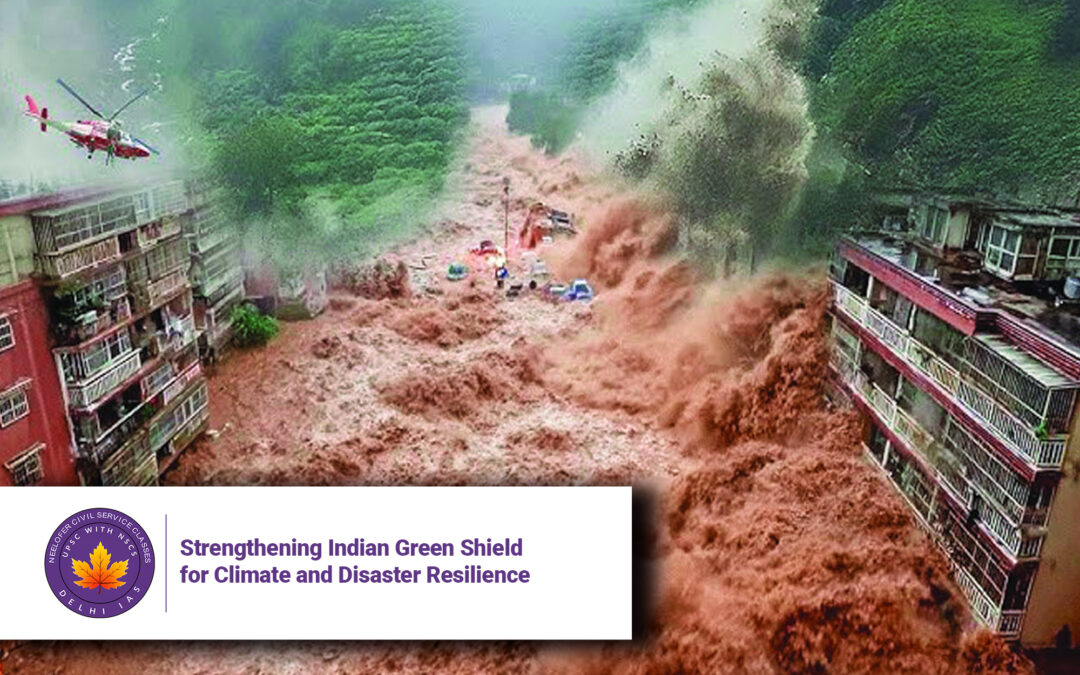
Strengthening Indian Green Shield for Climate and Disaster Resilience
Why in News
India is currently facing some of the harshest climate-linked disasters in its history. The record-breaking heatwaves of 2024, with temperatures in parts of Rajasthan crossing 50°C, the devastating floods in Himachal Pradesh and Uttarakhand, and the recurring cyclones in coastal Bengal and Odisha, highlight the urgency of climate resilience. Experts warn that India’s most underutilised yet powerful line of defence lies in its forests — ecosystems that regulate water, stabilise slopes, buffer coasts, cool cities, and act as critical carbon sinks.
Introduction
Extreme weather events are no longer isolated occurrences in India; they have become the new normal. The year 2023–24 alone witnessed unprecedented calamities:
-
Cyclones ravaging the eastern coastline.
-
Glacial lake outbursts in Uttarakhand and Himachal Pradesh, triggering flash floods and landslides.
-
Sudden cloudbursts in Jammu and Kashmir, destroying villages and infrastructure.
-
Urban floods in Delhi and Hyderabad due to short, intense rainfall episodes.
Behind these disasters lies a larger story of reckless development, deforestation, and climate change. Forests, which once served as natural shields against environmental shocks, have been systematically degraded. Yet, as India struggles to adapt, it is becoming increasingly clear that forests are not just biodiversity hotspots but living systems critical to disaster management and climate resilience.
Key Issues and Background
-
India’s Climate Vulnerability
-
Ranked among the top five most climate-vulnerable nations globally, India experiences frequent floods, heatwaves, droughts, and storms.
-
Himalayan states, in particular, face a dual threat of glacial melt and erratic monsoons, destabilising fragile mountain ecosystems.
-
-
Deforestation and Reckless Development
-
Urban expansion, mining, dam construction, and highway projects have fragmented forest landscapes.
-
Large-scale deforestation has amplified risks by destabilising slopes, reducing rainfall absorption, and worsening flash floods.
-
-
Urban Green Belts as Shields
-
In Delhi and Hyderabad, studies reveal that urban forests and green belts have reduced local temperatures by 2–3°C and significantly cut down flood risks.
-
However, lack of policy prioritisation often leads to the destruction of these protective ecosystems in favour of “development projects.”
-
-
Forests as Natural Carbon Banks
-
According to the Forest Survey of India’s 2021 report, the country’s forest area stands at 827,357 sq km, covering about 25% of India’s geographical area.
-
India’s estimated total carbon stock in forests is 7,285 million tonnes, with an increase of 81.5 million tonnes compared to the last assessment.
-
Current assessments indicate that India’s forests hold around 40.3 billion tonnes of CO₂ equivalent, yet this potential remains underutilised.
-
Specific Impacts or Effects
-
Disaster Risk Reduction
-
Forests absorb excess rainfall, reduce surface runoff, and stabilise soil. This makes them crucial against flash floods and landslides.
-
In Odisha, post-Cyclone Phailin (2013), restoration of mangroves reduced coastal damage and improved recovery speed.
-
-
Food, Medicine, and Livelihood Support
-
During disasters, bamboo and wood serve as essential materials for temporary shelters.
-
Non-timber forest produce provides food and medicine when supply chains collapse.
-
-
Agricultural Protection
-
Agroforestry and watershed management practices in Himachal Pradesh’s Shiwalik hills have reduced erosion and protected farmlands.
-
Forest-based models in Bundelkhand have boosted local resilience by stabilising groundwater and soil fertility.
-
-
Cooling Cities and Mitigating Heatwaves
-
Urban forests and tree-lined avenues reduce urban heat islands.
-
Studies confirm that green spaces in Delhi and Hyderabad have lowered peak summer temperatures, making cities more liveable.
-
-
Biodiversity as a Climate Shield
-
Diverse ecosystems such as mangroves, wetlands, and Himalayan forests are natural bulwarks against climate shocks.
-
Mangroves, for example, act as buffers against storm surges and tsunamis.
-
Challenges and the Way Forward
-
Weak Policy Implementation
-
Forest protection laws exist but are often bypassed for infrastructure projects like roads, hydropower dams, and mining.
-
Environmental Impact Assessments (EIA) are frequently diluted or ignored.
-
-
Institutional Gaps
-
Coordination between central and state agencies on forest-related disaster resilience remains weak.
-
Community participation in forestry projects is minimal.
-
-
Economic Constraints
-
Investments often prioritise “grey infrastructure” like seawalls and concrete flood barriers, which are costlier and less effective than nature-based solutions.
-
Despite being cheaper, forestry-based solutions are underfunded.
-
-
Need for Technology and Research
-
Remote sensing, GIS, and AI-based monitoring must be integrated into forest and disaster management plans.
-
Japan’s “greenbelt tsunami shield” project can serve as a model for India’s coastal states.
-
Conclusion
India stands at a critical juncture. As disasters intensify due to climate change, forests must be repositioned from being “secondary concerns” to “primary infrastructure.” Investing in forestry is not merely about conservation—it is about survival, resilience, and long-term economic stability.
From silent guardians like urban green belts that cool cities, to strategic shields like mangroves protecting coasts, forests are India’s natural defence line. Strengthening them is not optional—it is imperative.
India’s climate strategy must therefore adopt a nature-first approach, making forests central to disaster resilience frameworks. Only then can the country hope to navigate the increasingly uncertain and dangerous climate future.
5 Questions & Answers
Q1. Why are forests considered India’s “green shield” against disasters?
Forests regulate rainfall, stabilise slopes, reduce floods, buffer coasts, and store carbon. They provide natural disaster protection at a lower cost compared to artificial infrastructure like seawalls.
Q2. How do urban forests help cities like Delhi and Hyderabad?
Urban forests reduce local temperatures by 2–3°C, mitigate air pollution, and cut down flood risks by absorbing excess rainwater. They also improve overall liveability in heat-stressed cities.
Q3. What is India’s current forest carbon stock, and why is it important?
India’s estimated total carbon stock in forests is 7,285 million tonnes, which equals around 40.3 billion tonnes of CO₂ equivalent. This is critical in meeting India’s climate commitments and mitigating global warming.
Q4. What are the major challenges in integrating forestry into disaster resilience planning?
Challenges include weak policy enforcement, deforestation due to development projects, lack of institutional coordination, insufficient funding, and minimal use of technology in forest management.
Q5. What steps can India take to strengthen its forests for climate resilience?
-
Strict enforcement of forest protection laws.
-
Inclusion of forests in all Environmental Impact Assessments.
-
Increased funding for afforestation and agroforestry.
-
Community-based forest management.
-
Integration of modern technology like satellite monitoring for forest health.

