
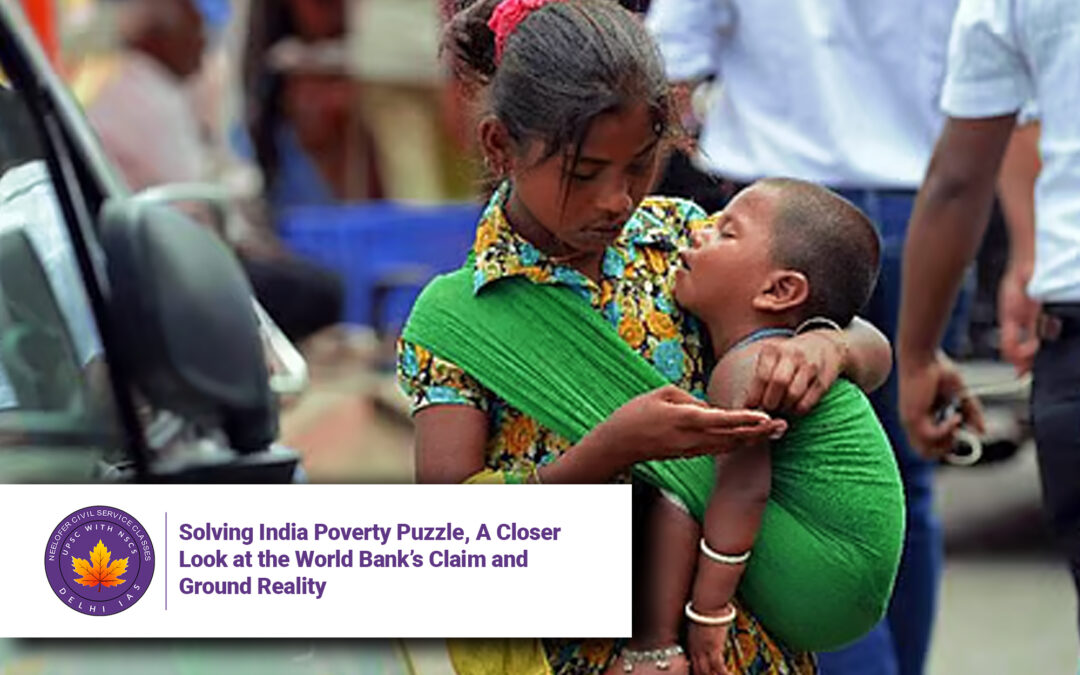
Solving India Poverty Puzzle, A Closer Look at the World Bank’s Claim and Ground Reality
Why in News?
The World Bank, in a recent report released in April, claimed that poverty in India has been nearly eradicated, citing a dramatic drop in the percentage of people living below the revised international poverty line. However, this optimistic assessment has sparked debate among economists, analysts, and public policy experts, highlighting a deeper “poverty puzzle” in the Indian context. 
Introduction
According to the World Bank, the percentage of people in India living below the revised international poverty line of $2.15 per capita per day (2017 PPP) has fallen from 22.5% in 2011-12 to just 3.5% in 2022-23. If accurate, this would mark one of the sharpest declines in global poverty ever recorded. Yet, when juxtaposed with domestic data on health, nutrition, employment, and inequality, the picture appears far more complex.
Key Findings of the World Bank Report
-
A sharp reduction in poverty from 22.5% to 3.5% over a decade.
-
The data is based on National Family Health Surveys and extrapolated using new consumption estimates.
-
The methodology included aligning PPP standards and estimating consumption through imputed rent and food subsidies.
The Contradictions and Criticisms
Economist K. Ninan argues that while the poverty numbers may look impressive, they overlook critical ground realities:
-
Employment & Wages:
A large section of India’s workforce remains underemployed or in low-paying informal jobs. -
Nutrition and Health Indicators:
-
35.5% of Indian children are stunted.
-
19% of children are wasted.
-
Only 8.7% of men and 57% of women consume enough nutritious food daily.
-
-
Inequality and Consumption:
The Oxfam Inequality Report notes that the top 1% controls over 40% of India’s wealth, while the bottom 50% owns just 3%. -
Underestimated Cost of Living:
The $2.15/day poverty line is insufficient to reflect real living conditions in urban or even semi-urban India.
India’s Poverty Landscape Today
Despite economic growth, India continues to face:
-
Malnutrition, poor healthcare access, and educational deficiencies.
-
Low per capita GDP growth and a high dependency on welfare schemes.
-
Growing income inequality, where gains from GDP growth are unevenly distributed.
Key Takeaways
-
The World Bank’s poverty estimate of 3.5% for India is based on global standards and may not reflect real-life deprivation.
-
Indicators such as child malnutrition, lack of access to clean water and education, and job insecurity remain concerning.
-
India’s official poverty line has not been updated since the Tendulkar Committee’s 2011 report.
-
Consumption inequality and the informal economy continue to skew the data.
-
Poverty reduction must be understood in tandem with health, employment, and access to basic services.
Challenges and the Way Forward
Challenges:
-
Disconnect between economic growth and equitable development.
-
Outdated official poverty benchmarks.
-
Poor quality of data and surveys at the national level.
-
Deepening rural-urban disparities.
Way Forward:
-
Revise the national poverty line with realistic consumption benchmarks.
-
Integrate nutritional, employment, and housing metrics into poverty estimates.
-
Expand public health and education services.
-
Strengthen employment guarantees and social protection frameworks.
Q&A Section
1. What is the new global poverty line used by the World Bank?
The revised international poverty line is $2.15 per person per day (in 2017 PPP terms).
2. What percentage of Indians reportedly live below this poverty line, according to the World Bank?
3.5% in 2022-23, down from 22.5% in 2011-12.
3. Why are these figures being questioned?
They do not align with ground realities, such as high levels of malnutrition, poor healthcare access, and persistent income inequality.
4. How has inequality changed during this period?
Oxfam reports show India’s top 1% owns more than 40% of total wealth, while the bottom 50% owns just 3%, highlighting rising inequality.
5. What does the article suggest to improve poverty assessment?
A multidimensional approach incorporating nutrition, education, healthcare, employment, and updated consumption standards.
Conclusion
While India’s fight against poverty has certainly seen significant gains, celebrating near-eradication may be premature. The real challenge lies not just in counting the poor by outdated standards, but in addressing deprivation with sustainable and inclusive development policies. The “poverty puzzle” can only be solved when numbers are matched by lived realities.

