
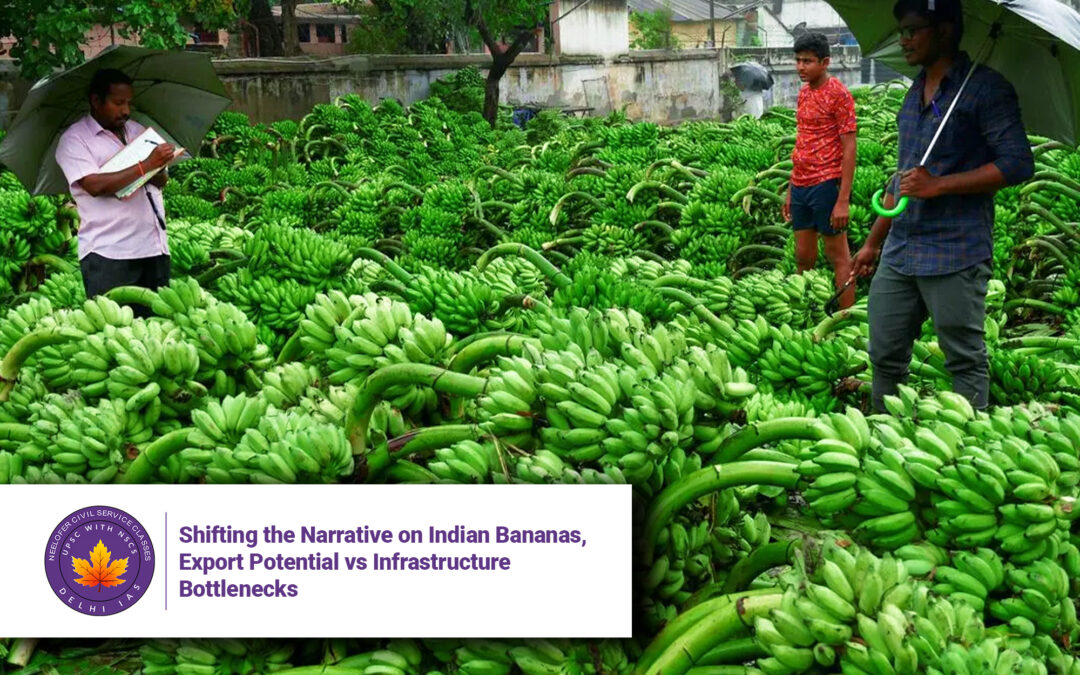
Shifting the Narrative on Indian Bananas, Export Potential vs Infrastructure Bottlenecks
Why in News?
Despite being the largest banana-producing country in the world, India’s banana export share remains just 2%, largely due to infrastructure gaps and global quality perceptions. A new report by UN-KNCO Christian Aid highlights climate-related stress and structural barriers as key concerns, urging renewed attention to banana cultivation in India. 
Introduction
India produces over 37 million tonnes of bananas annually, holding the top rank globally. Yet, this production does not translate into significant exports, with India contributing a mere 2% to global banana exports. The reasons are both domestic (infrastructure and logistics) and international (Western standards and perceptions).
Climate Shift and Regional Impact
-
The UN-KNCO report found that 69% of banana-growing areas in India are under threat due to climate stress, such as:
-
Extreme weather
-
Rising temperatures
-
Uncertain rainfall
-
-
This has caused a regional shift in banana farming:
-
Farmers are moving production within states to adapt to climate conditions.
-
For instance, Tamil Nadu’s banana zones are shifting to different microclimates with better farming conditions.
-
Dr. R. S. Sakharia, Director at ICAR – National Research Centre for Banana, states that though climate may not reduce overall output, it is shifting the zones of cultivation. There is also a noted change in banana varieties grown for different market demands.
India’s Banana Cultivation Landscape
-
India cultivates about 20% of global banana farmland.
-
Regions include:
-
Tropical (South India)
-
Subtropical (North-East India)
-
Semi-arid zones
-
-
Traditional banana belts like Tamil Nadu, Maharashtra, and Andhra Pradesh are now complemented by rising production in the North and East India regions.
Export Challenges: Infrastructure and Perception
Despite India’s abundant banana production, export remains limited due to:
1. Poor Infrastructure
-
Lack of air cargo volume for perishable exports.
-
Cold storage chains are insufficient to preserve freshness.
-
Inadequate port logistics slow down shipment speed.
-
Export via sea is more economical but requires better logistics and container standards.
2. Western Quality Standards
-
Western markets demand a specific “look and size” of bananas, impacting India’s competitiveness.
-
Indian bananas are nutritious but do not always meet cosmetic standards set by the West.
3. Low Branding and Global Awareness
-
Unlike Latin American countries, India has not invested enough in banana branding or global image-building.
-
There is a need to counter Western dominance in banana markets with Indian quality certification and brand promotion.
The Way Forward
To boost banana exports, India must:
-
Modernize export infrastructure, especially for cold chains.
-
Increase air and sea freight capacity for perishable produce.
-
Engage in global quality negotiations to challenge the one-sided standards.
-
Create India-centric banana brands, educating markets on nutrition over looks.
-
Focus on agri-diplomacy and bilateral fruit trade policies, especially with Europe and the Middle East.
Conclusion
India’s banana sector is both an agricultural strength and an underutilized export opportunity. To realize its true potential, India must upgrade logistics, counter unfair global standards, and project Indian bananas as a global superfruit rooted in sustainability, nutrition, and indigenous farming wisdom.
Q&A Section
Q1. Why does India export so few bananas despite being the largest producer?
Because of poor cold chain infrastructure, low air cargo capacity, and Western-dominated quality standards.
Q2. What are the climate-related challenges facing Indian banana farmers?
Rising temperatures, erratic rainfall, and extreme weather are shifting banana-growing zones and affecting yield patterns.
Q3. Which Indian states dominate banana cultivation?
Tamil Nadu, Maharashtra, Andhra Pradesh, and regions in the North and East India have large banana cultivation zones.
Q4. What do Western banana quality standards focus on?
They focus on appearance, uniform size, and texture, which affects exports of Indian bananas despite their high nutrition.
Q5. What steps can India take to boost banana exports?
Improve infrastructure, develop cold chains, establish Indian quality norms, and invest in international banana branding.

