
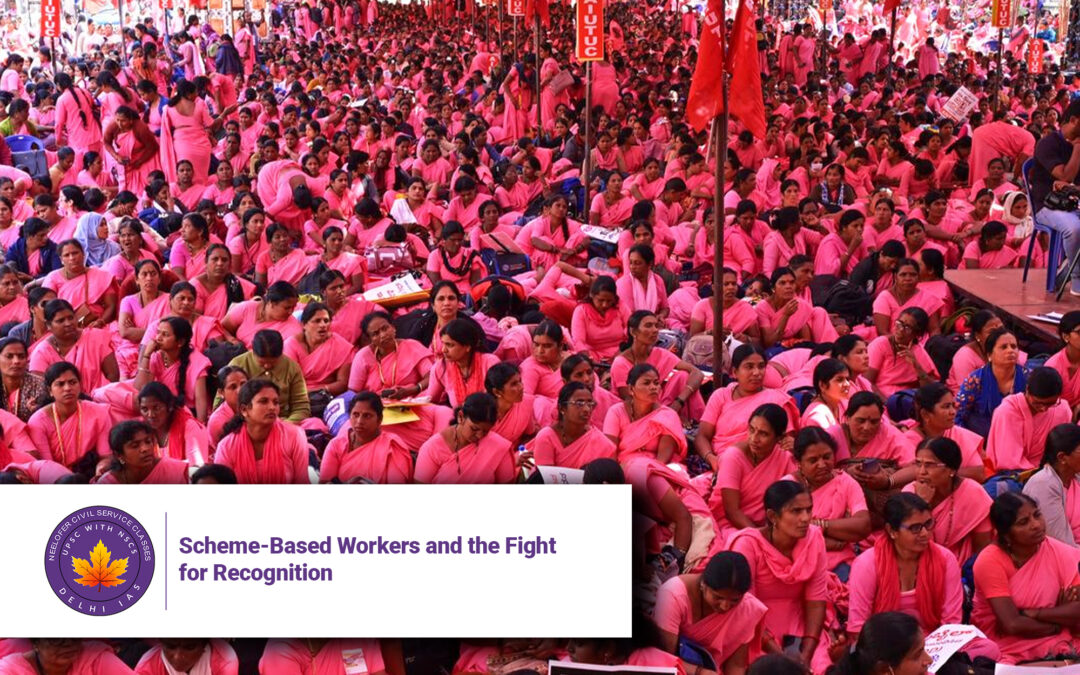
Scheme-Based Workers and the Fight for Recognition
Why in News?
Despite contributing significantly to vital public welfare schemes, scheme-based workers (SBWs) in India continue to be denied basic labour rights, including minimum wages, social security, and formal worker status. Their continued protests, legal victories, and national dialogues have once again brought their long-standing demands into focus. 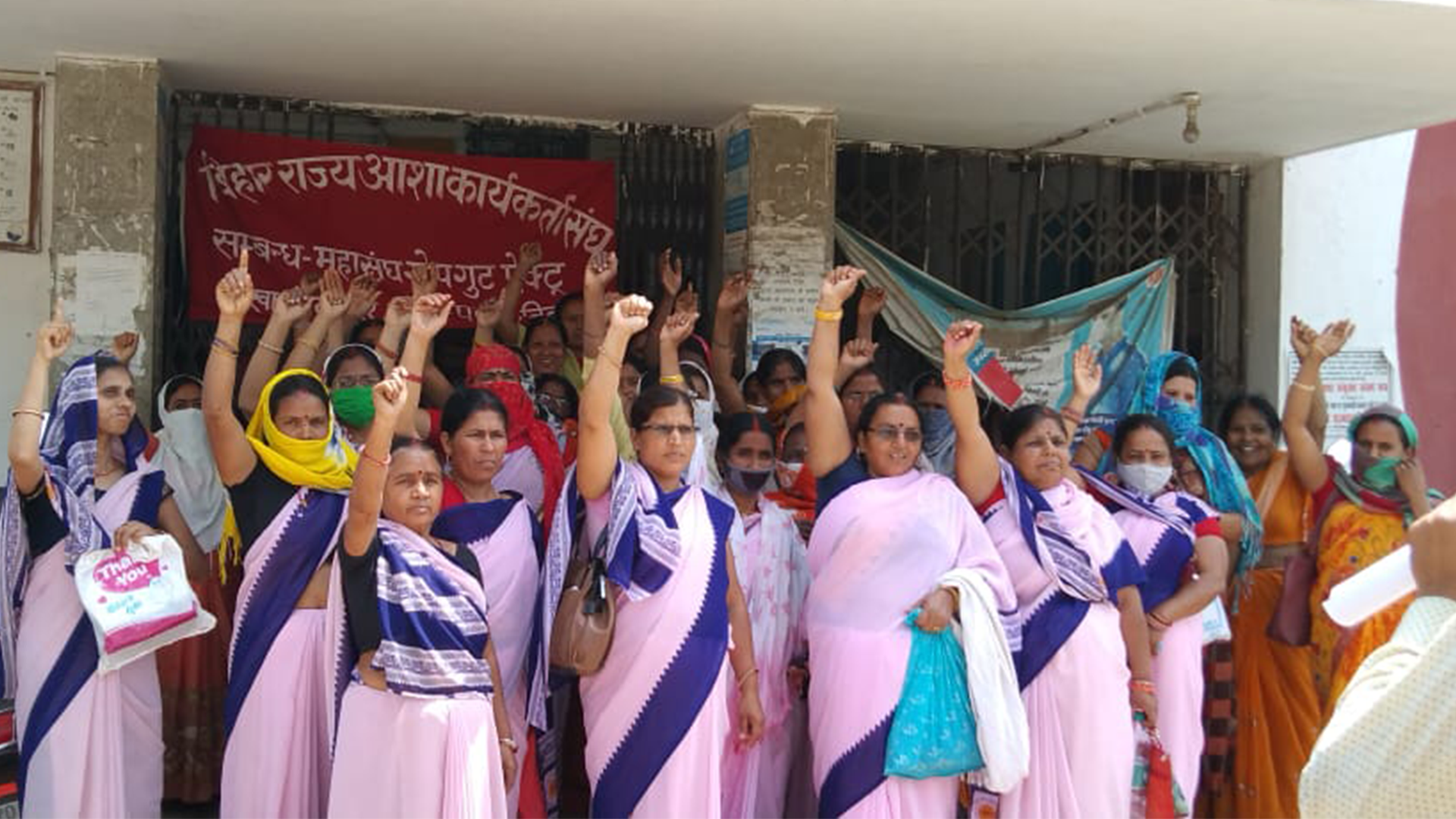
Introduction
The central government employs millions of workers through flagship schemes like the Integrated Child Development Services (ICDS), the National Rural Health Mission (NRHM), and the Mid-Day Meal Scheme. This includes Anganwadi Workers and Helpers, Accredited Social Health Activists (ASHAs), and Mid-Day Meal Workers (MDMWs), totaling over 60 million workers. Yet, these essential workers remain outside the formal framework of labour recognition, with no guaranteed wages, benefits, or dignity of work.
Key Issues and Background
1. Lack of Legal Recognition
Despite being the backbone of public health, education, and nutrition programs, SBWs are not officially recognised as “workers.” This results in a lack of access to fair wages, social security, and statutory protections.
2. Persistent Exploitation
Their duties include caring for children, supporting school enrollment, and managing public health campaigns. Yet, they are paid honorariums instead of wages and face insecure job conditions.
3. Struggles for Rights
SBWs have resorted to strikes, legal actions, and social dialogue. In March 2025, Anganwadis in Kerala staged a 13-day strike, reflecting rising dissatisfaction. Legal setbacks like the 2006 Supreme Court ruling in State of Karnataka v. Umadevi denied them worker status, but later judgments like the 2022 Supreme Court ruling and the 2024 Gujarat High Court judgment began recognizing their rights under laws like the Payment of Gratuity Act.
Five Key Observations
-
Judicial Push for Recognition
Recent court rulings have supported the inclusion of Anganwadi Workers and Helpers under gratuity and suggested their regularisation as Class III and IV employees. -
Central Government’s Reluctance
Despite court pressure and recommendations by the Indian Labour Conference (ILC), the central government has consistently delayed action, citing policy implications and financial costs. -
Political and Union Mobilisation
Major trade unions like AITUC, BMS, and CITU have taken up the SBWs’ cause. Their success often depends on state-level politics and proximity to ruling parties. -
Privatisation Threats
There is growing concern about moves to privatise schemes like ICDS, which could worsen the working conditions and recognition struggles of SBWs. -
Existential Demand, Not Just Economic
SBWs are not simply demanding higher pay. They seek recognition of their identity as “workers”, a dignified status that aligns with their actual contributions.
Challenges and the Way Forward
Challenges:
-
Lack of uniform national policy
-
Financial burden concerns of regularising SBWs
-
Politicisation and administrative inertia
-
Resistance to recognising them as “employees” rather than “volunteers”
Way Forward:
-
Implement ILC’s recommendation to grant SBWs minimum wages, insurance, pensions, and job security
-
Develop a clear roadmap to regularise workers as Class III/IV government employees
-
Ensure judicial directives are followed by both central and state governments
-
Create a social dialogue forum to address their concerns regularly
-
Avoid privatisation that undermines the public welfare framework and the workers within it
Conclusion
Scheme-based workers are the unsung heroes of India’s welfare machinery. Their demands for recognition, rights, and respect are not just economic but rooted in justice and dignity. The central and state governments must stop evading their responsibilities and act on long-pending recommendations. Recognising SBWs as workers is no longer a favour; it is a necessity to uphold the spirit of equity and justice in India’s labour system.
5 Questions and Answers
Q1: Who are considered scheme-based workers (SBWs)?
A: Workers like Anganwadi Workers/Helpers, ASHAs, and Mid-Day Meal Workers employed under central government schemes such as ICDS, NRHM, and MDM.
Q2: What are the key demands of SBWs?
A: They demand formal recognition as workers, minimum wages, social security, and job regularisation.
Q3: How has the judiciary responded to their demands?
A: Courts have progressively acknowledged their rights, granting gratuity eligibility and recommending regularisation under public employment grades.
Q4: What is the central government’s stance?
A: While acknowledging their importance, the government often delays implementation citing financial implications and policy complexity.
Q5: Why is this demand not just about wages?
A: SBWs seek the status of “workers” as a recognition of their essential contributions, not just financial compensation. It’s about dignity and identity.

