
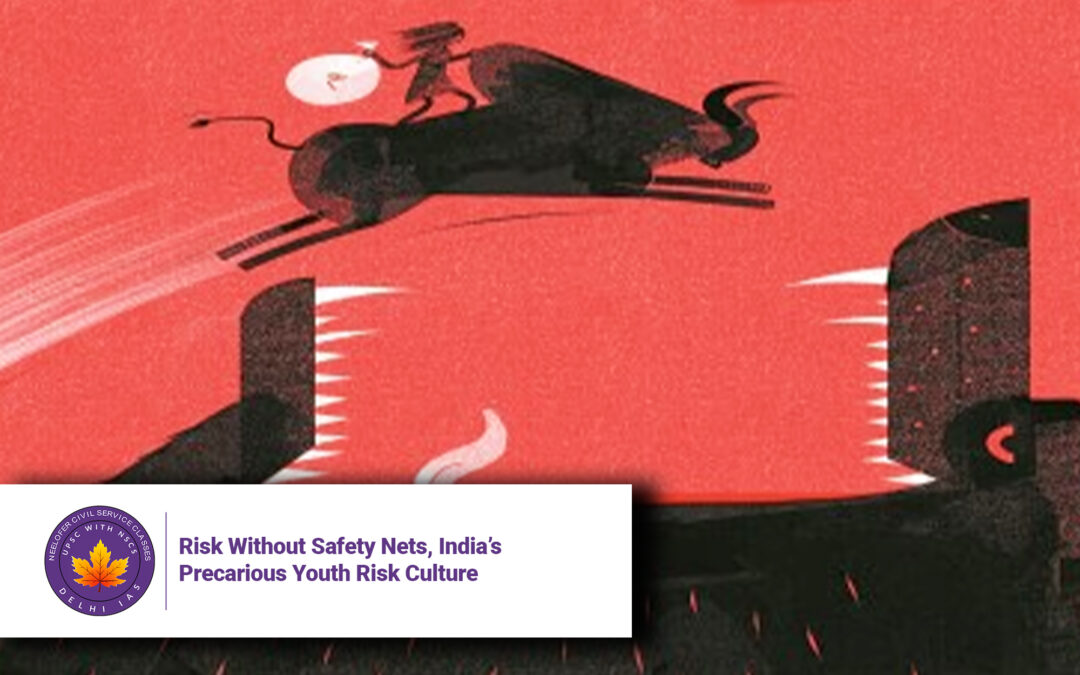
Risk Without Safety Nets, India’s Precarious Youth Risk Culture
Why in News?
A growing trend of Indian youth embracing risky economic, personal, and career choices amid the absence of institutional and social safety nets has reignited concerns over the country’s precarious risk culture, especially when compared to Western counterparts. 
Introduction
Indian youth today are active participants in what can be termed the “new economies of danger” — spaces where high risks are taken with little structural support or fallback. While risk-taking has been normalized in modern societies globally, India’s context is unique and concerning due to inadequate support systems and the continued erosion of traditional networks of security.
Key Issues
-
Erosion of Safety Nets: In many countries, increased risk-taking has coincided with stronger government or community support structures. However, in India, traditional forms of security like family and community are weakening, with no equivalent institutional replacements.
-
Neo-liberal Economic Shifts: Post-1990s liberalization and reforms triggered a wave of new aspirations, especially among the youth. Yet, the infrastructure to back these aspirations, such as healthcare, employment stability, or social welfare, has not kept pace.
-
Gender and Social Vulnerability: Risk-taking behavior is not equally distributed. Women, marginalized groups, and lower-income youth often face more dangerous consequences for the same risks taken by the more privileged.
-
Romanticization of Risk: Media narratives and cultural shifts often glorify entrepreneurial leaps or unconventional choices, masking the dangers and costs when support systems fail.
-
Cultural Transition: India is transitioning from traditional, community-based security to individual responsibility without the necessary social framework in place to support such a transition.
Challenges and the Way Forward
-
Build Institutional Safety: To mitigate precarity, there must be deliberate efforts to build structures that provide fallback options—unemployment benefits, accessible mental health support, and universal healthcare.
-
Recognize Diverse Experiences: Risk must be contextualized. It is essential to differentiate between privileged risk (where failure is survivable) and marginalized risk (where failure can be fatal).
-
Strengthen Civic Systems: Better regulation, accountability, and community involvement in public services are crucial to support aspirational youth without setting them up for severe consequences.
-
Inclusive Policies: Policymakers must account for socioeconomic diversity when shaping employment, education, and welfare policies.
Conclusion
India stands at a critical intersection where dreams are soaring but safety nets are shrinking. Encouraging ambition is vital, but doing so without building strong support frameworks risks turning the energy of a generation into a wave of disillusionment. Risk culture without protection is not bravery—it’s systemic negligence.
5 Q&A Based on the Article
Q1. What does the article mean by “new economies of danger”?
A: It refers to spaces where individuals, especially youth, engage in high-risk economic or life decisions—such as freelancing, startups, or migration—without traditional or institutional safeguards.
Q2. How does India’s risk culture differ from that of Western countries?
A: Unlike in many Western societies where risk-taking is cushioned by social security and government support, India’s youth face risks without such protections, making consequences more severe.
Q3. What has led to increased risk-taking among Indian youth?
A: Economic liberalization, global media influence, and a rise in aspirations have encouraged youth to pursue unconventional paths, often romanticized as success stories.
Q4. Why is risk-taking more dangerous for marginalized groups in India?
A: These groups lack the family wealth, social connections, or institutional support to fall back on if their risks fail, making their situation far more precarious.
Q5. What can be done to create a healthier risk culture in India?
A: Strengthening social safety nets, recognizing unequal consequences of risk, and ensuring inclusive, supportive policies for all sections of society.

