
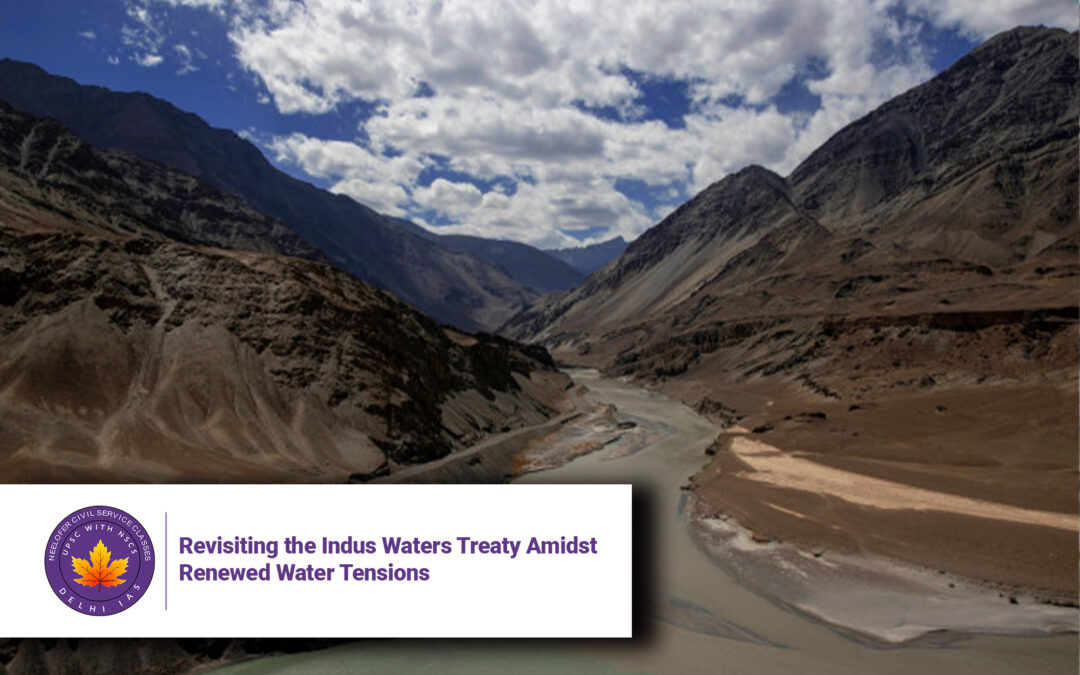
Revisiting the Indus Waters Treaty Amidst Renewed Water Tensions
Why in News?
With the recent renewed hostilities and terror attacks between India and Pakistan, the long-standing Indus Waters Treaty (IWT), signed in 1960, has come under public and diplomatic scrutiny once again. The treaty has often been hailed as one of the most successful water-sharing agreements in the world but is now being critically reassessed due to continued tensions. 
Introduction
The Indus Waters Treaty, signed on September 19, 1960, by Prime Minister Jawaharlal Nehru and Pakistani President Mohammad Ayub Khan in Karachi, was brokered by the World Bank to resolve disputes over the sharing of six rivers of the Indus River system. However, with the killing of 26 Indian soldiers in a recent terrorist attack in Poonch on April 23, 2023, the debate over whether India should continue honoring the treaty has intensified.
Historical Background
Before the partition of 1947, water from the Indus river system flowed freely. However, after the creation of Pakistan, disputes arose over the use of water, particularly from the Central Bari Doab and the Dipalpur Canal. In response to water stoppages and political confrontations, several interim agreements were put in place.
Eventually, the IWT was signed after 12 years of negotiation, largely thanks to World Bank mediation. Under this treaty:
-
India received control over the eastern rivers: Ravi, Beas, and Sutlej.
-
Pakistan received control over the western rivers: Indus, Chenab, and Jhelum.
India was also required to provide financial compensation for construction of replacement canals in Pakistan.
Key Features of the Treaty
-
India had to pay £62 million (₹116 crore) to Pakistan in three equal installments for its infrastructure.
-
The agreement was so specific and detailed that it assigned daily water shares, conflict-resolution mechanisms, and ensured World Bank supervision.
-
The World Bank established the Permanent Indus Commission to manage treaty-related issues.
Present-Day Concerns and Relevance
India has never revoked or suspended the treaty, even during wars or severe cross-border tensions. However, growing frustration over Pakistan’s continued sponsorship of terrorism, and its legal challenge to Indian hydroelectric projects, has led to increased calls for reviewing or withdrawing from the treaty.
The treaty is again in the spotlight due to the terrorist attack in Poonch, with many in India questioning why a treaty meant to encourage peace continues to be honored despite provocations.
Conclusion
While the Indus Waters Treaty is globally praised for surviving wars and hostility, its future depends on political will and mutual trust—both of which are fragile today. India continues to face the dilemma of being a responsible global actor versus protecting its own national security and strategic interests.
5 Questions and Answers
Q1: What is the Indus Waters Treaty and when was it signed?
A: The IWT is a water-sharing agreement signed on September 19, 1960, between India and Pakistan with the mediation of the World Bank, allocating the Indus river system between the two nations.
Q2: Which rivers were allocated to India and which to Pakistan under the treaty?
A: India got Ravi, Beas, and Sutlej, while Pakistan got Indus, Jhelum, and Chenab.
Q3: What recent event has reignited debate over the IWT?
A: The terror attack in Poonch on April 23, 2023, that killed 26 Indian soldiers has reignited calls to review or scrap the treaty.
Q4: What role did the World Bank play in the IWT?
A: The World Bank acted as mediator, facilitated funding, and established the Permanent Indus Commission for ongoing treaty implementation.
Q5: Has India ever withdrawn from the treaty during previous wars?
A: No, India has honored the treaty even during the 1965 and 1971 wars, as well as during the Kargil conflict.

