
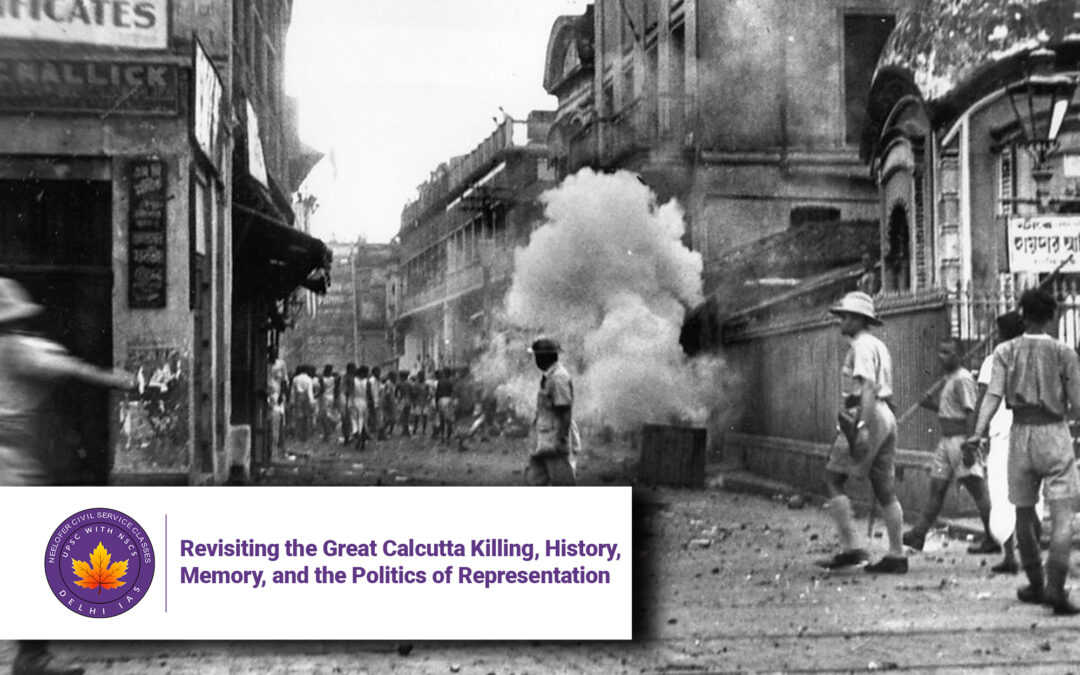
Revisiting the Great Calcutta Killing, History, Memory, and the Politics of Representation
Why in News?
The upcoming film The Bengali Files by filmmaker Vivek Agnihotri has sparked controversy for its portrayal of Gopal ‘Patha’ Mukherjee, a key figure in the Great Calcutta Killing of August 1946. The film’s trailer depicts Mukherjee as a Hindu nationalist vigilante, wielding a sword and blaming Mahatma Gandhi for the Partition. This representation has drawn criticism from Mukherjee’s grandson, Shantanu Mukherjee, who alleges that the film distorts his grandfather’s legacy and reduces a complex historical narrative to sensationalist propaganda. The controversy underscores the ongoing tensions over the memory of Partition-era violence and the political instrumentalization of history in contemporary India. This article examines the historical context of the Great Calcutta Killing, the role of Gopal Mukherjee, and the implications of cinematic representations for public understanding of this traumatic period.
Introduction
The Great Calcutta Killing of August 1946 remains one of the most brutal episodes of communal violence in South Asian history. Over four days, between 5,000 and 10,000 people were killed in clashes between Hindus and Muslims, foreshadowing the horrors of Partition. At the center of this violence was Gopal ‘Patha’ Mukherjee, a local strongman who organized Hindu resistance against Muslim rioters. His actions have been interpreted variously as heroic defense or sectarian brutality, reflecting the polarized narratives that continue to define India’s historical memory. The recent controversy over The Bengali Files highlights how historical events are often repurposed for contemporary political agendas, raising questions about accountability, representation, and the ethics of storytelling. This article explores the historical facts, the legacy of violence, and the enduring impact of the Great Calcutta Killing on Indian society.
Key Issues and Background
1. Historical Context: The Road to Partition
By 1946, the Indian independence movement had reached a critical juncture. The Muslim League, under Muhammad Ali Jinnah, had rejected the Cabinet Mission Plan, which proposed a united India with a decentralized federal structure. Instead, Jinnah declared August 16, 1946, as Direct Action Day, demanding the creation of Pakistan. The call for “direct action” was intended to demonstrate Muslim solidarity but quickly escalated into violence.
2. The Role of H.S. Suhrawardy
As the Prime Minister of Bengal, H.S. Suhrawardy played a controversial role in the violence. Historians accuse him of inciting Muslim mobs and deliberately restraining the police, allowing the violence to spiral. His speech in Calcutta’s Maidan, attended by an estimated 100,000 people, is seen as a catalyst for the bloodshed.
3. The Violence Unfolds
The violence began on August 16 and continued for four days, with mobs using knives, rods, firebombs, and pistols to attack civilians. The military was only called in on August 19, by which time the city had descended into chaos. American photojournalist Margaret Bourke-White documented the horrors, capturing images of vultures feasting on corpses in the streets.
4. Gopal ‘Patha’ Mukherjee: Vigilante or Defender?
Gopal Mukherjee, a local meat-shop owner, emerged as a leader of Hindu resistance. He organized a group of 800 young men to protect Hindu neighborhoods from Muslim rioters. While his supporters view him as a savior who prevented Calcutta from becoming part of Pakistan, critics label him a communalist who perpetuated the cycle of violence.
5. The Aftermath and Legacy
The Great Calcutta Killing deepened communal divisions and set the stage for Partition. It also established a pattern of violence that would repeat in Punjab, Delhi, and elsewhere. The memory of the event remains contested, with different groups claiming victimhood or valor.
Specific Impacts or Effects
1. Communal Polarization
The violence entrenched Hindu-Muslim divisions, making reconciliation increasingly difficult. It also galvanized support for Partition, as communities lost faith in the possibility of peaceful coexistence.
2. Political Consequences
The failure of the British administration and local government to control the violence exposed the fragility of colonial governance and accelerated the transfer of power.
3. Historical Memory
The event has been memorialized in divergent ways, with Hindu nationalist narratives emphasizing Muslim aggression and secular accounts highlighting the shared tragedy.
4. Contemporary Relevance
The controversy over The Bengali Files reflects ongoing debates about history, identity, and the role of media in shaping public perception.
Challenges and the Way Forward
Challenges
-
Historical Distortion: Political agendas often distort historical events, perpetuating division.
-
Communal Tensions: The memory of violence can be weaponized to fuel contemporary hostility.
-
Ethical Storytelling: Filmmakers and historians face the challenge of representing trauma without sensationalism.
Steps Forward
-
Inclusive Narratives: Promote histories that acknowledge the suffering of all communities.
-
Educational Reform: Integrate balanced accounts of Partition into school curricula.
-
Dialogue and Reconciliation: Encourage inter-community dialogues to heal historical wounds.
-
Responsible Media: Encourage filmmakers and journalists to adhere to ethical standards in representing violence.
Conclusion
The Great Calcutta Killing stands as a somber reminder of the human cost of communal politics. The figure of Gopal ‘Patha’ Mukherjee embodies the complexities of that era—a man driven by duty yet implicated in violence. As India grapples with its past, it is essential to approach history with nuance and empathy, recognizing that heroism and brutality often coexist. The controversy over The Bengali Files is not merely about one film but about who gets to tell the story and to what end. In remembering the tragedies of 1946, we must strive for a narrative that honors the victims and fosters reconciliation rather than division.
5 Questions and Answers
Q1: What was Direct Action Day?
A: Direct Action Day was called by the Muslim League on August 16, 1946, to demand the creation of Pakistan. It escalated into violent riots in Calcutta.
Q2: Who was Gopal ‘Patha’ Mukherjee?
A: He was a Hindu vigilante who organized resistance against Muslim rioters during the Great Calcutta Killing.
Q3: What role did H.S. Suhrawardy play?
A: As Prime Minister of Bengal, he is accused of inciting violence and preventing police intervention.
Q4: How did the Great Calcutta Killing impact Partition?
A: It deepened communal divisions and made Partition inevitable.
Q5: Why is The Bengali Files controversial?
A: It is accused of distorting history and promoting a partisan narrative of the violence.

