
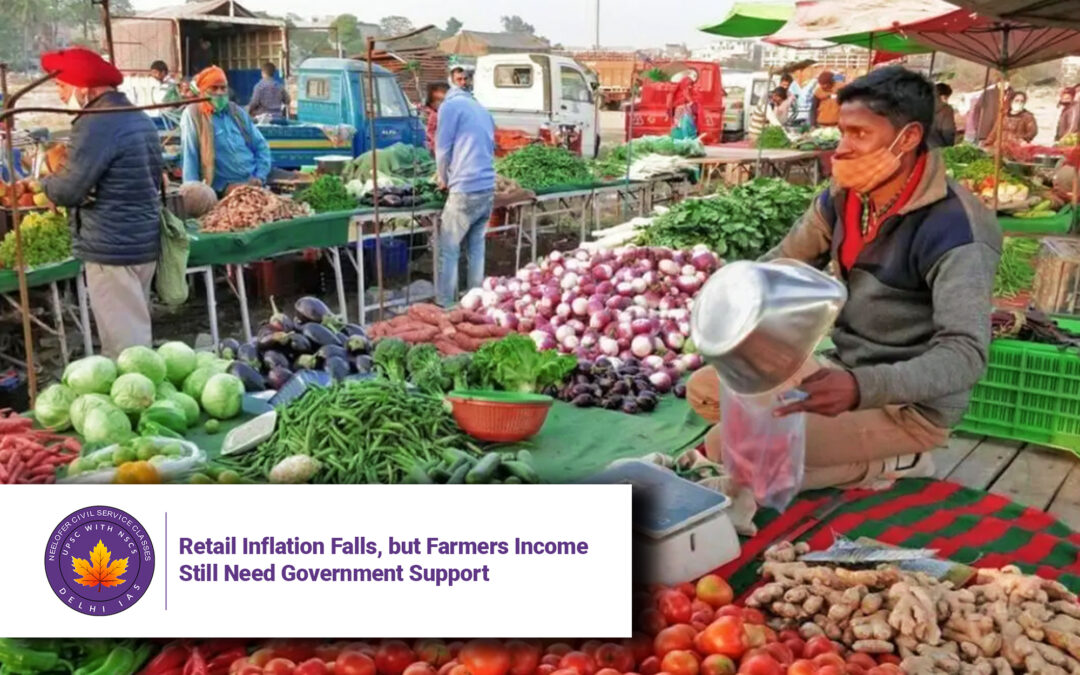
Retail Inflation Falls, but Farmers Income Still Need Government Support
Why in News?
India’s retail inflation in March 2025 dropped to a near two-year low of 3.34%, giving the Reserve Bank of India (RBI) room to cut interest rates further. However, despite this positive macroeconomic trend, farmers are struggling with low incomes, price crashes for produce, and high post-harvest losses, highlighting the need for urgent government action. 
Introduction
The drop in inflation is often seen as a sign of economic stability and growth. However, for India’s farmers—who are already battling low prices, erratic weather, and market instability—this comes with new challenges. The current economic conditions are reducing food prices sharply, but this is lowering farmer income, which could hurt long-term rural demand and overall economic health.
Key Issues and Institutional Concerns
1. Retail and Food Inflation Trends
Retail inflation dropped to 3.34% in March 2025, down significantly from 6.6% in October 2024. The decline was driven largely by a sharp fall in vegetable prices (down 7.04%) and other food categories. While beneficial for consumers, this price drop is hurting producers.
2. Post-Harvest Losses
According to the Ministry of Food Processing, post-harvest losses in India reach ₹1.52 lakh crore every year, especially due to poor storage and lack of infrastructure for perishables like tomatoes and onions. In Andhra Pradesh, tomato prices fell to ₹1/kg recently due to overproduction and lack of proper market channels.
3. Farmer Income and Structural Issues
A significant 86% of Indian farmers operate on less than two hectares of land. NABARD data shows average monthly income at ₹13,661, and older NSSO data (2019) estimates it at ₹10,218. These figures remain low, especially compared to other emerging economies.
4. Rural Consumption and Demand
While urban consumption is slowly recovering, rural demand is still weak. This is a worrying trend as rural India forms the backbone of the country’s consumption economy.
Challenges and the Way Forward
-
Develop Cold Storage and Transport Infrastructure: Reducing post-harvest losses will require investment in cold chains and market-linked storage facilities.
-
Stabilize Prices with MSP and Procurement: Expanding the government’s procurement to more crops and at fair prices can help protect farmers against sudden crashes.
-
Encourage Food Processing: Strengthening food processing can absorb excess supply, reduce waste, and provide higher prices to farmers.
-
Boost Rural Incomes: Direct income support schemes, better market access, and diversification of crops can help stabilize farmer livelihoods.
-
Strengthen Farmer Producer Organizations (FPOs): Helping farmers organize will give them better bargaining power in markets and reduce dependency on middlemen.
Conclusion
India’s falling inflation is good news for the economy, but unless steps are taken to support farmers, the benefits will not be equally shared. The government must focus on strengthening infrastructure, securing better prices for farm produce, and boosting farmer incomes to ensure a balanced and inclusive recovery.
Q&A Section
Q1. What is India’s retail inflation rate in March 2025?
It dropped to 3.34%, a near two-year low.
Q2. Why is falling inflation not entirely good for farmers?
Because it lowers food prices, which reduces the income farmers get for their produce.
Q3. How much are India’s annual post-harvest losses estimated at?
₹1.52 lakh crore, due to lack of cold storage and proper transport.
Q4. What is the average monthly income of Indian farmers?
As per NABARD, it is ₹13,661. According to older NSSO estimates, it is ₹10,218.
Q5. What can the government do to help farmers during low inflation?
Improve infrastructure, expand minimum support prices, invest in cold storage, support food processing, and provide income security schemes.

