
Reforming Indian Colonial Era Bureaucracy for a Deep Tech Future
Why in News?
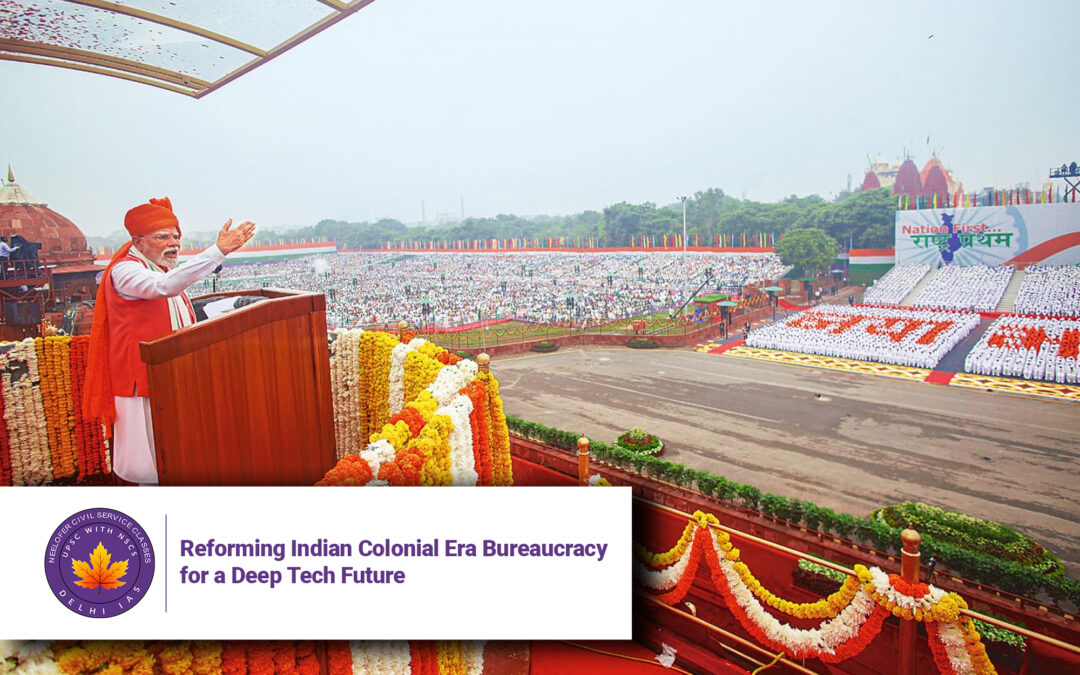
In his Independence Day address from the Red Fort, Prime Minister Narendra Modi emphasized the need for India to achieve self-reliance (atmanirbharta) in frontier technologies such as semiconductors, artificial intelligence, quantum computing, and aerospace. However, the success of this deep-tech push hinges on overcoming systemic bottlenecks rooted in India’s colonial-era bureaucracy, regulatory frameworks, and judiciary. Despite global recognition in mid-tech sectors like fintech, India remains import-dependent in critical high-tech areas. This analysis explores the imperative of administrative reforms to dismantle the “steel frame” of the Indian Civil Service, inherited from British rule, and create a responsive, accountable, and innovation-friendly governance structure.
Introduction
India’s journey from a colonial economy to a global technology player has been remarkable. With the world’s largest per capita data consumption (32 GB) and hubs like Bengaluru and Hyderabad leading innovation, the country has made significant strides in digitalization. However, as Prime Modi’s vision shifts toward deep-tech—AI, quantum computing, robotics, and beyond—the limitations of India’s governance structures become apparent. The bureaucracy, often described as a “steel frame,” remains entrenched in colonial-era rules and procedures that stifle innovation, delay decision-making, and hinder accountability. This analysis examines the historical context of India’s administrative system, its challenges, and the reforms necessary to align governance with the ambitions of a Viksit Bharat (Developed India).
Key Issues
1. Colonial Legacy of the Bureaucracy
-
Historical Context: The Indian Civil Service (ICS), now the Indian Administrative Service (IAS), was designed by British administrators to maintain control and ensure subservience. The Public Service Commission (1926) was established to train Indians for bureaucratic roles but within a framework prioritizing obedience over innovation.
-
Persistence of Colonial Mindset: Despite independence, the bureaucracy retains hierarchical, rule-bound approaches that resist change, prioritize process over outcomes, and lack domain expertise.
-
UPSC Centenary: 2026 marks 100 years of the UPSC, presenting an opportunity to overhaul recruitment and training systems.
2. Challenges in Deep-Tech Advancement
-
Import Dependency: India relies heavily on imports for critical technologies like semiconductors, jet engines, and advanced robotics. For instance, over 90% of semiconductors are imported.
-
Talent vs. Execution: While India has a vast talent pool—evidenced by R&D centers of global giants like Nvidia and IBM—bureaucratic red tape slows down policy implementation, research funding, and public-private partnerships.
-
Regulatory Hurdles: Complex compliance requirements, overlapping jurisdictions, and slow approvals deter investment and innovation in deep-tech sectors.
3. Ineffectiveness of Past Reforms
-
Veerappa Moily Committee (2005): Recommended direct appointment of domain experts, a code of ethics, and accountability mechanisms. Most suggestions remain unimplemented.
-
Lateral Entry Scheme: PM Modi’s initiative to bring outside experts into senior government roles has seen limited success due to resistance from the entrenched bureaucracy.
-
Deregulation Commission: Formed in 2024 to identify redundant compliance burdens, but its impact is yet to be seen.
4. Global Comparisons
-
United States: Political leadership has supremacy over bureaucracy, with flexibility to appoint domain experts (e.g., tech leaders in defense projects).
-
China: Bureaucracy is tightly controlled by the Communist Party, ensuring rapid execution of strategic priorities like AI and semiconductors.
-
United Kingdom: Recent debates under Boris Johnson’s advisor Dominique Cummings advocated opening senior roles to external competition and increasing ministerial control.
5. PM Modi’s Vision and Roadblocks
-
Technology Push: Initiatives like the Semiconductor Mission, National Quantum Strategy, and Jet Engine Development require agile decision-making and public-private collaboration.
-
Bureaucratic Resistance: The existing system favors generalists over specialists, discourages risk-taking, and delays projects through endless file movements.
-
Accountability Deficit: Lack of consequences for inefficiency or corruption perpetuates status quo.
Alternative Approaches
-
Overhauling Recruitment and Training
-
Domain-Specific Recruitment: Reserve a percentage of senior positions for specialists in technology, economics, and law.
-
Reform UPSC: Introduce exams focused on innovation, problem-solving, and technical knowledge alongside traditional subjects.
-
Continuous Training: Mandate mid-career upskilling in emerging technologies and governance innovations.
-
-
Enhancing Accountability and Ethics
-
Code of Ethics: Implement the Moily Committee’s recommendation for a legally enforceable code of conduct for bureaucrats.
-
Performance-Linked Promotions: Base advancements on outcomes (e.g., project completion, ease of doing business) rather than seniority.
-
Digital Governance: Use AI and blockchain to automate processes, reduce discretion, and ensure transparency.
-
-
Regulatory Reforms
-
Single-Window Clearances: Create unified platforms for deep-tech projects involving multiple ministries (e.g., defense, electronics, environment).
-
Sandbox Frameworks: Allow testing of new technologies in controlled environments without full regulatory compliance.
-
Fast-Track Courts: Resolve technology-related disputes swiftly to boost investor confidence.
-
-
Public-Private Collaboration
-
Innovation Fellowships: Attract private sector experts to work on government projects for fixed terms.
-
R&D Funding: Increase grants for deep-tech startups and research institutions with simplified application processes.
-
Global Benchmarks: Adopt best practices from countries like Israel (cybersecurity) and South Korea (semiconductors).
-
-
Political Empowerment
-
Ministerial Control: Empower ministers to hire and fire bureaucrats based on performance, as in the UK model.
-
National Technology Council: Create a high-level body chaired by the PM to oversee deep-tech initiatives and bypass bureaucratic delays.
-
Challenges and the Way Forward
-
Resistance to Change: The bureaucracy’s inertia and vested interests will oppose reforms.
-
Implementation Gap: Past committees’ recommendations have gathered dust due to lack of political will.
-
Balancing Stability and Innovation: While accountability is needed, excessive political control should not lead to patronage-based appointments.
The Way Forward:
-
PM Modi’s Leadership: His popularity and mandate provide a unique opportunity to drive administrative reforms.
-
Phased Approach: Start with pilot projects in deep-tech sectors, gradually expanding reforms.
-
Stakeholder Engagement: Involve industry leaders, academics, and civil society in designing reforms.
-
Legislative Support: Pass laws to institutionalize changes, such as the Indian Administrative Service (Reform) Bill.
Conclusion
Prime Minister Modi’s vision for a self-reliant India in deep-tech is achievable only if the colonial foundations of its governance are replaced with a modern, agile, and accountable system. The bureaucracy’s “steel frame” must be reforged into a flexible structure that encourages innovation, rewards performance, and serves the citizens. As India prepares to celebrate the UPSC’s centenary in 2026, it is time to redefine the role of the civil servant from a regulator to an enabler. The future of Viksit Bharat depends not just on technological prowess but on the administrative revolution that supports it.
5 MCQs Based on the Article
Q1. What is the main obstacle to India’s deep-tech advancement according to the article?
A) Lack of talent
B) Colonial-era bureaucracy
C) Insufficient funding
D) Global competition
Answer: B) Colonial-era bureaucracy
Q2. Which committee recommended the direct appointment of domain experts in bureaucracy?
A) Sarkaria Commission
B) Veerappa Moily Committee
C) Sinho Commission
D) NITI Aayog Committee
Answer: B) Veerappa Moily Committee
Q3. What percentage of semiconductors does India import?
A) 50%
B) 70%
C) 90%
D) 100%
Answer: C) 90%
Q4. Which country’s recent bureaucratic reforms were led by Dominique Cummings?
A) United States
B) China
C) United Kingdom
D) Australia
Answer: C) United Kingdom
Q5. What is India’s per capita data consumption as mentioned in the article?
A) 22 GB
B) 29 GB
C) 32 GB
D) 35 GB
Answer: C) 32 GB

