
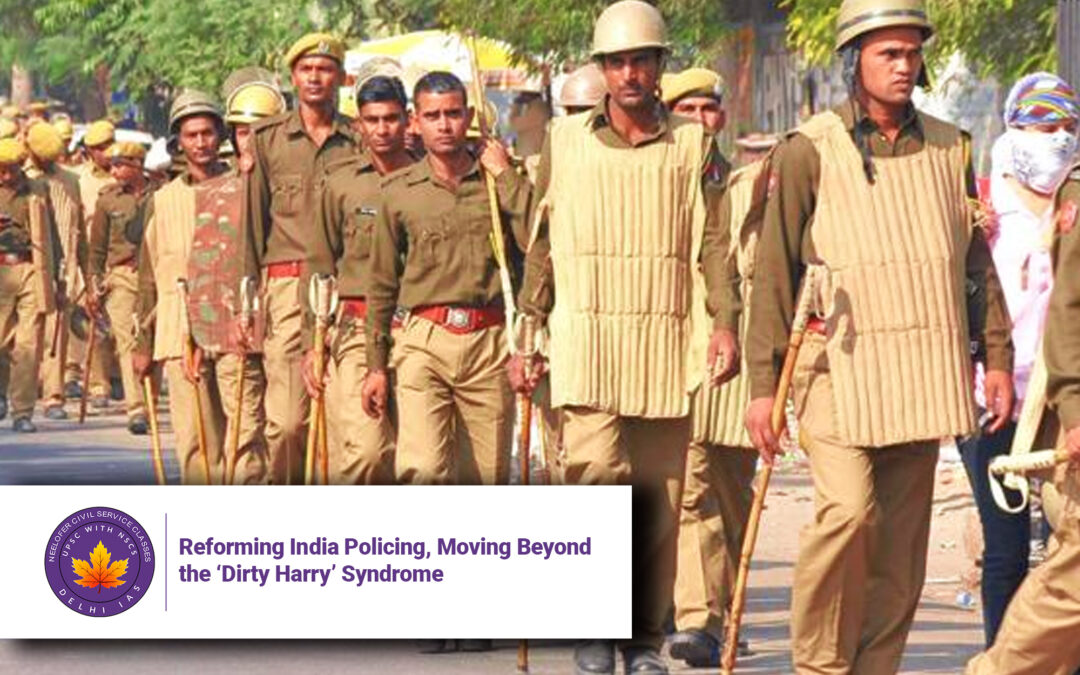
Reforming India Policing, Moving Beyond the ‘Dirty Harry’ Syndrome
Why in News:
The custodial death of Ajith Kumar in Tamil Nadu has revived a national debate on India’s policing culture—specifically, the widespread use of torture and coercion under the guise of justice delivery. The call is growing louder to overhaul the system and shift from a “Dirty Harry”-style policing model to a rule-based, rights-oriented approach.
Introduction:
India’s criminal justice system has long been haunted by the dilemma between brute efficiency and lawful diligence. In popular culture, two fictional detectives—Sherlock Holmes and Dirty Harry—symbolize this divide. Holmes, calm and methodical, represents due process. Dirty Harry, impatient and brutal, represents swift, lawless punishment. Increasingly, India’s policing system is leaning toward the latter, jeopardizing democratic values, human rights, and institutional credibility.
Key Issues and Background:
-
A Culture of Impunity:
The Tamil Nadu custodial death of Ajith Kumar—a 27-year-old remand prisoner—echoes systemic issues. The Tamil Nadu Police Commission has highlighted alarming trends:-
65% of people in police custody (2018–2023) were held illegally.
-
States with the highest numbers of custodial deaths include Gujarat (53), Maharashtra (68), Madhya Pradesh (50), and Tamil Nadu (69).
-
Few cases lead to convictions; only 4 police personnel were convicted during that period.
-
-
Normalisation of Torture:
Custodial violence is often justified as a means to speed up investigations or obtain confessions. However, the Supreme Court in D.K. Basu (1996) and K.S. Puttaswamy (2017) reinforced that dignity and autonomy are non-negotiable rights, yet the practice of torture remains rampant. India has failed to ratify the UN Convention Against Torture (despite signing it in 1997).
Specific Impacts or Effects:
-
Torture Doesn’t Guarantee Truth:
Global research and real-world cases repeatedly show that torture is ineffective at extracting reliable information. Examples include:-
CIA black sites, where detainees gave false confessions under duress.
-
In the Birmingham bombing case (UK), innocent people were convicted based on forced confessions.
-
The 2009 Mumbai attack case, where Ajmal Kasab’s fair trial and execution, contrasted with unethical methods, earned global respect.
-
-
Psychological Trauma & Loss of Faith:
Victims suffer long-term mental and emotional damage. Public trust in police erodes, especially among vulnerable communities. -
Tarnished Global Image:
India’s repeated failures to reform policing practices hinder its global human rights credibility, and dent its position as the world’s largest democracy.
Challenges and the Way Forward:
-
Need for Legislative Reform:
India must enact standalone anti-torture laws. Despite recommendations by the Law Commission and NHRC, Parliament has failed to pass meaningful legislation. -
Training and Mindset Shift:
Police training must focus on investigative skills, forensics, and human rights, rather than coercion. -
Strengthening Oversight Mechanisms:
Independent oversight boards, internal affairs units, and civilian review panels can help monitor abuses. -
Shift Towards Rule-Based Policing:
We need a police force that values professionalism over fear, and due process over violence—a culture where justice isn’t just quick, but also fair.
Conclusion:
India is at a crossroads. The temptation to use fear and force in policing may offer short-term gains but causes long-term democratic damage. Torture cannot be the price paid for efficiency. India must choose between Dirty Harry’s gun and Sherlock Holmes’ magnifying glass.
The choice is clear: uphold rule of law, protect human dignity, and reform the police in spirit and practice. It’s time India stepped out of Dirty Harry’s shadow—and into the light of justice.
5 Questions and Answers:
1. What triggered the renewed debate on custodial torture in India?
The custodial death of Ajith Kumar in Tamil Nadu reignited concerns about police brutality and impunity.
2. What are the main criticisms of India’s current policing approach?
It often relies on coercion, lacks transparency, and prioritizes quick confessions over proper investigations.
3. Has India legally outlawed torture?
No. India signed but has not ratified the UN Convention Against Torture, and lacks a standalone anti-torture law.
4. What are some global examples that show torture doesn’t work?
The CIA’s black sites and the Birmingham bombing case highlight how torture led to false confessions and wrongful convictions.
5. What reforms are urgently needed?
India needs legal safeguards, human rights-based training for police, independent oversight bodies, and an end to the culture of impunity.

