
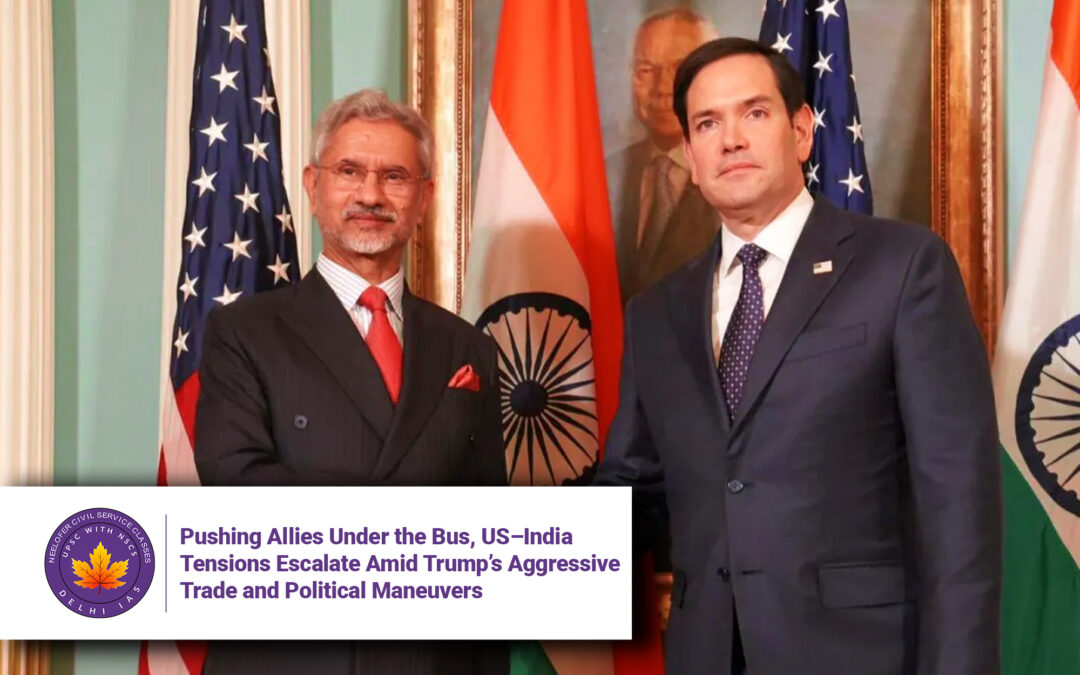
Pushing Allies Under the Bus, US–India Tensions Escalate Amid Trump’s Aggressive Trade and Political Maneuvers
Why in News?
Recent tensions between India and the United States have intensified after former US President Donald Trump’s renewed criticisms and imposition of additional tariffs on Indian goods. The developments followed Indian Prime Minister Narendra Modi’s statement in Parliament regarding Operation Sindoors and his firm rejection of any external pressure to stop the operation. Trump’s remarks and actions — including a clear shift toward closer ties with Pakistan — have sparked concern in New Delhi about the trajectory of Indo–US relations, especially in the context of shifting global alliances, trade disputes, and the ongoing geopolitical chess game in the Indo-Pacific.
Introduction
The phrase, “To be an enemy of America is dangerous, but to be a friend is fatal,” attributed to Henry Kissinger, seems increasingly relevant to India’s current predicament. Despite being a strategic partner of the US and a key player in the Indo-Pacific, India is now in Washington’s crosshairs, largely due to Trump’s frustration over his stalled foreign policy goals, especially the inability to end the Russia–Ukraine conflict. With a Nobel Prize in mind and eyes on domestic political advantage, Trump has resorted to strong-arm tactics against allies — India being his latest target.
At the heart of the controversy is a combination of trade disputes, geopolitical repositioning, and a clash of negotiation styles. India’s refusal to bow to Trump’s trade demands, coupled with Modi’s uncompromising stance on security operations like Sindoors, has made the diplomatic environment increasingly tense.
Key Issues and Background
1. Trump’s Retaliatory Tariffs on India
Following PM Modi’s statement on July 29, in which he declared that no world leader had asked India to halt Operation Sindoors and emphasized India’s precise and non-escalatory military actions, Trump responded aggressively. On July 30, he imposed additional tariffs of 25%, on top of the existing 50% tariffs on certain Indian products. This was framed as a response to India’s refusal to alter its foreign policy under pressure.
Trump’s decision to escalate tariffs reveals multiple layers of strategy:
-
Political Frustration: He has been unable to achieve a breakthrough in the Russia–Ukraine war and is seeking other avenues to assert leadership.
-
Economic Leverage: India is seen as an easier target compared to China, which can retaliate by controlling critical mineral exports.
-
Symbolic Messaging: By targeting a major democracy like India, Trump signals to his domestic audience that no country is beyond his influence.
2. The Pakistan Factor
Trump’s overtures toward Pakistan have not gone unnoticed in India. The recent invitation extended to Pakistan’s Prime Minister to meet at the White House, coupled with statements favoring Pakistan’s role in regional stability, have raised alarms in New Delhi. Analysts believe Trump’s proximity to Pakistan is partly to counterbalance India’s growing independence in foreign policy.
From India’s perspective, this realignment poses significant challenges:
-
Pakistan continues to support anti-India terrorism.
-
US endorsement, even symbolically, emboldens Pakistan’s diplomatic stance.
-
The China–Pakistan axis, already a strategic headache for India, gains additional weight with US–Pakistan engagement.
3. Russia, China, and the Geopolitical Chessboard
Trump’s inability to challenge China directly has shaped his focus on India. China exports rare earth minerals crucial to US industries, making high tariffs risky. India, with smaller trade leverage, becomes the more feasible target.
Meanwhile, Russia’s steadfast commitment to its Ukraine strategy frustrates Trump, as he cannot claim credit for ending the conflict. Russia’s relationship with India further complicates US–India ties:
-
India continues to engage with Russia on defense procurement and energy imports.
-
High-profile visits, such as National Security Advisor Ajit Doval’s trip to Moscow, reinforce the India–Russia partnership.
-
US policymakers perceive this as undermining their efforts to isolate Moscow.
4. India’s Diplomatic Response
India has adopted a firm yet measured approach:
-
No Concessions on Sovereignty: Modi made it clear that India will take all necessary measures to protect national interests and economic security.
-
Rejecting External Pressure: India refuses to rush into agreements or policy shifts solely to appease US demands.
-
Strategic Patience: Negotiations, like the India–UK Free Trade Agreement, are deliberately paced to ensure all concerns are addressed.
India is also weighing both internal and external options to mitigate the impact of US sanctions, including diversifying trade partnerships and reinforcing regional alliances such as BRICS.
5. The QUAD Dilemma
Trump’s pressure tactics cast uncertainty over QUAD (Quadrilateral Security Dialogue) cooperation. India has indicated it will not attend the QUAD summit if its national interests are compromised.
-
US Push for Alignment: Washington expects QUAD members to fall in line with its Indo-Pacific strategy.
-
India’s Independent Stance: New Delhi is unwilling to be drawn into confrontations that do not align with its own strategic priorities.
Specific Impacts or Effects
-
Economic Impacts
-
The new tariffs are expected to hurt Indian exporters, particularly in agriculture, textiles, and engineering goods.
-
Indian industries may redirect trade toward ASEAN, Africa, and Latin America to offset losses.
-
-
Diplomatic Strain
-
Trust between the two nations has eroded, complicating defense cooperation agreements.
-
Trump’s unpredictable behavior makes long-term strategic planning difficult for Indian policymakers.
-
-
Geopolitical Realignment
-
US pressure may push India closer to Russia and China in certain economic frameworks, despite strategic rivalries.
-
India is likely to deepen ties with non-Western blocs like BRICS to maintain balance in foreign policy.
-
Challenges and the Way Forward
Challenges
-
Maintaining Strategic Autonomy: India must resist being drawn into either US–China or US–Russia confrontations.
-
Managing Trade Pressures: Tariffs will hurt key sectors unless alternative markets are developed.
-
Balancing Alliances: Navigating relationships with the US, Russia, China, and Pakistan without alienating any is a delicate task.
Steps Forward
-
Diversify Export Markets: Reduce dependence on the US by expanding into emerging economies.
-
Strengthen Regional Partnerships: Build deeper economic and security ties within Asia and Africa.
-
Enhance Negotiation Leverage: Use India’s growing global influence to secure better trade terms without compromising sovereignty.
-
Public Communication: Clearly convey to domestic and international audiences why India’s positions are non-negotiable in matters of sovereignty and security.
Conclusion
The friction between India and the United States underscores a broader shift in global power dynamics. Trump’s aggressive, transactional approach to foreign policy has strained ties with even the most strategic partners. For India, the challenge lies in protecting its economic interests, safeguarding national security, and maintaining strategic autonomy — all while navigating an increasingly polarized global environment.
In this volatile climate, New Delhi’s policy of measured diplomacy, diversification of alliances, and refusal to be coerced into one-sided deals will be critical. The coming months will reveal whether both nations can recalibrate their relationship or if the gulf will widen, pushing India further toward alternative global alliances.
5 Questions and Answers
Q1: Why has Donald Trump imposed additional tariffs on India?
A: Trump imposed 25% additional tariffs, on top of existing ones, in retaliation for India’s refusal to alter its policies after Operation Sindoors and to assert his political strength amid frustrations in other foreign policy areas.
Q2: How is Pakistan involved in the current US–India tensions?
A: Trump has signaled closer ties with Pakistan, possibly to counterbalance India’s independent stance, which worries New Delhi due to Pakistan’s continued support for anti-India terrorism.
Q3: Why is Trump targeting India instead of China?
A: China controls critical mineral exports, giving it strong retaliatory leverage, while India has less economic capacity to counter US tariffs, making it a more convenient target.
Q4: How has India responded to Trump’s trade and political pressure?
A: India has maintained a firm stance, refusing to bow to pressure, emphasizing national interest, and exploring alternative trade and diplomatic partnerships.
Q5: What impact could these tensions have on the QUAD alliance?
A: If US pressure continues, India may skip QUAD summits or reduce cooperation, prioritizing its independent foreign policy over alignment with Washington’s Indo-Pacific strategy.

