
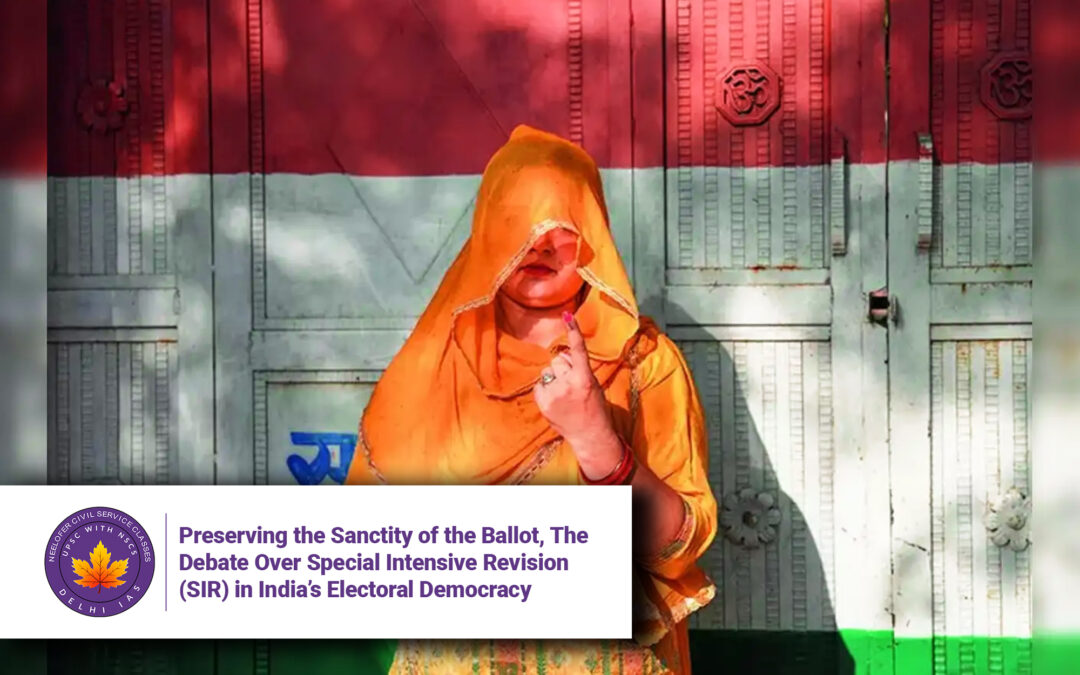
Preserving the Sanctity of the Ballot, The Debate Over Special Intensive Revision (SIR) in India’s Electoral Democracy
Why in News?
The Special Intensive Revision (SIR) of electoral rolls in Bihar has triggered a national conversation about voter disenfranchisement and the role of the Election Commission of India (ECI) in safeguarding the fundamental right to vote. With the Supreme Court stepping in to caution against arbitrary voter deletions, the debate over SIR has become central to the future of electoral inclusion in India. The Election Commission is now extending SIR efforts to states like Delhi, Manipur, and West Bengal, bringing this issue to the forefront of national attention.
Introduction
Democracy thrives on the power of the vote. In India, where elections remain the most direct form of citizen participation, the integrity of the electoral roll is paramount. The Special Intensive Revision (SIR) process aims to clean the voter list, identify discrepancies, and eliminate duplicate or ineligible entries. While the goal is to ensure accuracy, critics argue that the process is increasingly being used in ways that may exclude vulnerable populations.
This article explores the implications of the SIR process on electoral democracy, the interventions by the judiciary, and the larger question of voter inclusion versus voter exclusion. It also highlights the underlying socio-political concerns, such as infiltration narratives and identity documentation, which have intensified the debate.
Understanding SIR: What is it and Why is it Controversial?
The Special Intensive Revision is a focused process undertaken by the Election Commission to verify and clean the electoral roll. This involves cross-checking existing voter entries, identifying inconsistencies, and sometimes removing entries that are deemed invalid.
In Bihar, the first phase of SIR reportedly led to a reduction in the voter base. Given Bihar’s high birth rate and a relatively young demographic, this shrinkage raised red flags. Critics warn that such revisions, if not handled with extreme caution, could lead to mass disenfranchisement.
The controversy stems from two main concerns:
-
Exclusionary Criteria for Document Verification:
The Election Commission has taken a rigid stance on the types of identity documents it deems acceptable. Aadhaar, ration cards, and election identity cards (EPIC), though widely held, are not considered sufficient in many cases. The Commission argues that these are susceptible to forgery. However, the Supreme Court has countered that EPIC, for example, carries a “presumption of correctness,” meaning it should be acceptable unless proven otherwise. -
Narratives of Infiltration and National Security:
SIR is often justified by citing concerns over illegal immigrants—specifically Bangladeshis and Rohingyas—being on voter rolls. While national security is a legitimate concern, critics argue that using this as a blanket rationale for SIR leads to profiling and exclusion of legitimate citizens, especially from marginalized communities.
Judicial Intervention: A Necessary Safeguard
The Supreme Court’s intervention in the matter has added a layer of protection against arbitrary disenfranchisement. The Court emphasized that the goal of the electoral process should be “mass inclusion” rather than exclusion. It questioned the ECI’s approach, stating that denying voter rights based on the fear of forgery undermines the very essence of democracy.
Universal adult franchise, a cornerstone of the Indian Constitution, means that every adult citizen has the right to vote—regardless of socio-economic status, education, or identity markers. By placing undue burdens of documentation on voters, the ECI risks violating this foundational principle.
The Role of Documentation in Democracy
Documentation is often a double-edged sword in governance. While necessary for verification and transparency, overly stringent document requirements can marginalize the very populations that governance seeks to uplift.
The ECI’s current list of 11 accepted documents does not include widely used ones like Aadhaar or ration cards. The rationale provided is that these can be forged, but the Court has maintained that widespread exclusion cannot be justified on such general grounds. The exclusion of common ID cards is especially problematic in rural and semi-urban areas, where such documents are often the only form of identification people possess.
The Threat of Shrinking Electorates
In Bihar, the first phase of SIR led to a decrease in the number of registered voters. This is alarming in a state that traditionally has high voter participation and a growing population. The shrinking electorate signals a potential suppression of democratic participation, especially among vulnerable groups such as migrant laborers, the poor, and minorities who often face difficulties in producing multiple forms of identification.
This trend may repeat in other states like Delhi, Manipur, and West Bengal if the same process is replicated without safeguards. The threat is not just to individual voters but to the very ethos of representative democracy.
The Political and Social Implications
At the heart of the SIR controversy lies a deeper political narrative. References to illegal immigrants and infiltrators are not new in Indian politics, but their inclusion in the discourse around electoral rolls adds a communal and exclusionary angle to what should be a neutral administrative process.
Critics argue that such narratives are being used to justify voter suppression under the guise of national security. While electoral integrity is essential, it cannot come at the cost of large-scale disenfranchisement. A balance must be struck between verification and inclusion.
Recommendations for the Way Forward
-
Expand the List of Acceptable Documents:
Include Aadhaar, EPIC, and ration cards as valid documents unless specific proof of forgery exists. The presumption should be in favor of inclusion. -
Increase Public Awareness:
Many citizens are unaware of the SIR process and the documentation required. The ECI should launch an awareness campaign to educate voters. -
Independent Oversight Mechanism:
Establish a neutral body to oversee the implementation of SIR and address grievances promptly. -
Data Transparency:
The ECI should publish detailed data on voter additions and deletions to allow public scrutiny and academic analysis. -
Avoid Inflammatory Narratives:
National security concerns should not be used indiscriminately in the electoral process. Every deletion must be backed by credible evidence.
Conclusion
The right to vote is not just a democratic formality; it is a fundamental assertion of citizenship. The Special Intensive Revision process, if conducted without adequate checks and balances, can turn into a tool for exclusion rather than inclusion. While it is necessary to maintain a clean electoral roll, this must not come at the cost of eroding faith in the democratic process.
As the Supreme Court rightly observed, the goal should be “mass inclusion”—to ensure that every eligible Indian is on the voter list. The Election Commission, while fulfilling its mandate of maintaining electoral integrity, must remember that its ultimate duty is to the citizen, not to the bureaucracy of documents. In a country as diverse and complex as India, democracy must be accessible, not gated behind paperwork.
India’s electoral democracy is its greatest strength. It must not be weakened in the name of efficiency. Instead, reforms should aim to expand access, ensure fairness, and preserve the spirit of universal franchise. The path forward lies not in suspicion, but in trust.
Q&A Section
1. What is Special Intensive Revision (SIR)?
SIR is a targeted process conducted by the Election Commission of India to verify the accuracy of voter rolls, eliminate discrepancies, and remove ineligible voters. However, it has come under criticism for potentially leading to the mass exclusion of eligible voters.
2. Why is the SIR process controversial in Bihar?
In Bihar, the first phase of SIR led to a noticeable shrinkage in the electorate. This is seen as problematic in a state with a growing population. The concern is that the process may be excluding legitimate voters due to overly strict document requirements.
3. What has the Supreme Court said about SIR and the role of ECI?
The Supreme Court has emphasized that the goal of the electoral process should be “mass inclusion.” It criticized the ECI for not accepting commonly used documents like Aadhaar and EPIC and warned against using SIR as a tool for voter suppression.
4. How does the exclusion of certain documents affect voter inclusion?
By not accepting widely held documents like Aadhaar, ration cards, and EPIC, the ECI increases the likelihood that poor, rural, and marginalized citizens will be excluded from the voter rolls due to lack of alternative identification.
5. What are the broader implications of SIR if not handled properly?
If SIR leads to the removal of millions of legitimate voters, it undermines the democratic process and citizen rights. This could lead to reduced public faith in elections, increased political polarization, and international concerns about electoral fairness.

