
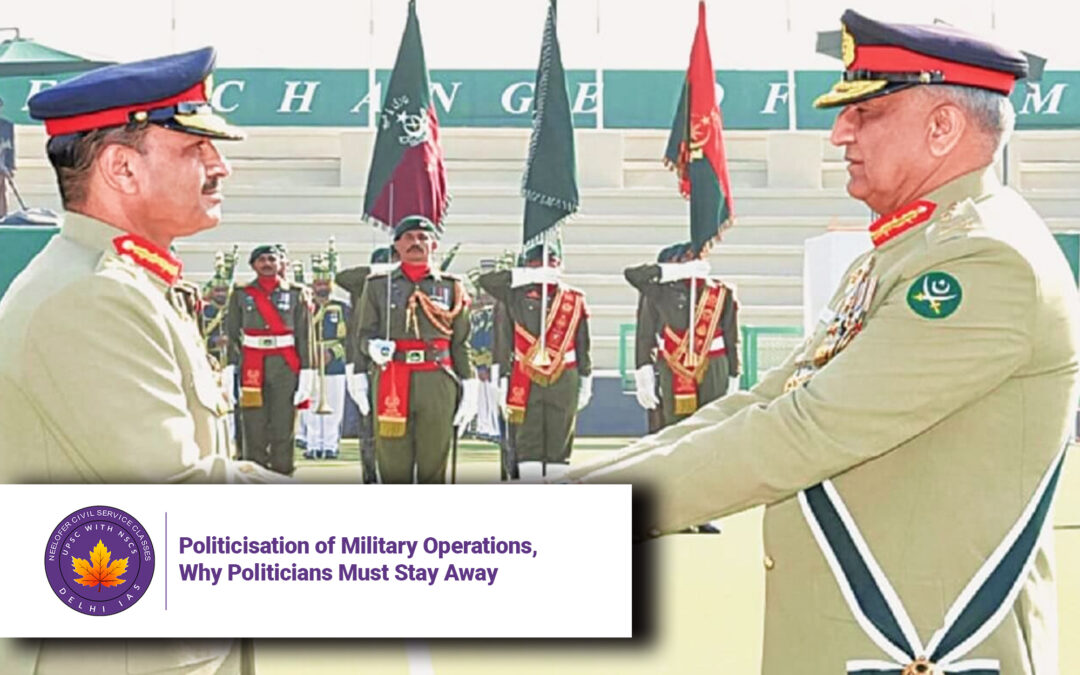
Politicisation of Military Operations, Why Politicians Must Stay Away
Why in News?
Recent debates surrounding India’s military actions—especially after major incidents like Pulwama and the Balakot airstrikes—have triggered renewed concerns about the politicisation of military operations. The exploitation of these operations for electoral gains, combined with questionable political narratives and public demands for military evidence, has raised a serious question: Should political parties steer clear of military affairs? This issue becomes critical as India continues to face internal and external security threats, while political entities frequently leverage these events for votes, media narratives, and ideological battles. 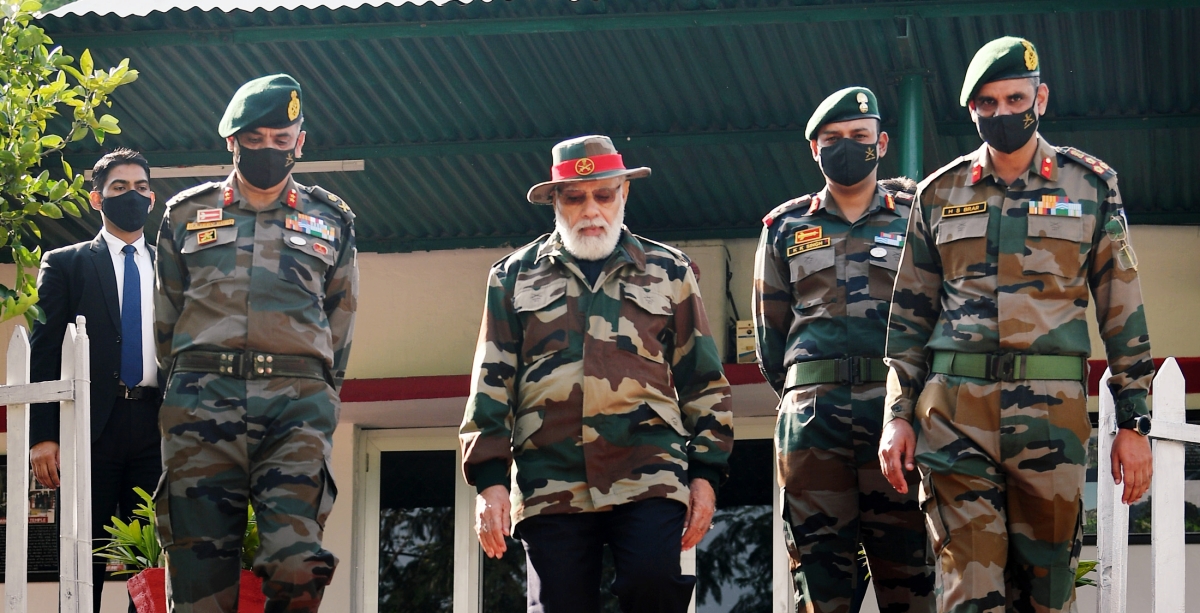
Introduction
In a politically charged country like India, where elections dominate the socio-political landscape, every national development—from infrastructural progress to border skirmishes—is absorbed into the electoral narrative. However, this integration becomes problematic when it involves the military. The armed forces, as a neutral and professional entity responsible for national security, should remain above political affiliations. Unfortunately, recent years have witnessed an alarming trend where military operations, particularly those involving Pakistan, have been politicised to a significant extent.
From the government taking ownership of military success to opposition parties demanding “proof” of airstrikes, and international players like the US and China reacting to these developments, the conversation has escalated far beyond military circles into full-blown political battles. This article delves deep into how and why this politicisation is dangerous for India’s democratic and military institutions.
Key Issues
1. Exploitation of Military Successes for Electoral Benefits
The turning point in this ongoing politicisation saga was the post-Pulwama military strike—Operation Bandar—conducted by the Indian Air Force in Balakot, Pakistan. The government, in response to the Pulwama terror attack, convened an all-party meeting, and announced the retaliatory action. However, rather than being acknowledged as a national security response, it soon became political ammunition.
The ruling party coined phrases like “Ghar mein ghus ke maarenge” (We will enter your home and kill you), invoking strong emotional and nationalistic sentiments. The government’s credit-claiming attempts weren’t limited to reporting military actions but extended to using them as benchmarks of political will and strength—particularly in comparison to previous governments’ approaches.
This sentiment was reflected even more strongly in political rallies and campaigns, where military operations began to substitute traditional policy-driven narratives, indicating a shift in electioneering techniques.
2. Opposition’s Demand for Proof and Consequences
The opposition, particularly the Congress party under leaders like Rahul Gandhi, began to question the government’s claims of success. During the Balakot strikes, opposition parties demanded concrete proof of terrorist casualties and structural damages in Pakistan. This public questioning, although framed as political accountability, had unintended repercussions.
It undermined the military’s credibility, demoralised the armed forces, and provided ammunition to Pakistan’s counter-narratives. Islamabad swiftly adopted the opposition’s narrative, painting India as exaggerating its success, thereby muddying the waters in the global diplomatic sphere. Ironically, while opposition leaders thought they were holding the government accountable, they unintentionally reinforced Pakistan’s international propaganda.
3. Lack of Accountability and Investigations
While the government was swift in responding to the Pulwama incident militarily, internal security lapses that led to the attack remained unaddressed. No high-ranking political or bureaucratic official accepted responsibility. Though voices like J&K Governor Satya Pal Malik mentioned security failures and lapses in intelligence, no formal investigation held any individual or system accountable.
The decision to allow CRPF personnel to travel via convoy in a volatile area like Pulwama without adequate protection reflected systemic negligence. Despite this, the focus remained on retaliatory actions rather than addressing internal vulnerabilities—again, pointing to a deliberate political redirection of public attention.
4. Impact on India’s International Image and Diplomacy
The politicisation of military actions has also had unintended diplomatic consequences. The U.S., for instance, did not directly condemn the Pulwama attack or support India’s narrative. President Donald Trump’s reaction—stating “you had India, you had Pakistan, and they were going at it”—reflected a lack of concern for differentiating aggressor from victim. Worse still, Trump’s statements about the aircraft loss during the airstrike created political embarrassment back home, as it became evident that losses on the Indian side were being downplayed.
Furthermore, Pakistan utilised these developments to make strategic diplomatic moves, nominating Asim Munir for the Nobel Peace Prize and aggressively campaigning to shape global perceptions of restraint and victimhood.
5. Pakistan’s Propaganda Machinery and Media Warfare
Pakistan’s media machinery, supported by digital networks and influencers, took full advantage of India’s internal political bickering. Statements by Indian opposition leaders questioning the government and the armed forces were amplified on Pakistani media and social platforms. This information war had one clear goal: to weaken India’s narrative globally and to provide plausible deniability of terrorism support within Pakistan.
The internal divide within India became a strategic win for Pakistan. The more Indian politicians fought amongst themselves over military operations, the stronger Pakistan’s counter-narrative became.
Alternative Approaches
a. Institutional Respect and Non-Interference
One of the first corrective measures India must consider is creating institutional norms and unwritten codes that prevent political leaders from leveraging military operations for party-based narratives. While freedom of speech must be preserved, political restraint when commenting on national security is necessary.
b. Accountability in Security Apparatus
Rather than jumping straight to retaliation, a comprehensive examination of security lapses should be conducted and made public, ensuring transparency and learning from past mistakes. This would enhance public trust and prevent misuse of military action to cover internal failures.
c. Establishing Parliamentary Oversight on Military Matters
While operational control should always remain with the executive, discussions around military actions should be routed through secure and confidential parliamentary committees, away from media scrutiny. This would allow for accountability without national embarrassment or international fallout.
Challenges and the Way Forward
1. Blurry Lines Between Nationalism and Jingoism
The Indian political landscape is increasingly merging nationalism with jingoism. As parties outdo each other to appear more “pro-army” or “patriotic,” the true message of national service and defence readiness gets lost. Public rallies turn into war-mongering stages, and peace discourse is treated as weakness.
2. Public Perception Management and Media Responsibility
Media houses, both mainstream and digital, often play along with the prevailing political narrative. Sensationalism sells, and televised shows with military maps, fighter jet animations, and countdown clocks fuel a war-like hysteria. Instead, media must adopt more ethical guidelines when reporting on military matters—focusing on verified facts rather than emotional spectacles.
3. Maintaining Military Neutrality
India’s military has historically maintained its neutrality and refrained from direct political involvement. However, when political parties selectively quote statements from retired generals or use images of soldiers in campaign posters, the perception of neutrality suffers. The military must remain an apolitical pillar, respected and above political games.
4. Cyber Propaganda and Strategic Communications
Both India and Pakistan are investing in digital propaganda tools. India needs a more robust strategy for handling cross-border misinformation campaigns. Ministries, military spokespersons, and think tanks must collaborate to offer coherent, consistent, and truthful messaging—without dipping into populism.
Conclusion
Military operations are a matter of national survival and dignity—not political capital. While the government has the right to inform the public and ensure confidence in the armed forces, using such sensitive events for votes erodes democratic principles and endangers national unity.
The opposition, too, must reflect before issuing statements that may undermine national interests, especially in volatile geopolitical contexts. Constructive criticism and accountability must never come at the cost of national credibility.
Ultimately, India must develop a mature political culture where all parties, irrespective of ideology, understand that military operations belong to the nation, not to any political party. The battlefield must remain sacred and separate from the ballot box.
Five Questions and Answers
Q1. Why is the politicisation of military operations considered dangerous for democracy?
A: It blurs the lines between national interest and party interest, undermines the neutrality of the military, and can lead to irresponsible statements that harm diplomatic and security positions.
Q2. What were the main political developments post-Balakot strikes?
A: The ruling party projected the strike as a major success, while the opposition demanded proof. This created internal divisions that Pakistan exploited to weaken India’s narrative internationally.
Q3. How did media and international actors respond to India’s military operations?
A: Reactions were mixed. While some countries supported India’s right to self-defence, others like the US maintained neutrality. Trump’s comments also embarrassed India by implying losses were hidden.
Q4. What measures can be taken to depoliticise military actions?
A: Establishing parliamentary oversight, media guidelines, avoiding campaign references to military actions, and ensuring accountability for internal security lapses.
Q5. How does Pakistan exploit India’s political divisions?
A: By amplifying opposition criticisms on global platforms, nominating military leaders for peace prizes, and using internal Indian disputes to question the legitimacy of Indian actions.

