
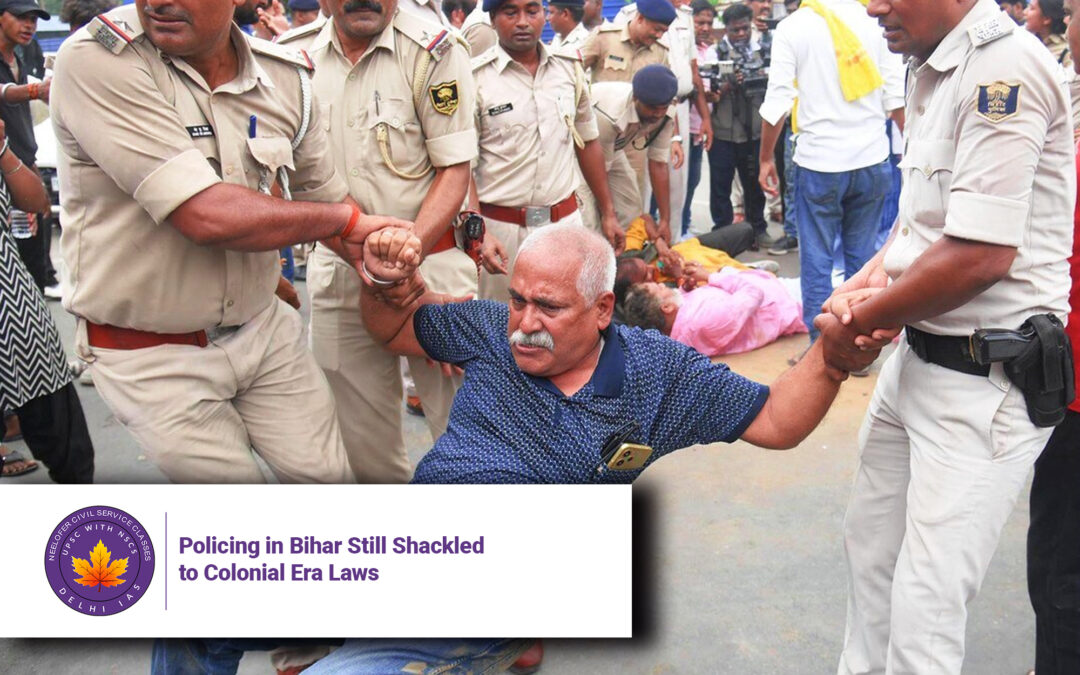
Policing in Bihar Still Shackled to Colonial Era Laws
Why in News
Recent high-profile murders in Bihar—including the killings of industrialist Gunjan Khemka and Indigo manager Rupesh Kumar Singh—have reignited national concern about law enforcement failure in the state. These murders reflect a deeply rooted policing crisis stemming from the continued use of the outdated 1861 Police Act, designed by colonial rulers to suppress rather than protect. Calls for urgent police reform are rising. 
Introduction
In Bihar, a disturbing trend has emerged: repeated high-profile murders with similar patterns—precision killings, weak investigations, and no convictions. Despite modern crimes, the state’s police remain bound to a 164-year-old colonial law: the 1861 Police Act. Originally drafted after the 1857 rebellion, it aimed to control a restless population, not protect a free one.
From weak forensic infrastructure to low conviction rates and an archaic chain of command, policing in Bihar is broken at its foundation. The law enforcement system suffers not due to a lack of resources or brave officers, but because of a structure that rewards patrol optics over justice delivery.
Key Issues and Background
The article by Khagesh Gautam, a law professor at Jindal Global Law School, outlines six major political and industrial murders that took place between 2018 and 2025 in Bihar. All followed the same grim pattern:
-
Victims shot in public view.
-
Killers vanished quickly.
-
Police arrived just in time to photograph the corpse.
This practice has become known as the “Patna Protocol”—a term coined to describe the predictable pattern of gangland-style murders that are not rooted in individual bravado or conspiracy, but in institutional failure.
At the heart of the issue is the 1861 Police Act, drafted to create a constabulary to control the public, not serve it. Investigation remains optional, while patrolling is obligatory. A constable with a lathi—a baton—is still the iconic image of the state police.
Specific Impacts or Effects
-
Forensic Failure: Bihar has just one functioning forensic lab, facing shortages of supplies and staff. Only 5% of officers are certified in collecting ballistic evidence. In some cases, police evidence is stored in disused broom closets.
-
Police Shortage: Against a sanctioned strength of 115 per 100,000 people, Bihar has only 76 deployed officers—far below the global standard of 222.
-
Emergency Response Delays: Bihar’s average emergency response time is 34 minutes. In contrast, Uttar Pradesh’s UP-100 helpline averages under 15 minutes.
-
Investigation Breakdown: When a 9-mm bullet is sent to the forensic lab, political winds may have shifted by the time results return. Cases often fall apart due to vanishing evidence and unreliable witnesses.
-
Loss of Public Trust: With low conviction rates, citizens lose faith in the justice system. Some turn to private justice, extortion, or silence.
-
Judiciary Overload: Courts are under-resourced and overburdened. They often admit weak forensic evidence simply because the system lacks the ability to produce stronger proof.
Challenges and the Way Forward
Bihar’s police force faces not only logistical shortages but also a deeper crisis of purpose. The colonial doctrine of “control over service” still dominates policing. Even when modern tools like SUVs were given to the police in 2015, many went unused due to lack of drivers or fuel. Patrolling became ceremonial.
The author highlights the contrast with New York City’s NYPD in the 1990s, where police reform under CompStat emphasized case resolution over patrol hours. Investigators were trained in forensic and trial-ready evidence collection—leading to a surge in convictions and trust.
Bihar does not lack brave officers; it lacks a systemic, institutional incentive to deliver justice based on science and evidence.
Conclusion
Policing in Bihar has failed to evolve past its colonial roots. The 1861 Police Act was never meant to serve a democratic society; it was meant to suppress uprisings. Today, it does the same—only the victims have changed. Murders are now documented, not solved. The law is present, but justice is absent.
The solution lies in scrapping the outdated Police Act and implementing the 2006 Model Police Act, which proposes:
-
Independent police oversight.
-
Scientific and forensic-based training.
-
Tenured appointments.
-
Protection from political interference.
It’s time Bihar stopped treating public safety as a charitable favor and recognized it as a constitutional right. Citizens deserve to be protected, not policed like subjects under imperial rule.
5 Questions and Answers
1. What is the “Patna Protocol”?
A term describing a pattern of high-profile killings in Bihar where the state fails to investigate or prosecute due to systemic policing failures.
2. Why is the 1861 Police Act problematic?
It was designed by colonial rulers to suppress, not protect. It emphasizes control, not investigation or justice.
3. What is Bihar’s current police-to-population ratio?
76 officers per 100,000 people—far below the UN-recommended 222.
4. What forensic infrastructure does Bihar lack?
Only one forensic lab, few certified officers, and poorly maintained equipment hinder crime-solving capabilities.
5. What reforms are suggested?
Repeal the 1861 Act and adopt the 2006 Model Police Act with independent oversight, scientific training, and fixed tenures.

